The pimple is long gone. The mirror still tells the story. A few dark spots on the cheeks, a couple of tiny dents near the nose, maybe a patch of pink that never quite faded. So you search for “acne marks”, buy a brightening serum, and wait.
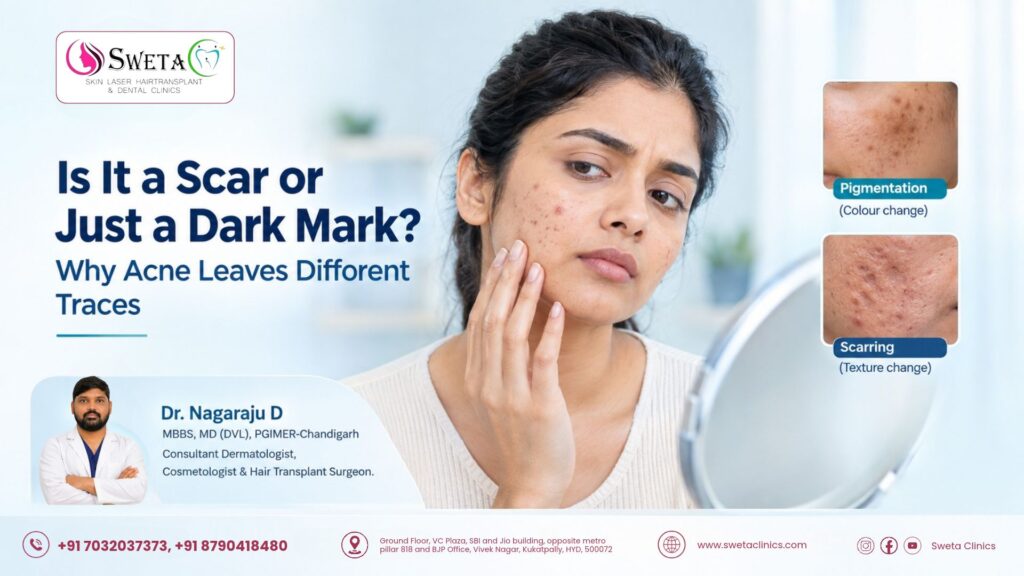
Months later, nothing has changed, or only some of it has. That’s the catch. “Acne marks” is a catch-all phrase, but it covers two very different problems. One is pigmentation, which is a change in colour. The other is scarring, which is a change in texture. The first usually fades, while the second doesn’t.
This guide explains acne scars vs pigmentation in plain words. You’ll learn how to tell them apart at home and why the difference matters for treatment. You’ll also see when a dermatologist can help.
Acne Scars vs Pigmentation: The Core Difference
Pigmentation is about colour. After a pimple settles, the skin sometimes keeps extra melanin in that spot. Doctors call this post-inflammatory hyperpigmentation, or PIH. The surface stays smooth. According to StatPearls, acne is one of the most common causes of PIH in people with darker skin.
A scar is about structure. Deep or long-lasting inflammation damages the collagen under the skin. The body repairs it imperfectly, so the surface ends up with a dent or a raised bump. The StatPearls review of laser scar revision explains that atrophic scars are depressions caused by collagen breakdown after skin inflammation, as in acne.
So pigmentation changes how the skin looks, while a scar changes how the skin is built. That’s why a cream can help one and do almost nothing for the other.
What Acne Scars Look Like
Most acne scars are dents. Doctors group them by shape, because the shape guides the treatment.
Icepick scars are narrow and deep, like tiny puncture marks. Boxcar scars are wider, with steep, sharp edges. Rolling scars are broad and wave-like, with gentle slopes that make the skin look uneven.
Some scars rise instead of dipping. Hypertrophic scars are raised but stay within the area of the original pimple. Keloids go further and grow beyond it. These are more common on the chest, shoulders and jawline.
Scars show up most on the cheeks, temples and jawline. Their colour is usually close to your normal skin tone, though some look a little paler or pinker. What gives them away is the shadow. Dents catch the light and cast tiny shadows. Unlike dark marks, scars won’t fade with time.
What Acne Pigmentation Looks Like
Pigmentation marks are flat. They sit exactly where an old pimple used to be, and they match its size. The colour ranges from tan to brown to dark brown. Run a fingertip over them and the skin feels smooth.
Deeper pigment looks different. According to StatPearls, pigment that sits in the deeper skin layer looks blue-grey and can be harder to treat. Surface pigment, in contrast, tends to improve over time, though it may take months to years without treatment.
You may also see pink or red marks. These come from lingering inflammation and small blood vessels, not from extra melanin. They tend to show more on lighter skin and often fade as the skin settles.
Sun matters here. UV light darkens these marks and slows their fading. That’s why many people find the spots look worse after a holiday or a long summer.
Quick Comparison
| Pigmentation Marks | Acne Scars | |
| What changed | Skin colour | Skin texture |
| How it feels | Smooth and flat | A dent, pit or raised bump |
| Colour | Tan, brown, dark brown, sometimes blue-grey or pink | Close to normal skin colour, sometimes paler or pinker |
| Shadow in side light | None | Yes, in dents |
| When you stretch the skin | Stays the same | Rolling scars soften; icepick and boxcar often stay |
| Over time | Usually fades, over months to years | Stays unless treated |
| Effect of sun | Gets darker | Contrast looks stronger on tanned skin |
| Main goal of treatment | Even out colour and protect from sun | Rebuild collagen and smooth the surface |
A Simple Check at Home
You can’t diagnose yourself, but three quick checks give you useful clues.
First, try the light test. Stand near a window, or hold your phone torch close to the skin and angle it from the side. Dents cast tiny shadows. Flat marks don’t.
Second, try the touch test. Run a clean fingertip lightly over the spot. A smooth surface points to pigmentation. A dip or a bump points to a scar.
Third, try the stretch test. Gently pull the skin sideways. Rolling scars often soften, while discolouration stays exactly as it is.
Many people have both at once, so don’t be surprised if your results are mixed. Also, take a photo in the same light every month. That shows you what’s really changing.
Why These Two Get Mixed Up
Both appear in the same place, after the same pimple. A dark spot at the bottom of a dent looks like a deep scar. Meanwhile, shadows make flat marks look hollow in photos, and bright bathroom lights flatten real dents.
There’s another reason. Most people call everything a “scar”, and most skincare ads call everything “marks”. So the words blur together. Also, dark patches that have nothing to do with pimples, especially on both cheeks, may be a different condition. Our guide on melasma vs sun tan explains that one.
Why Dark Marks Are So Common on Indian Skin
Brown skin makes pigment actively, which is a natural protection against the sun. The downside is that it also reacts strongly to inflammation. According to StatPearls, PIH is particularly common in people of Asian, African and Latin American descent. It adds that, with acne, the rate in darker skin can be as high as 65%.
Hyderabad’s strong sun adds to the problem. UV exposure keeps marks dark for longer, and a tan can hide how much has actually faded.
This also affects treatment. Procedures that use heat or light carry a higher risk of pigment changes on darker skin types. The StatPearls review on laser and skin type notes that the risk is greater in Fitzpatrick skin types IV to VI, which includes many Indian skin tones. So the choice of settings matters a lot.
What Raises the Risk of Scars
Not every pimple scars. The risk goes up with deep, painful, long-lasting pimples, such as nodules and cysts. Picking and squeezing is another big factor, because it pushes inflammation deeper. Waiting years before treating active acne also adds to the risk.
Family history plays a part too. Some people form raised scars or keloids easily, even from small pimples. If that’s you, tell your dermatologist early.
How a Dermatologist Tells Them Apart
The diagnosis is mostly visual. The doctor looks at your skin in good side lighting and checks the shape, depth and colour of each mark. A handheld magnifier called a dermatoscope helps. A Wood’s lamp, which is a black light, can also show how deep the pigment sits.
You’ll also be asked a few questions. How long did you have acne? Do you pick at pimples? How much sun do you get? Which creams have you used? Does anyone in your family form keloids? Those answers shape the plan as much as the exam does.
Finally, the doctor sorts your marks into types. Pigment gets a pigment plan, and each scar type gets its own approach.
Treating Pigmentation Marks
Pigmentation treatment works in steps. According to StatPearls, the plan is usually stepwise and combined, with daily sun protection and treatment of any active inflammation first.
So the first step is sunscreen, every day, even indoors near windows. Then your dermatologist may add prescription creams that slow pigment production. Gentle chemical peels can speed up fading in selected cases. For stubborn marks, light-based toning may be considered, with careful settings for your skin type.
Patience is the hard part. Marks fade slowly, often over several months. So consistency beats intensity. Also, avoid strong bleaching creams and steroid “fairness” creams. They can thin the skin and make pigment worse.
Treating Acne Scars
Scar treatment depends on the type and depth. The common thread is that most procedures work by prompting the skin to build fresh collagen.
Options your dermatologist may discuss include microneedling, radiofrequency treatments, and fractional lasers. You can read more on our laser scar removal page. Chemical peels can help some narrow icepick scars. For rolling scars, a small procedure under the skin can release the bands that pull the surface down. Deeper or stubborn scars may need minor surgical techniques, which we outline on our scar removal surgery page. Raised scars and keloids need a different approach, covered on our keloid and hypertrophic scar page.
Most plans need several sessions, spaced a few weeks apart. Downtime varies by procedure. And results differ from person to person. Most scars improve, but few disappear completely, so honest expectations matter.
Why the Order of Treatment Matters
Sequence makes a real difference. First, control active acne. New pimples create new marks, so treating old ones while fresh ones keep appearing is like mopping a leaking floor.
Next, calm and protect the pigment. Procedures done on inflamed or freshly tanned skin can trigger more pigment, especially on brown skin. After that, the scar work can begin, with settings chosen for your skin type.
If your bumps are itchy, uniform and don’t respond to acne products, check that they aren’t something else. Our guide on acne vs folliculitis shows how to tell them apart.
Daily Habits That Help
The biggest habit is also the simplest: don’t pick. Squeezing a pimple is the most preventable cause of both scars and dark marks. If a pimple bothers you, ask a doctor instead.
Beyond that, wear a broad-spectrum sunscreen of SPF 30 or higher every morning, and reapply if you’re outdoors. Also, use a gentle cleanser and light, non-oily products. Rubbing and scrubbing only inflame the skin.
Be wary of home remedies, too. Lemon juice, toothpaste and baking soda can burn the skin and leave darker marks than the ones you started with.
Common Myths About Acne Marks
“Scars fade on their own, just like dark spots.” Dark spots often fade. Scars generally don’t, because the collagen underneath has changed.
“Lemon or toothpaste lightens marks.” These irritate the skin and can leave new dark patches.
“Fairness creams fix acne marks.” Many contain steroids or harsh bleaching agents. They can thin the skin and make things worse.
“Home dermarollers work like clinic treatments.” Home rollers can irritate the skin and carry infection risk. Clinic procedures follow sterile steps and use settings chosen for your skin.
“Squeezing helps pimples heal faster.” It usually does the opposite, and it raises the chance of a mark or scar.
When to See a Dermatologist
Consider a visit if any of these apply:
- You still get new pimples regularly.
- You have dents, pits or raised scars.
- Dark marks haven’t improved after a few months of sun protection.
- You have a family history of keloids.
- You’ve used fairness or steroid creams for a while.
- The marks affect your confidence.
You can also browse the full list of skin treatments before you visit.
Skin Evaluation at Sweta Clinics
Sweta Clinics in Kukatpally is a multi-specialty skin, hair, laser, and dental centre. For acne marks, the evaluation starts with your history and a close look at each type of mark. Tests are advised only when they’re needed.
The evaluation is led by Dr. Nagaraju D, MBBS, MD (DVL), PGIMER. The clinic is easily reached from KPHB, Miyapur, Nizampet, Pragathi Nagar, Chandanagar, Madhapur, and Hitech City.
Frequently Asked Questions
1. What is the difference between acne scars and pigmentation?
Pigmentation is a flat colour change left after a pimple. A scar is a change in texture, such as a dent or a raised bump.
2. Will acne marks go away on their own?
Dark marks often fade slowly, sometimes over months to years. Scars usually stay unless they’re treated.
3. How can I tell if my mark is a scar?
Look at it in side light and run a fingertip over it. A dent, a shadow or a raised bump suggests a scar. A smooth, flat mark suggests pigmentation.
4. Can I have both scars and pigmentation?
Yes, many people do. A dermatologist can separate the two and plan each.
5. Does sunscreen really help acne marks?
Yes. UV light darkens marks and slows fading, so daily sunscreen is the foundation of pigment care.
6. Are scar treatments safe for brown skin?
They can be, when the settings and the timing are chosen carefully. Heat-based procedures carry a higher risk of pigment changes on darker skin, so experience matters.
7. How many sessions do acne scars need?
It depends on the type and depth. Most plans need several sessions spaced a few weeks apart. Your dermatologist can explain what to expect.
8. Why do pimples leave marks in some people and not others?
Skin type, pimple depth, sun exposure, picking and family tendency all play a part. Brown skin, in particular, forms dark marks easily.
9. Can I treat acne marks at home?
Sun protection and gentle skincare help at home. However, harsh remedies and home needling can make marks worse, so get advice first.
10. Where can I get acne marks evaluated in Kukatpally?
Sweta Clinics offers dermatologist-led evaluation for acne marks and scars. It serves patients across KPHB, Miyapur, Nizampet, and nearby areas.
Know What You’re Treating Before You Treat It
Dark marks and scars both start with a pimple, but they need different plans. Pigment needs patience and sun protection. Scars need collagen-building treatment, planned around your skin. A proper look tells you which one you have.
For more guides like this, visit the Sweta Clinics blog.
Medically reviewed by: Dr. Nagaraju D, MBBS, MD (DVL), PGIMER. Registered with [Andhra Pradhesh State Medical Council], Registration No. [77603].
This article is for general education. It does not replace a medical consultation.
📞Contact us: 7032037373 / 8790418480
🌐 Website: www.swetaclinics.com
📍 Find us on Google: Sweta Clinics
📍 Address: Ground Floor, VC Plaza, SBI and Jio building, opposite metro pillar 818 and BJP Office, Vivek Nagar, Kukatpally, HYD, 500072