Have you been typing “PCOS hair loss treatment near me in Kukatpally” into Google late at night? You’re not alone.
Hair fall linked to Polycystic Ovary Syndrome (PCOS) is one of the most emotionally draining symptoms women deal with. It rarely gets the attention it deserves. Most of the focus goes to irregular periods or weight gain instead.
At Sweta Clinics in Kukatpally, we see this every week. Women in their twenties and thirties notice more hair on their pillow, in the shower drain, and on their hairbrush. They’re not sure if it’s stress, diet, or something deeper.
Here’s the truth: hair loss due to PCOS has a distinct pattern and a distinct cause. It responds well to the right combination of medical management and dermatological treatment, especially when caught early.
If your hair fall might not be PCOS-related, start with our guide on general female hair fall treatment to understand the difference. Otherwise, keep reading. This guide breaks down what’s happening to your hair, why it’s happening, and what a qualified hair specialist for PCOS hair loss can actually do about it.
What Is PCOS and Why Does It Cause Hair Loss?
Polycystic Ovary Syndrome is a common hormonal condition. It affects how your ovaries function.
It’s typically marked by irregular ovulation and small cysts on the ovaries. Critically for your hair, it also causes an excess of androgens — the “male hormones” like testosterone that every woman’s body produces in small amounts.
So what happens when androgen levels rise? They don’t just affect your cycle and skin. They also act directly on the hair follicles on your scalp.
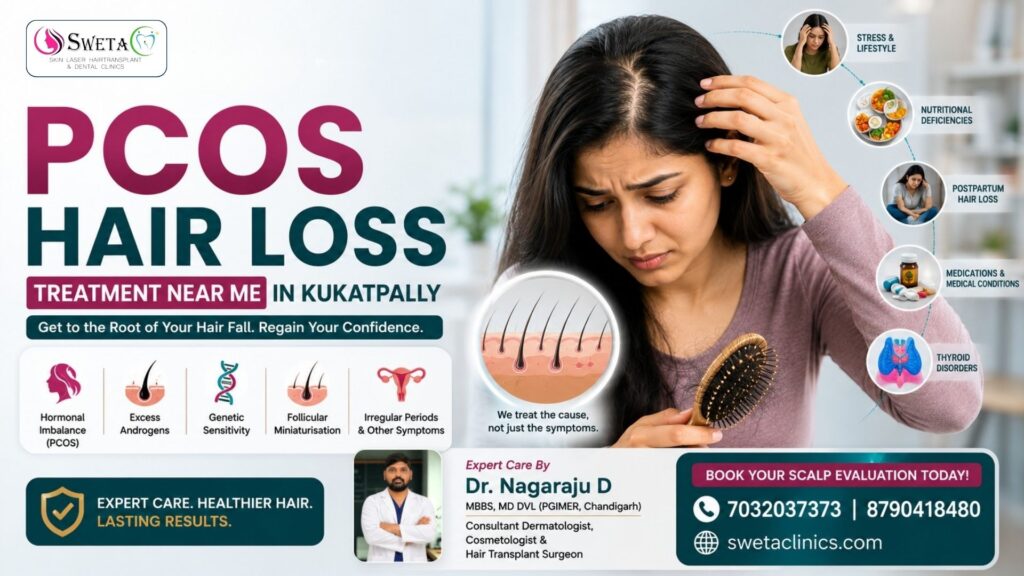
Follicles that are genetically sensitive to androgens begin to shrink over time. Doctors call this process follicular miniaturisation. Each hair grows back thinner, weaker, and for a shorter cycle than before. Eventually, some follicles stop producing visible hair altogether.
This is why PCOS hair fall looks and behaves differently from hair loss caused by stress, poor diet, or seasonal shedding. It’s a hormonal condition affecting the hair growth cycle itself, not just a temporary shedding phase. That’s exactly why home remedies alone rarely fix it.
Understanding Female Hair Loss Due to PCOS
Female hair loss due to PCOS most often shows up as a pattern rather than random shedding. Instead of losing hair evenly across the scalp, women typically notice thinning concentrated in specific zones — a pattern also described in our broader female hair fall treatment guide.
Recognising this pattern early makes a real difference to how well treatment works. Common signs include:
- Widening of the centre parting, sometimes called a “Christmas tree” pattern
- Noticeable thinning at the crown while the front hairline stays mostly intact
- Increased visibility of the scalp under bright light or in photographs
- Hair that feels finer and more fragile than it used to
- Excess strands on the pillow, comb, or shower floor over several months, not just occasionally
This pattern is a form of androgenetic alopecia. In women with PCOS, it’s driven directly by hormonal imbalance rather than ageing alone.
It’s also frequently accompanied by other PCOS symptoms — irregular periods, jawline acne, and excess facial or body hair (hirsutism). Together, these are a useful clue for diagnosis.
Signs You’re Dealing With PCOS Hair Fall
Not every case of hair thinning is PCOS related. So how do you know if yours is hormonal rather than temporary or nutritional?
You may be dealing with PCOS hair fall if you notice:
- Hair thinning alongside irregular or missed periods
- New or worsening acne, particularly along the chin and jawline
- Increased hair growth on the face, chest, or back
- Unexplained weight gain, especially around the abdomen
- Family history of PCOS or hormonal hair loss
- Gradual thinning that has progressed over months rather than appeared suddenly
If two or more of these apply to you, it’s worth getting a proper hormonal and scalp evaluation. Don’t just assume it’s stress or a bad shampoo.
Why You Need a Hair Specialist for PCOS Hair Loss
It’s tempting to try serums, supplements, and oil massages first. There’s nothing wrong with supporting your scalp health this way.
But PCOS-driven hair loss is fundamentally hormonal. That means you need a hair specialist for PCOS hair loss who looks at the full picture — your hormone levels, scalp condition, and hair growth cycle together, not just the surface symptoms.
A qualified dermatologist will typically:
- Take a detailed history of your menstrual cycle, weight changes, and family history
- Examine your scalp under magnification to assess the pattern and severity of thinning
- Recommend relevant blood tests (androgen levels, thyroid function, iron studies) where needed
- Rule out other causes of hair fall, such as anaemia, thyroid disorders, or telogen effluvium
- Build a treatment plan that addresses both the hormonal root cause and the visible hair thinning
This is exactly the assessment our dermatology team carries out at Sweta Clinics. It’s led by Dr. Nagaraju D (MBBS, MD DVL, PGIMER), who specialised in dermatology, venereology, and leprosy at PGIMER. He has treated a wide range of hormonal and pattern hair loss cases across Kukatpally and the surrounding areas.
Cases involving associated skin symptoms are co-managed with Dr. Amru Bhukya (MBBS, DNB DVL). This ensures acne, pigmentation, or excess hair growth linked to PCOS are treated alongside the hair fall itself.
PCOS Hair Fall Treatment Options at Sweta Clinics
There is no single universal PCOS hair fall treatment. The right approach depends on how advanced the thinning is, your hormone profile, and your overall health goals.
At Sweta Clinics, treatment is built around a combination of the options below, tailored to each patient after consultation.
Medical and Hormonal Management
The root cause of PCOS hair loss is androgen excess. So addressing the hormonal imbalance is often the foundation of treatment.
This may involve anti-androgen medication or hormone-regulating treatment, prescribed after appropriate blood work and always under medical supervision. This step alone can significantly slow further thinning.
Topical Treatments
Scalp-applied treatments such as minoxidil-based solutions are commonly used to stimulate hair follicles and extend the growth phase. Over time, this improves hair density.
These work best when started early and used consistently, as advised by your dermatologist.
PRP (Platelet-Rich Plasma) Therapy
PRP therapy uses a concentration of growth factors drawn from your own blood. It’s injected into the scalp to stimulate dormant follicles and improve blood supply to thinning areas.
It’s a popular option for PCOS-related hair loss because it works directly on follicle health without added hormones. In fact, clinical research shows PRP can meaningfully increase hair density compared to placebo. It’s typically done as a short in-clinic session with minimal downtime.
GFC (Growth Factor Concentrate) and Mesotherapy
GFC and mesotherapy work on a similar principle to PRP, but use a more concentrated growth factor formulation. Sessions deliver nutrients and growth stimulants directly into the scalp.
These are often recommended alongside other treatments for more visible, faster results.
Low-Level Laser Therapy (LLLT)
Laser-based scalp treatments help stimulate cellular activity in hair follicles. They’re frequently used as a supportive therapy alongside PRP or medical treatment.
This combination is especially useful for patients looking to slow further thinning while regrowth treatments take effect.
Diet, Lifestyle, and Supplement Support
PCOS is a metabolic condition as much as a hormonal one. So sustainable improvement in hair health often depends on supporting factors like balanced blood sugar, adequate protein intake, iron and vitamin D levels, and stress management.
Our team provides personalised guidance on this as part of your treatment plan. It’s a support system, not a replacement for medical treatment.
PCOS Hair Loss Treatment Near Me in Kukatpally – What to Expect
If you’re searching for PCOS hair loss treatment near me in Kukatpally, here’s what a first visit to Sweta Clinics typically looks like:
- Detailed consultation — a discussion of your hair fall history, menstrual cycle, lifestyle, and any prior treatments tried
- Scalp and hair analysis — a physical and, where needed, dermoscopic examination of your scalp
- Relevant investigations — blood tests may be advised to confirm PCOS-related hormonal imbalance and rule out other causes
- Personalised treatment plan — a combination of medical, topical, and in-clinic procedures suited to your specific case
- Follow-up schedule — since hair regrowth takes time, your dermatologist will outline realistic timelines and review points
Most patients notice reduced shedding within 8–12 weeks of consistent treatment. Visible improvement in density typically takes 4–6 months, since hair growth is a slow biological process.
Best PCOS Hair Loss Treatment Near Me in Kukatpally – Why Choose Sweta Clinics
When comparing options for the best PCOS hair loss treatment near me in Kukatpally, a few things genuinely make a difference in outcomes:
- Qualified dermatologists, not just aesthetic technicians, overseeing every treatment plan
- A diagnosis-first approach — treatment is based on your actual hormone and scalp profile, not a one-size-fits-all package
- In-house access to skin and hair specialists, useful since PCOS often affects both together
- Modern in-clinic procedures including PRP, GFC, and laser therapy under hygienic, supervised conditions
- Transparent, judgment-free consultations — PCOS is common, and our team treats it as the manageable medical condition it is
Sweta Clinics is a multi-specialty skin, hair, laser, and dental centre based in Kukatpally. It’s easily accessible for patients across KPHB, Miyapur, Nizampet, Pragathi Nagar, Chandanagar, Madhapur, and Hitech City.
PCOS Hair Loss Treatment Near Me in Kukatpally Price
One of the most common questions we get is about the PCOS hair loss treatment near me in Kukatpally price. The honest answer? It varies based on your specific treatment plan.
Costs typically depend on:
- The severity and stage of hair thinning
- Whether hormonal/medical management alone is sufficient, or in-clinic procedures like PRP or GFC are needed
- The number of sessions required, determined after assessing your scalp and response to initial treatment
- Any additional blood investigations recommended
As a general guide, an initial dermatology consultation is affordably priced. Procedure-based treatments like PRP or GFC are typically charged per session.
Because pricing depends heavily on individual diagnosis, we recommend booking a consultation for an accurate, personalised quote. This also ensures you’re not paying for treatments you don’t actually need.
Areas We Serve
Patients regularly travel to Sweta Clinics in Kukatpally for PCOS hair loss treatment from across:
- KPHB
- Miyapur
- Nizampet
- Pragathi Nagar
- Chandanagar
- Madhapur
- Hitech City
If you’re searching for a trusted hair specialist for PCOS hair loss near any of these areas, our Kukatpally clinic is centrally located and easy to reach.
Tips to Manage Hair Loss Due to PCOS at Home
Professional treatment addresses the root hormonal cause. But these habits can support your results between clinic visits:
- Use a gentle, sulphate-free shampoo and avoid over-washing or aggressive scalp scrubbing. This matters even more if you’re also managing dandruff alongside PCOS hair fall, since a flaky, irritated scalp can add to shedding
- Avoid tight hairstyles that pull on the hairline
- Prioritise protein-rich meals and stable blood sugar through regular, balanced meals
- Manage stress through sleep, movement, or activities that genuinely help you unwind
- Avoid excessive heat styling and chemical treatments while your scalp is recovering
- Be consistent with prescribed treatments — inconsistent use is one of the biggest reasons PCOS hair fall treatment plans underperform
Frequently Asked Questions
1. Is hair loss due to PCOS permanent? Not necessarily. With timely diagnosis and consistent treatment, hair thinning caused by PCOS can be significantly slowed or reversed. It works best when started before follicles are extensively miniaturised.
2. How long does PCOS hair fall treatment take to show results? Most patients notice reduced shedding within 8–12 weeks. Visible density improvement generally shows around 4–6 months, since the hair growth cycle is naturally slow.
3. Can I treat PCOS hair loss without medication? Topical and in-clinic treatments like PRP can help. But since the underlying cause is hormonal, addressing PCOS itself — sometimes with medical management — usually gives the best long-term results.
4. Do I need blood tests before starting treatment? In most cases, yes. Blood tests help confirm the hormonal imbalance behind your hair loss. They also rule out other causes like thyroid dysfunction or iron deficiency, which need different treatment.
5. Is PRP therapy safe for PCOS-related hair loss? Yes. PRP uses your own blood’s growth factors and is generally considered a safe, well-tolerated procedure when performed by a qualified dermatologist.
6. Where can I find a reliable hair specialist for PCOS hair loss near Kukatpally? Sweta Clinics in Kukatpally offers dermatologist-led consultations and treatment for PCOS hair loss. We serve patients across KPHB, Miyapur, Nizampet, and nearby areas.
Book Your Consultation at Sweta Clinics
Hair loss due to PCOS can feel overwhelming. But it’s a manageable condition with the right diagnosis and treatment plan. The earlier you address it, the better your hair follicles respond.
If your concern turns out to be non-hormonal, our female hair fall treatment and dandruff treatment guides are good next reads.
Don’t let another few months pass typing “PCOS hair loss treatment near me in Kukatpally” into search bars. Book a consultation with our dermatology team today.
📞 Call us: 7032037373 / 8790418480 🌐 Visit: swetaclinics.com 📍 Location: Ground Floor, VC Plaza, SBI and Jio building, opposite metro pillar 818 and BJP Office, Vivek Nagar, Kukatpally, HYD, 500072