You’ve already switched to “gentle” and “for sensitive skin” versions of everything. No harsh scrubs, no strong actives, nothing with fragrance if you can help it.
And yet your skin still feels tight after cleansing. It flushes red at the slightest heat or spice. It reacts unpredictably to products that are supposed to be safe for everyone.
Maybe your skin barrier just doesn’t feel like it’s holding up the way it used to. Pollution, weather changes, stress at work, irregular sleep, it all seems to show up on your face faster than it used to. You’ve cut back your routine to the bare minimum, hoping “less is more” would calm things down. But your skin still looks dull, uneven, and slightly irritated more often than not.
At Sweta Clinics in Kukatpally, we see this a lot. Patients arrive with skin that isn’t dealing with one specific problem like acne or pigmentation. It’s simply overwhelmed, stressed, reactive, and in need of genuine repair rather than more products layered on top of an already struggling barrier. This is exactly where a medi-facial fits in.
Searching for medi-facial treatment near me in Kukatpally because your skin feels like it needs more than another gentle cleanser? Here’s what’s actually going on, and what can help.
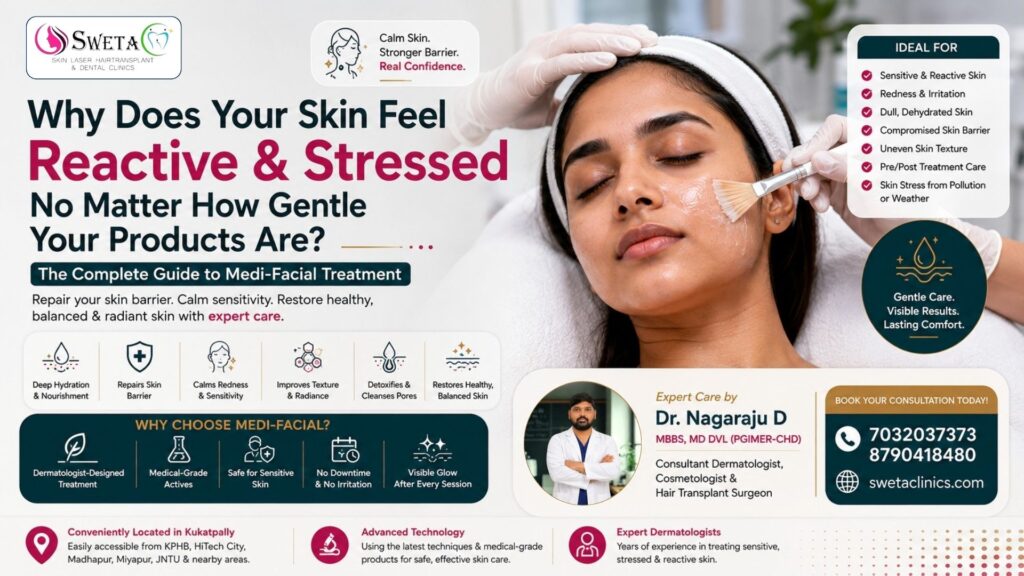
Why “Gentle” Products Alone Don’t Fix a Stressed Skin Barrier
Your skin barrier is the outermost layer that keeps moisture in and irritants out. It becomes more reactive, more prone to redness, and less able to retain hydration when it’s compromised, whether from over-exfoliation, harsh weather, pollution, stress, or years of trial-and-error with products.
The natural instinct is to simplify your routine and switch to gentler products, and that does help to an extent. But gentle products maintain healthy skin. They don’t necessarily repair a compromised barrier or calm underlying inflammation. They avoid making things worse, but they often lack the concentration or delivery method needed to meaningfully speed up recovery.
This is where the gap shows up. Your skin needs active support: hydration, barrier-repairing ingredients, and calming treatment, delivered in a way that’s still safe for reactive, sensitive skin. That’s a specific balance, and it’s hard to get right with home products alone.
What Exactly Is a Medi-Facial, and How Is It Different?
A medi-facial is a dermatologist-designed facial treatment. It sits between a purely cosmetic facial and a more intensive medical procedure.
Unlike a spa facial focused mainly on relaxation, a medi-facial works around your skin’s actual condition. We use medical-grade products and techniques chosen specifically to address concerns like sensitivity, dehydration, dullness, or early barrier damage.
The process is typically gentler than treatments like chemical peels or carbon laser peel. That makes it especially suitable for reactive or compromised skin, while still delivering more targeted, visible results than a standard relaxation facial.
A typical medi-facial session includes four steps:
- Gentle cleansing and assessment — we cleanse your skin with a formulation matched to your sensitivity level, then assess your specific concerns
- Mild exfoliation, if appropriate — we include a very gentle exfoliation step only if your skin can tolerate it, to support better product absorption without causing irritation
- Targeted serum infusion — we apply barrier-repairing, hydrating, or calming actives based on your skin’s needs, often supported with light massage or low-level devices to improve absorption
- Soothing mask and hydration lock-in — a calming mask suited to your skin type finishes the session, locking in hydration and reducing any redness or reactivity
Because we calibrate everything to your skin’s tolerance, a medi-facial tends to leave sensitive or stressed skin feeling calmer immediately, rather than more reactive. That’s a common concern with more intensive treatments.
Who Actually Benefits From a Medi-Facial?
A medi-facial isn’t only for one skin type or concern, which is part of why it’s such a versatile, frequently recommended treatment. You may be a good candidate if:
- Your skin feels tight, dry, or reactive despite using gentle products
- You notice frequent redness, flushing, or unpredictable sensitivity to products that used to work fine
- Your skin looks dull and dehydrated even though you moisturise consistently
- You’ve recently had a more intensive treatment like a peel or laser session and want gentle, supportive skin recovery
- You’re dealing with general skin stress from pollution, weather changes, or an irregular routine caused by travel or work schedules
- You want a safe, effective option before trying more intensive treatments, especially if you’re new to professional skincare
It’s also a popular option for patients who want consistent, ongoing skin maintenance without the downtime or intensity of stronger procedures.
What Happens If a Compromised Skin Barrier Goes Unaddressed
A stressed or reactive skin barrier doesn’t usually resolve on its own, especially if the underlying triggers, like pollution, harsh products, or unmanaged stress, continue. Left unaddressed, a few patterns tend to develop.
Sensitivity increases over time. Skin that stays compromised often becomes more reactive to a wider range of products and environmental triggers, not less. Chronic dullness and dehydration follow too, since a weakened barrier struggles to retain moisture and keeps skin looking tired regardless of how much you moisturise.
You’ll also find it harder to tolerate other treatments. Compromised skin often can’t handle stronger treatments like peels or lasers until we repair the barrier first, which can delay addressing other concerns like pigmentation or acne. And without professional guidance, many people fall into a frustrating cycle of trial and error, switching products trying to find “the one that finally works,” which often makes the underlying issue harder to identify.
Addressing barrier health early, through calibrated professional care, tends to prevent this cycle from becoming more entrenched.
The Medi-Facial Experience at Sweta Clinics
At Sweta Clinics, medi-facial treatment starts with understanding your skin’s actual tolerance level and concerns. We never use a fixed, generic protocol.
Initial Skin Consultation
Before any treatment, your dermatologist assesses your skin’s sensitivity, barrier condition, and specific concerns, whether that’s dehydration, dullness, reactivity, or post-procedure recovery. This determines the right products and technique for your session.
The Treatment Session
A medi-facial session typically takes 45 to 60 minutes, given the multiple gentle steps involved. Most patients describe it as soothing and relaxing, with no discomfort, tingling, or visible redness afterward.
Customised Product Selection
We choose targeted serums and masks based on your skin’s needs, whether that’s intensive hydration, barrier-repair actives, or calming, anti-inflammatory ingredients for reactive skin.
Immediate Comfort and Visible Calm
More intensive treatments can cause temporary redness or flaking. A medi-facial doesn’t. It typically leaves skin looking calmer, plumper, and more even-toned immediately, with zero downtime.
How Medi-Facial Compares to Other Skin Treatments
Since Sweta Clinics offers a range of skin treatments, it helps to know where a medi-facial fits.
Against HydraFacial, the focus differs: HydraFacial handles deep cleansing and pore extraction using vortex suction technology, while a medi-facial stays gentler and focuses more on barrier repair, hydration, and calming reactive skin. Against chemical peels, the intensity differs: peels work through controlled exfoliation for tone and texture concerns, while a medi-facial avoids aggressive exfoliation altogether, which makes it a better starting point for compromised or highly sensitive skin. And against a regular spa facial, the purpose differs: a spa facial exists primarily for relaxation using cosmetic-grade products, while a medi-facial uses medical-grade actives chosen specifically for your diagnosed skin concern.
Many patients use a medi-facial as a recovery step between more intensive treatments, or as an ongoing option when their skin needs consistent calm rather than active resurfacing.
How Often Should You Get a Medi-Facial?
Because it’s gentle and low-risk, you can repeat a medi-facial more frequently than stronger treatments. Many patients schedule sessions every 3 to 4 weeks for ongoing maintenance.
If you’re using it specifically to recover skin barrier health, your dermatologist may recommend a slightly more frequent initial schedule before moving to a maintenance routine.
Aftercare: What to Do (and Avoid) Post-Medi-Facial
Since a medi-facial is gentle by design, aftercare stays fairly simple:
- Continue using a barrier-supportive moisturiser to maintain the hydration benefits of your session
- Apply sunscreen daily, as with any professional skin treatment
- Avoid introducing new, potentially irritating products immediately after your session while your skin settles
- Stay consistent with your dermatologist’s guidance on which products to pause or continue at home
Common Myths About Medi-Facials
“It’s basically the same as a regular facial with a fancier name.” Not quite. A medi-facial uses medical-grade products, and an actual skin assessment guides it, which meaningfully differs from a standard cosmetic facial focused on relaxation alone.
“It’s only for people with serious skin problems.” Not true. It works just as well as a preventive, maintenance treatment for otherwise healthy skin dealing with general stress, dehydration, or dullness.
“Gentle treatments don’t really do anything.” Gentle doesn’t mean ineffective, it means calibrated. For compromised or sensitive skin, gentle, targeted treatment often produces better results than aggressive treatment the skin can’t tolerate.
“You need this only after a harsh treatment like a peel.” It’s a great recovery option post-procedure, but most patients benefit from it as a standalone, ongoing maintenance treatment too.
Why Choose Sweta Clinics for Medi-Facial Treatment
Dr. Nagaraju D (MBBS, MD DVL, PGIMER) oversees medi-facial and skin barrier repair treatments at Sweta Clinics. He brings over 10 years of experience in medical and cosmetic dermatology across Kukatpally and the surrounding areas.
Here’s what makes the difference:
- We assess your skin first, so products and technique match your actual sensitivity level and concern, never a fixed protocol
- We handle reactive, compromised, or post-procedure skin with extra care
- We offer flexibility to use it standalone or as a recovery step within a broader treatment plan
- We give you honest guidance on frequency and realistic expectations for barrier repair and skin comfort
Sweta Clinics is a multi-specialty skin, hair, laser, and dental centre in Kukatpally. Patients reach us easily from KPHB, Miyapur, Nizampet, Pragathi Nagar, Chandanagar, Madhapur, and Hitech City.
Frequently Asked Questions
1. Is a medi-facial suitable for very sensitive or reactive skin? Yes. We specifically design it to be gentle and calibrated to your skin’s tolerance, making it one of the safer options for sensitive or compromised skin.
2. Is there any downtime after a medi-facial? No. Most patients leave with calmer, more hydrated skin and no visible redness or recovery time needed.
3. How is a medi-facial different from a regular spa facial? An actual skin assessment guides a medi-facial, and it uses medical-grade products chosen for your specific concern, rather than a fixed relaxation-focused protocol.
4. Can a medi-facial help after a chemical peel or laser treatment? Yes. We commonly use it as a gentle recovery step to support healing and hydration after more intensive treatments.
5. How soon will I see results after a medi-facial? Most patients notice calmer, more hydrated, and more even-toned skin immediately after their first session.
6. How often should I get a medi-facial? Many patients schedule sessions every 3 to 4 weeks for ongoing maintenance, though your dermatologist may adjust this based on your skin’s specific needs.
7. Where can I get a reliable medi-facial near Kukatpally? Sweta Clinics in Kukatpally offers dermatologist-guided medi-facial treatment, serving patients across KPHB, Miyapur, Nizampet, and nearby areas.
Book Your Medi-Facial Consultation at Sweta Clinics
Your skin doesn’t need to keep feeling reactive and stressed while you experiment with product after product. Sometimes what it needs is calibrated, medical-grade care built around what your skin is actually going through.
📞 Call us: 7032037373 / 8790418480 🌐 Visit: swetaclinics.com 📍 Location: Ground Floor, VC Plaza, SBI and Jio building, opposite metro pillar 818 and BJP Office, Vivek Nagar, Kukatpally, HYD, 500072