
It’s a specific kind of denial. The photo from a friend’s wedding where the camera caught your crown from above. The moment you ran a hand through wet hair after a shower and felt more scalp than you expected. The hairline that used to sit lower, now edging back at the temples in a shape you didn’t choose.
You’ve told yourself it’s the lighting, the angle, genetics skipping a generation, or just “normal” shedding. For a while, that story holds up. Then you notice it again a few months later, and the hairline has moved a little further back, or the crown looks a little more open than before.
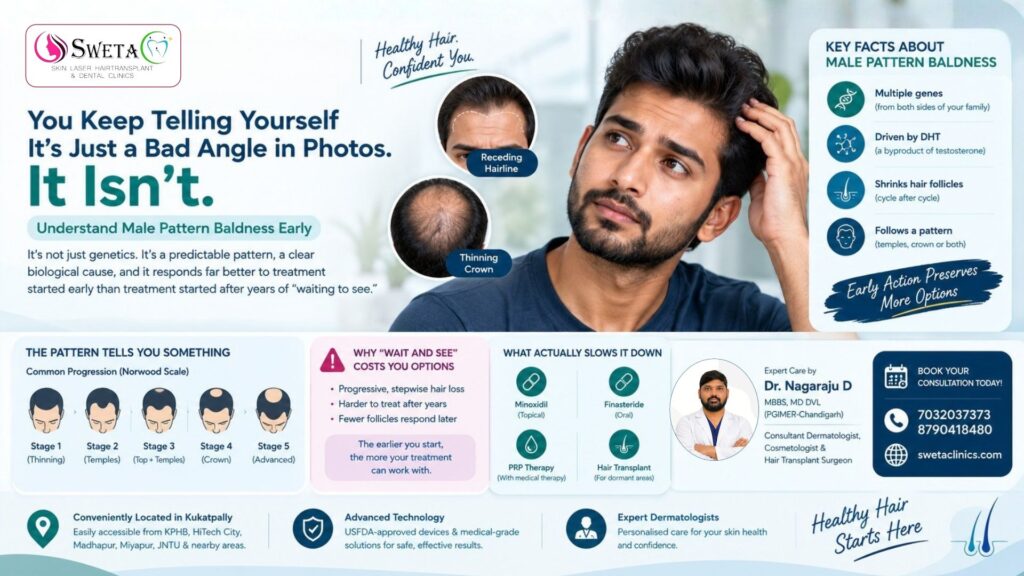
Here’s the thing worth knowing early: male pattern baldness is not random, and it’s not something you’re imagining. It follows a predictable pattern, it has a clear biological cause, and critically, it responds far better to treatment started early than treatment started after years of “waiting to see.”
It’s Not Just Genetics From One Side of the Family
Most men grow up hearing that baldness comes from your mother’s father, as if it’s a single gene you either got or didn’t. That’s an oversimplification. Male pattern baldness, medically called androgenetic alopecia, involves multiple genes inherited from both sides of your family, interacting with a hormone called dihydrotestosterone, or DHT.
DHT is a byproduct of testosterone, and in men genetically sensitive to it, DHT gradually shrinks the hair follicles on the scalp. Each hair cycle produces a slightly thinner, shorter strand than the one before, until some follicles stop producing visible hair altogether. This is why pattern baldness isn’t about losing hair suddenly. It’s about hair quietly downgrading, cycle after cycle, for years before it becomes obvious.
The Pattern Actually Tells You Something
Unlike patchy or diffuse hair loss from other causes, male pattern baldness follows a recognisable sequence. It typically starts at the temples, creating the familiar “M” shaped recession, or thins at the crown first, sometimes both at once. Dermatologists classify this progression using the Norwood scale, and recognising where you sit on that scale is part of what determines your treatment options.
This pattern recognition matters for a practical reason. If your hair loss doesn’t follow this typical shape, if it’s patchy, sudden, or accompanied by scalp irritation, it may not be pattern baldness at all, and it needs a different diagnostic approach entirely.
Why “Wait and See” Usually Costs You Options
Here’s what makes this condition different from a lot of other things you might reasonably choose to ignore for a while: androgenetic alopecia is progressive by nature. The Indian Journal of Dermatology, Venereology and Leprology describes it as a stepwise miniaturisation of the hair follicle, meaning it doesn’t plateau on its own. It continues, slowly, in the background, whether or not you’re paying attention to it.
This matters because the treatments that work best, medical therapy in particular, work by protecting hair you still have. They’re considerably less effective at bringing back follicles that have been dormant for years. The honest version of this advice is simple: the earlier you start, the more your treatment has to work with.
What Actually Slows This Down
Medical management is the foundation, and it’s less dramatic than people expect. Topical minoxidil and oral finasteride remain the two most established treatments for androgenetic alopecia, backed by decades of use and a strong evidence base in Indian dermatology literature. They don’t reverse years of loss overnight, but used consistently, they meaningfully slow progression and can improve density in follicles that haven’t fully miniaturised.
Where medical treatment alone isn’t enough, procedural options add another layer. PRP therapy, using growth factors drawn from your own blood, has shown real benefit as a supportive treatment alongside medical therapy, particularly for thinning that hasn’t progressed to complete baldness. If you want to understand this option in more depth, our PRP hair treatment guide walks through exactly how that process works.
For areas where follicles have already gone dormant, hair transplant becomes the relevant conversation. It’s worth knowing upfront, as the IJDVL’s own standard guidelines make clear, that transplant is a cosmetic, redistributive procedure. It relocates hair you still have into areas that need it. It does not stop the underlying process of pattern baldness, which is why most patients are advised to continue medical therapy alongside it, to protect the hair that wasn’t transplanted. If you’re weighing this against other options, our breakdown of PRP vs hair transplant covers how to think through that decision.
When This Stops Being a “Wait and Watch” Situation
A few signs mean it’s worth getting evaluated properly rather than continuing to monitor it yourself:
- Your hairline or crown has visibly changed over the past six to twelve months
- You’re noticing more scalp visible under normal indoor lighting, not just harsh angles
- A family history of early, significant baldness runs on either side, not just your mother’s side
- You’ve started adjusting your hairstyle specifically to hide thinning areas
- You want to start treatment while you still have the most options available
Getting an Actual Diagnosis, Not a Guess
At Sweta Clinics in Kukatpally, a male hair loss consultation starts with confirming the pattern is genuinely androgenetic, since several other conditions can mimic early stages of it. This typically includes a scalp examination, sometimes trichoscopy to assess follicle miniaturisation directly, and a conversation about family history and how quickly the change has progressed.
From there, treatment gets built around where you are on that progression, not a generic package applied regardless of severity. Dr. Nagaraju D (MBBS, MD DVL, PGIMER) leads this evaluation personally, bringing over 10 years of experience in diagnosing and managing pattern hair loss across Kukatpally and the surrounding areas. For a broader look at causes beyond androgenetic alopecia, our general hair fall treatment guide is a useful companion read if you’re not yet sure which category your hair loss falls into.
Sweta Clinics is a multi-specialty skin, hair, laser, and dental centre in Kukatpally, easily reached from KPHB, Miyapur, Nizampet, Pragathi Nagar, Chandanagar, Madhapur, and Hitech City.
A Few Straight Answers
Does male pattern baldness ever stop on its own? No. It’s progressive by nature, though the speed varies significantly between individuals. It doesn’t resolve without intervention.
Will minoxidil or finasteride regrow hair I’ve already lost completely? They work best on follicles that are miniaturised but not dormant. Completely bald areas usually need a transplant to restore visible hair.
Is it too late to start treatment if I’m already at an advanced stage? It’s rarely “too late” to slow further loss, but advanced stages do have fewer options for regrowth, which is exactly why earlier evaluation matters.
Can I combine a hair transplant with medical treatment? Yes, and it’s generally recommended. Continuing minoxidil or finasteride after a transplant protects your remaining natural hair from continued miniaturisation.
Where can I get this properly evaluated in Kukatpally? Sweta Clinics offers dermatologist-led diagnosis and treatment for male pattern baldness, serving patients across KPHB, Miyapur, Nizampet, and nearby areas.
The Honest Next Step
If you’ve been quietly tracking a hairline that’s moved, or a crown that looks thinner than it did last year, the useful move isn’t another product search. It’s a proper look at where you are on the progression, and what still responds to treatment right now.
📞 Call us: 7032037373 / 8790418480 🌐 Visit: swetaclinics.com 📍 Location: Ground Floor, VC Plaza, SBI and Jio building, opposite metro pillar 818 and BJP Office, Vivek Nagar, Kukatpally, HYD, 500072