
You notice more hair on your pillow. The drain looks fuller after a wash. Your ponytail feels thinner than it did last year. Naturally, you start to worry.
Here’s a question worth asking calmly: is this hair fall, or is it hair thinning? People often use the two words as if they mean the same thing. However, they don’t. The causes are different. So is the time frame. Often, the treatment differs too.
This guide explains hair fall vs hair thinning in plain words. You’ll learn how each one looks, what usually causes it, and how a dermatologist tells them apart. You’ll also find simple habits that protect your hair while you wait for answers.
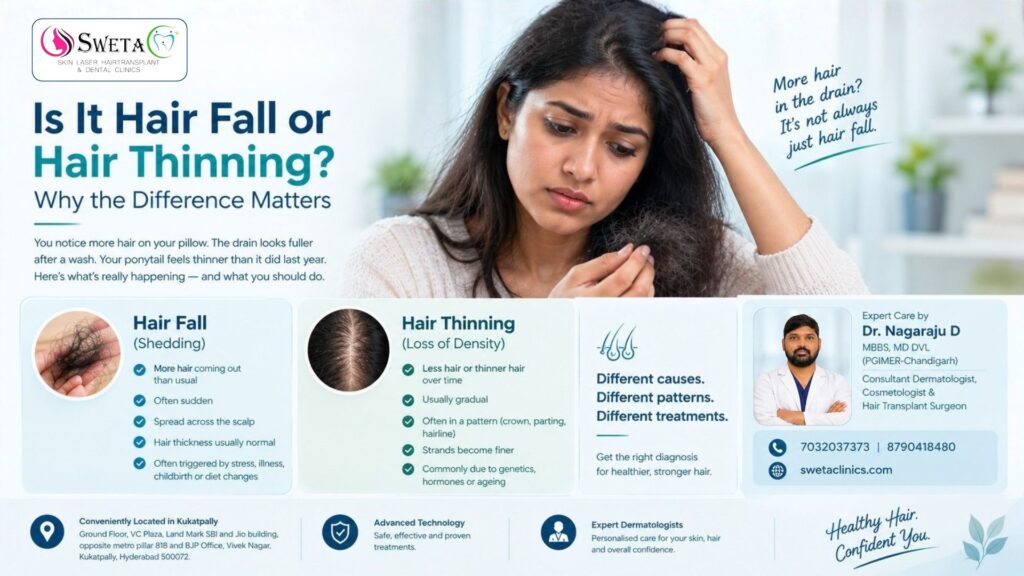
Hair Fall vs Hair Thinning: The Core Difference
Hair fall means you are shedding more hair than usual. The hair comes out from the root. The amount of hair loss rises, but new hair is still growing back in most cases. It often happens suddenly and spreads across the whole scalp.
Hair thinning means your hair is losing density or thickness over time. Each strand may become finer and shorter. Fewer hairs grow back at full strength. It usually builds slowly over months or years.
Think of it this way. In simple terms, hair fall is about how much hair leaves, while hair thinning is about how much hair is left.
You can have one without the other. However, some people have both at once.
How Normal Hair Growth Works
To understand the difference, it helps to know how a hair grows. Each hair follicle moves through a repeating cycle.
Growth phase (anagen). The hair grows actively. This phase lasts several years. Most of your scalp hair is in this phase at any time.
Transition phase (catagen). Growth slows and stops. This lasts a few weeks.
Resting phase (telogen). The hair rests for about three months. Then it sheds, and a new hair begins to grow in the same follicle.
Losing some hair every day is normal. In fact, many people shed roughly 50 to 100 hairs a day. However, the number varies from person to person. It can also be higher on wash days.
Problems begin when too many hairs enter the resting phase together. They can also begin when the follicle shrinks and grows weaker hairs each cycle.
What Hair Fall Looks Like
Hair fall, often called shedding, has a few typical signs:
- A sudden increase in hair on your pillow, comb, or bathroom floor
- Hair coming out in large amounts during washing or brushing
- Loss spread across the whole scalp, not in one spot
- Hair that still feels normal in thickness
- Onset a few weeks to three months after a trigger
That last point surprises many people. The trigger often happens well before the shedding starts. For example, a high fever, surgery, childbirth, or a stressful period can push many hairs into the resting phase. As a result, the shedding appears two to three months later.
The medical term for this pattern is telogen effluvium. In many cases, it settles once the trigger is gone. Regrowth usually follows, although it can take several months.
What Hair Thinning Looks Like
Hair thinning is quieter. You may not notice a big change on any single day. Instead, you notice the slow shift over time:
- A ponytail that feels thinner than before
- A wider hair parting
- A scalp that shows more through the hair
- A receding hairline or temples
- Finer, softer, shorter strands
- Less volume at the crown
The most common cause is androgenetic alopecia, also called pattern hair loss. It runs in families and involves hormones and genes. Then follicles slowly shrink. This is called miniaturisation. Each cycle, the hair grows back thinner and shorter, until the follicle may stop producing visible hair.
It can start as early as the late teens or twenties. Also, it becomes more common with age.
Quick Checklist: Which One Fits You Better?
Use this table as a starting point. It’s a guide, not a diagnosis.
| Feature | Hair Fall (Shedding) | Hair Thinning |
|---|---|---|
| Speed | Often sudden | Usually gradual |
| What you notice | More hair coming out | Less hair or thinner hair |
| Pattern | Spread across the scalp | Often in a pattern (crown, parting, hairline) |
| Hair thickness | Usually normal | Strands become finer |
| Common triggers | Illness, stress, childbirth, diet changes | Genes, hormones, ageing |
| Timing | Weeks to months after a trigger | Builds over months to years |
| Often reversible? | Often, once the cause is fixed | Needs long-term management |
If your hair matches the right-hand column, then a dermatologist can help you understand what’s happening.
Common Causes of Hair Fall
Many different triggers can cause increased shedding. In addition, some people have more than one.
Body and health triggers
Physical stress on the body. High fever, infections, major illness, surgery, or accidents can trigger shedding.
Childbirth. Many women shed hair a few months after delivery. This happens because hormone levels change.
Emotional stress. Long periods of worry, grief, or pressure can affect hair growth cycles.
Diet and nutrition triggers
Crash diets and rapid weight loss. For example, very low calorie or very low protein diets can reduce the nutrients hair needs.
Nutrient gaps. Low iron, low vitamin D, and low vitamin B12 are common in India. They are linked to hair shedding in many people. Therefore, doctors usually confirm this with blood tests rather than guessing.
Medical, scalp and hair-care triggers
Thyroid problems. Both an underactive and an overactive thyroid can change hair growth.
Medicines. Some drugs list hair shedding as a side effect. Never stop a prescribed medicine on your own. Instead, talk to your doctor first.
Scalp conditions. Severe dandruff, infections, and inflammation can raise shedding. Our dandruff treatment guide explains how dandruff looks and behaves, which helps you rule it in or out.
Harsh hair treatments. Frequent bleaching, straightening, colouring, and heat styling can damage hair and cause breakage.
Common Causes of Hair Thinning
Genetics. If close relatives have thinning hair, your chance is higher. This is the leading cause of long-term thinning in both men and women.
Hormonal changes. Androgens, the so-called male hormones, play a role in pattern hair loss. In women, conditions such as PCOS can also be linked to thinning.
Menopause. Hormone shifts after menopause often reduce hair density.
Ageing. Hair strands naturally become finer with age.
Long-term nutrient or health problems. However, if a cause isn’t corrected, shedding can slowly turn into visible thinning.
Tight hairstyles. Constant pulling from tight ponytails, braids, or buns can damage follicles. This is called traction alopecia. It can become permanent if it continues for years.
How Pattern Differs in Men and Women
Pattern hair loss looks different in men and women.
In men, it often begins at the temples and the crown. The hairline recedes in an “M” shape. Over time, the crown thins and the two areas may join.
In women, the hairline is usually kept. The parting widens, and the hair becomes thin over the top of the scalp. Women rarely go fully bald from this type. The StatPearls overview of pattern hair loss describes the same difference between the sexes.
Therefore, knowing your pattern helps your dermatologist decide on the next step.
Other Conditions That Can Look Similar
Not every case of hair loss is shedding or pattern thinning. For example, a few other conditions look alike at first.
Alopecia areata. This causes smooth, round bald patches. It happens when the immune system attacks hair follicles. It can appear suddenly.
Scalp infections. Fungal infections can cause patchy hair loss with scaling or redness.
Scalp psoriasis. Thick, silvery scale and redness on the scalp can come with temporary shedding. Our guide on scalp psoriasis vs dandruff explains how to tell them apart.
Scarring alopecias. These conditions damage the follicle permanently. They may cause redness, pain, burning, or visible scarring on the scalp. They need early medical care.
Trichotillomania. This is a habit of pulling out one’s own hair. It needs sensitive, supportive care.
Hair breakage. Here the hair snaps along the shaft. The root is not the problem. Damage from chemicals or heat is the usual cause.
Because these look similar, a proper examination matters before any treatment.
Why Oils, Shampoos, and Home Remedies Often Fall Short
Many people try a new hair oil, onion juice, or a “hair growth” shampoo. These products are everywhere. But they work on the surface of the scalp. They can’t correct a thyroid problem, an iron deficiency, or a hormone-related pattern.
Some products can also cause problems:
- For example, strong oils can clog the scalp and worsen dandruff.
- Harsh ingredients can cause itching and allergy.
- In addition, spending months on the wrong approach delays a proper diagnosis.
Gentle care is fine. But if hair loss lasts more than a few weeks, it’s wise to find the cause first.
A Simple Self-Check at Home
You can’t diagnose yourself at home. You can, however, gather useful information for your doctor.
Count your shedding. First, collect the hair that falls during a wash and combing for a few days. Then note whether it’s more than usual.
Do a gentle pull test. Hold about 50 to 60 hairs between your fingers. Slide down gently from root to tip. A few hairs coming out is normal. However, many hairs coming out is worth reporting.
Take photos. Take a clear photo of your parting and hairline once a month in the same light. This also helps track slow changes.
Note your timeline. Write down when it started. Add any illness, stress, diet change, new medicine, or childbirth in the last six months.
Note your family history. Ask whether parents or siblings have thinning hair.
Finally, bring these notes to your consultation.
How Hair Loss Is Diagnosed
First, a dermatologist begins with questions. Expect to talk about:
- How long the hair loss has lasted
- Your diet, sleep, and stress levels
- Recent illness, surgery, or childbirth
- Medicines and supplements you take
- Menstrual history and hormone-related concerns
- Hair care habits and treatments
- Family history
Next comes a scalp examination. Doctors may use a hand-held magnifying device called a dermatoscope. Using it, they can see the follicles and judge hair thickness. A gentle pull test may also be done. For many patients, a careful history and examination are enough to identify shedding, as the StatPearls review of telogen effluvium notes.
Blood tests are not needed for everyone. Instead, they are chosen based on your history. Common checks include iron levels, thyroid function, vitamin D, and vitamin B12. Hormone tests may be advised in selected cases. A scalp biopsy is rare and used only when the diagnosis stays unclear.
How Treatment Is Planned
Treatment depends on the cause. Therefore, there is no single method for everyone. Results also vary from person to person.
Treatment for hair fall (shedding)
First, find and correct the trigger. For example, this may mean treating a nutrient gap, managing a thyroid problem, or recovering from an illness. In many cases, shedding settles once the cause is addressed. However, regrowth takes time, often several months.
Treatment for hair thinning
This is a long-term condition, so doctors may discuss prescription options based on your age, sex, health, and goals. Some options are applied to the scalp, while others are taken by mouth and are suitable only after a doctor’s review. Some procedures may be considered in selected cases. Your dermatologist will explain the benefits, limits, and side effects of each.
Treatment for other causes
Patchy loss, scalp infections, and scarring conditions each need their own plan.
Be cautious of anyone who promises guaranteed results, because hair treatment needs patience. Most plans need at least three to six months before a fair judgement can be made. Ongoing follow-up is often needed.
Food and Lifestyle Habits That Support Healthy Hair
Habits can’t replace medical care. They do support it.
Eat enough protein. Because hair is made mostly of protein, include dal, eggs, fish, paneer, or other protein sources you prefer.
Eat a balanced diet. Include vegetables, fruits, nuts, and whole grains.
Avoid crash diets. Fast weight loss can trigger shedding.
Don’t take supplements blindly. Too much of some vitamins and minerals can be harmful. Test first, and then take what your doctor advises.
Manage stress. Regular sleep, light exercise, and relaxation habits help.
Be gentle with your hair. Use a wide-toothed comb. Also, avoid brushing hard when hair is wet. In addition, skip very tight hairstyles.
Limit heat and chemicals. Reduce frequent straightening, bleaching, and colouring.
Keep your scalp clean. Wash as often as your scalp needs, using a mild shampoo.
Common Myths About Hair Fall and Thinning
Myth: Washing hair daily causes hair loss. In fact, shampooing removes hairs that were already shed, so it doesn’t cause new loss.
Myth: Wearing a cap or helmet causes baldness. Clean, normal use doesn’t cause pattern hair loss. However, very tight headgear worn for long hours may cause friction.
Myth: Cutting hair makes it grow thicker. Trimming only changes the ends, because it doesn’t affect the follicle under the skin.
Myth: Pattern baldness comes only from the mother’s side. Genes from both parents can play a part.
Myth: Hair thinning happens only to men. In fact, women get it too, and it often shows as a wider parting.
Myth: Every hair fall needs a transplant. In fact, most people with shedding never need a surgical procedure. Instead, the cause decides the plan.
When Should You See a Dermatologist?
Consider a consultation if any of these apply:
- Hair fall has lasted more than six to eight weeks.
- You see a wider parting, receding hairline, or thinning crown.
- Hair is falling in round patches.
- Your scalp is itchy, red, painful, or scaly.
- Hair loss started after a new medicine.
- You have other symptoms, such as tiredness, weight change, or irregular periods.
- Hair loss is affecting your confidence or daily life.
Early evaluation helps because some conditions are easier to manage when found sooner.
Hair Evaluation at Sweta Clinics
Sweta Clinics in Kukatpally is a multi-specialty skin, hair, laser, and dental centre. For hair concerns, the evaluation begins with a history and a scalp examination. Tests are advised only when your history points to a need.
The evaluation is led by Dr. Nagaraju D, MBBS, MD (DVL), PGIMER. The clinic is easily reached from KPHB, Miyapur, Nizampet, Pragathi Nagar, Chandanagar, Madhapur, and Hitech City.
Frequently Asked Questions
1. What is the difference between hair fall and hair thinning?
Hair fall means you are shedding more hair than usual. Hair thinning means your hair is losing density or becoming finer over time. They have different causes, but they can occur together.
2. How many hairs is it normal to lose in a day?
Many people lose roughly 50 to 100 hairs a day. The number varies by person and hair length. However, a sudden rise in shedding is worth noting.
3. Is hair fall permanent?
Shedding caused by stress, illness, or diet is often temporary. Hair usually regrows once the cause is corrected. Pattern thinning, however, is long-term and needs ongoing care.
4. Can stress cause hair fall?
Yes. Major physical or emotional stress can push many hairs into the resting phase. Shedding then appears a few months later.
5. Which vitamins affect hair?
Iron, vitamin D, and vitamin B12 are often discussed. Don’t self-prescribe. Instead, get tested and follow your doctor’s advice.
6. Can women get pattern hair loss?
Yes. In women, it usually shows as a wider parting and less volume on top, rather than a receding hairline.
7. Does hair thinning always lead to baldness?
No. The course varies, and many people, especially women, stay with partial thinning. Still, early evaluation helps you understand your own pattern.
8. How long does hair treatment take to show a change?
Because hair grows slowly, most plans need at least three to six months before a fair judgement. However, results differ from person to person.
9. Do hair oils stop hair fall?
Oils can condition the hair and scalp, but they do not treat the underlying causes of shedding or pattern thinning.
10. Where can I get hair loss evaluated in Kukatpally?
Sweta Clinics offers dermatologist-led evaluation for hair and scalp concerns. It serves patients across KPHB, Miyapur, Nizampet, and nearby areas.
Know Your Hair Concern Before You Choose a Treatment
Hair fall and hair thinning are not the same problem. For example, shedding often has a trigger that can be found and corrected. In contrast, thinning usually needs a longer, steady plan. Therefore, a proper evaluation tells you which one you have.
Medically reviewed by: Dr. Nagaraju D, MBBS, MD (DVL), PGIMER. Registered with [Andhra Pradhesh State Medical Council], Registration No. [77603].
This article is for general education. It does not replace a medical consultation.
📞 Appointments: 7032037373 / 8790418480
🌐 Website: swetaclinics.com
📍 Address: Ground Floor, VC Plaza, SBI and Jio building, opposite metro pillar 818 and BJP Office, Vivek Nagar, Kukatpally, HYD, 500072