
It started small. A single itchy, reddish patch, maybe on your inner thigh, your waistline, or between your toes. You picked up an antifungal cream from the pharmacy, used it for a few days, and it seemed to fade. Then it came back. Or it spread to a new spot. Or it never really left in the first place, just quieted down enough to make you think it had.
If you’re scratching more at night, avoiding tight clothing, or feeling embarrassed about a patch you can’t seem to shake, you’re dealing with something incredibly common in Hyderabad’s heat and humidity. You’re also dealing with something that’s become genuinely harder to treat than it used to be, and that’s not in your head.
At Sweta Clinics in Kukatpally, fungal infections are one of the conditions we see recur most often, usually because they were never fully treated the first time. There’s also a newer reason behind this, one most patients haven’t heard of yet.
Searching for fungal infection treatment near me in Kukatpally because yours just won’t go away? Here’s what’s actually happening, and why the approach matters more than ever right now.
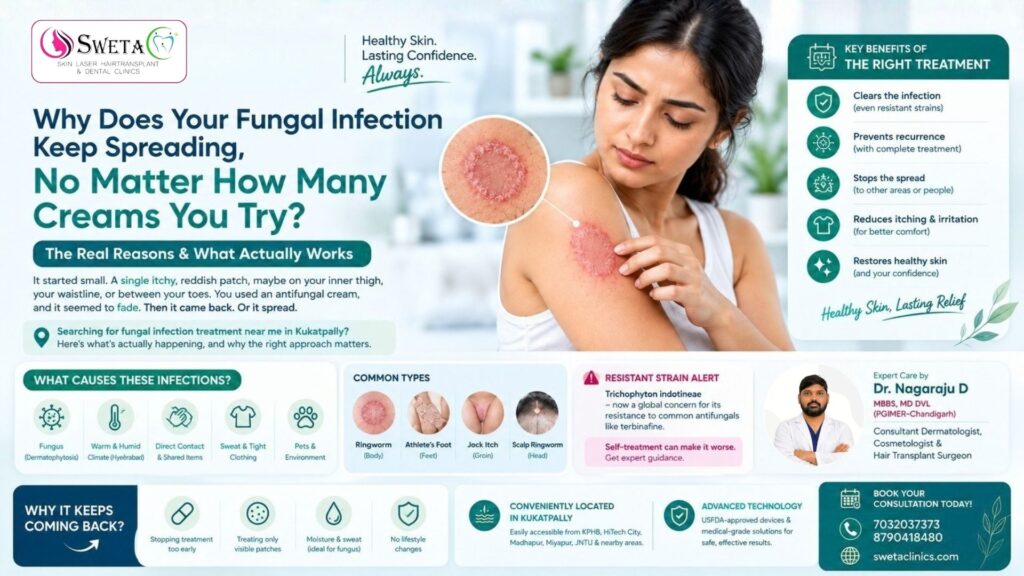
What Causes These Infections
Most fungal skin infections fall under a group called dermatophytosis, more commonly known as ringworm or tinea, even though no worm is involved at all. The American Academy of Dermatology explains that the name comes from the ring-shaped, raised border the rash often forms as it spreads outward.
These fungi thrive in warm, moist environments, which makes Hyderabad’s climate close to ideal for them. They spread easily too, through direct skin contact, shared towels or clothing, gym equipment, and even pets. Tight, sweaty clothing and prolonged moisture on the skin make it significantly easier for the fungus to take hold and spread.
Depending on where it shows up, the same type of infection goes by different names: athlete’s foot on the feet, jock itch in the groin, and scalp ringworm on the head, alongside the classic ring-shaped patches you’ll see on the body or limbs.
Why Your Infection Might Be Resistant to Regular Treatment
Here’s the part most patients don’t know. Over the past several years, doctors have tracked a genuinely new problem: strains of fungus that no longer respond well to standard antifungal creams and even some oral medications.
One specific strain, Trichophyton indotineae, was first identified in India and has since become a recognised global concern for its resistance to terbinafine, one of the most commonly used antifungal medications. If you’ve used a standard cream correctly and consistently, and your infection still isn’t clearing, this kind of resistance may be exactly why.
This matters enormously for how treatment should be approached. A resistant infection needs a different medication, sometimes a different class of antifungal entirely, and this is a decision that genuinely needs a dermatologist’s judgment rather than repeating the same over-the-counter cream and hoping for a different result.
Why Self-Treatment Often Backfires
Beyond resistance, there’s a second, very common reason fungal infections keep coming back: people stop treatment the moment symptoms disappear.
Dermatologists specifically warn that antifungal medicine often clears visible symptoms within days, while the fungus itself is still present in the skin. Stopping early lets it regrow within weeks, often in the same spot. Treating only the most visible patch while ignoring a milder one elsewhere on your body causes the same problem, since the infection simply spreads back from the untreated area.
Skin also needs to stay clean and dry throughout treatment, since the fungus thrives in the exact damp conditions that sweat and tight clothing create. Without addressing that environment, even the right medication struggles to fully clear the infection.
What Happens If a Fungal Infection Goes Untreated or Undertreated
Left alone, or treated incompletely, a fungal infection typically doesn’t just stay put.
It tends to spread across a larger area of skin over time, since the fungus keeps growing outward from its original site. It can also spread to other parts of your body through scratching, or to other people through shared surfaces and close contact. Untreated nail or scalp involvement can become considerably harder to clear than skin patches, sometimes requiring months of oral treatment instead of a short topical course. And the itching and visible rash tend to affect confidence and comfort the longer they persist, particularly when they show up somewhere hard to hide.
What a Proper Fungal Infection Diagnosis Looks Like
Getting the right treatment starts with confirming exactly what you’re dealing with, since several skin conditions can look similar to a fungal rash at first glance.
At Sweta Clinics, your visit typically includes:
- A detailed examination of the affected area and its pattern of spread
- A conversation about how long you’ve had it, what you’ve already tried, and how consistently you used it
- Skin scraping for lab testing when needed, especially for infections that haven’t responded to prior treatment
- A treatment plan matched to the type and severity of infection, including resistant cases
Fungal Infection Treatment Options at Sweta Clinics
Treatment depends heavily on the type, location, and how the infection has responded to anything tried before.
Topical Antifungal Treatment
For localised, uncomplicated infections, we prescribe medical-strength topical antifungals, often stronger and more targeted than what’s available over the counter.
Oral Antifungal Medication
For widespread, resistant, nail, or scalp infections, oral antifungal medication reaches the fungus more effectively than topical treatment alone. We select this based on your specific case and any signs of resistance.
Combination and Extended Treatment Plans
For infections that have proven resistant to standard treatment, we may combine approaches or extend the treatment duration well beyond what a typical over-the-counter course would suggest, since resistant strains genuinely need more sustained treatment.
Guidance to Prevent Recurrence
Alongside medication, we give you specific guidance on hygiene, clothing, and environment to stop the infection from returning once it clears, since dermatologists emphasise that treating the full course and the full affected area is what actually prevents relapse.
Who Should See a Dermatologist for a Fungal Infection?
Consider getting evaluated rather than continuing to self-treat if:
- Your infection hasn’t cleared after a full course of over-the-counter antifungal cream
- It’s spreading to new areas, or affecting a larger patch than before
- It keeps coming back after seeming to clear
- It’s affecting your nails or scalp, which usually need oral treatment
- The affected skin looks unusually inflamed, painful, or is oozing
- You’ve been treating it inconsistently or stopped early once symptoms improved
Why Choose Sweta Clinics for Fungal Infection Treatment
Dr. Nagaraju D (MBBS, MD DVL, PGIMER) leads fungal infection diagnosis and treatment at Sweta Clinics. He brings over 10 years of experience in medical dermatology across Kukatpally and the surrounding areas, including recognising and managing treatment-resistant cases.
Here’s what makes the difference:
- We identify resistant infections early, rather than repeating a treatment that isn’t working
- We use lab testing when needed, so treatment matches exactly what’s causing your infection
- We give you a full, specific treatment duration, rather than a generic course that stops too soon
- We guide you on the hygiene and environmental factors that prevent recurrence, not just the medication itself
Sweta Clinics is a multi-specialty skin, hair, laser, and dental centre in Kukatpally. Patients reach us easily from KPHB, Miyapur, Nizampet, Pragathi Nagar, Chandanagar, Madhapur, and Hitech City.
Frequently Asked Questions
1. Why does my fungal infection keep coming back after treatment? This usually happens when treatment stops too early, an area is left untreated, or the strain is resistant to the medication used. A dermatologist can identify which applies to your case.
2. How do I know if my fungal infection is resistant to treatment? If it hasn’t improved after a full, consistent course of standard antifungal cream, resistance is a real possibility worth discussing with a dermatologist.
3. Is fungal infection contagious to family members? Yes, it spreads through direct contact and shared items like towels, clothing, and combs. Treating it promptly reduces the risk to others in your household.
4. Can I use the same cream for different fungal infections on my body? Not always. Different areas and infection types sometimes need different strengths or formulations, and treating all affected areas at the same time matters.
5. How long does fungal infection treatment usually take? Simple cases often clear in two to four weeks, but resistant, nail, or scalp infections can take considerably longer, sometimes months with oral medication.
6. Is it safe to keep using over-the-counter antifungal cream if it’s not working? No. Continuing an ineffective treatment can allow the infection to spread or worsen. It’s better to get evaluated for a stronger or different approach.
7. Where can I get reliable fungal infection treatment near Kukatpally? Sweta Clinics in Kukatpally offers dermatologist-led fungal infection diagnosis and treatment, serving patients across KPHB, Miyapur, Nizampet, and nearby areas.
Book Your Fungal Infection Consultation at Sweta Clinics
If a fungal infection keeps returning or spreading despite your best efforts, it’s time to stop guessing with the same cream. The right diagnosis, and the right full course of treatment, is what actually ends the cycle.
📞 Call us: 7032037373 / 8790418480 🌐 Visit: swetaclinics.com 📍 Location: Ground Floor, VC Plaza, SBI and Jio building, opposite metro pillar 818 and BJP Office, Vivek Nagar, Kukatpally, HYD, 500072