Most people don’t think much about a dark mark on their face until it’s been there for months. Then comes the Googling, the home remedies, the cream a friend swore by — and somewhere in that process, the actual cause of the mark gets lost entirely.
Here’s the thing dermatologists wish more people understood early: a dark spot from sun damage, a mark left by an old pimple, and a raised keloid from a piercing are three completely different conditions — even when they look similar at first glance. Treating them the same way rarely works, and sometimes makes things worse.
This guide breaks down what’s actually behind facial pigmentation, surgical scars, and keloids, what genuine treatment looks like for each, and when it’s time to stop experimenting and book a proper consultation.
If something has been bothering you for a while, the most useful first step is usually a skin evaluation at Sweta Clinics in Kukatpally — not another product. Call 7032037373 / 8790418480 to book.
What Causes Dark Spots on the Face?
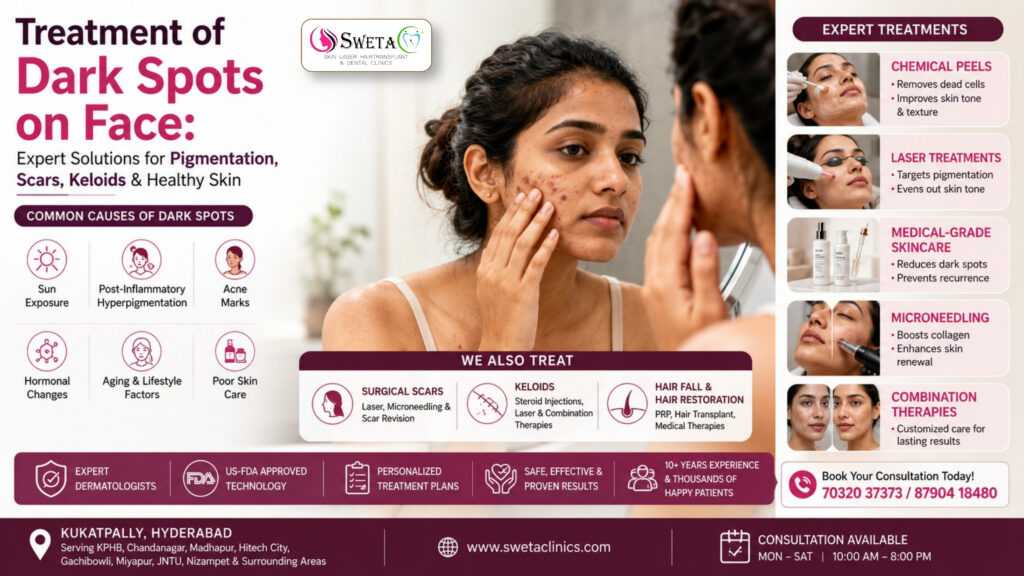
Dark spots happen when your skin produces excess melanin — the pigment responsible for skin colour — in response to a trigger. The trigger matters more than people realise, because it determines what will actually fade the mark.
Sun Exposure
UV light stimulates melanin production as a defence mechanism. Years of cumulative exposure show up as flat brown or tan spots — often called sun spots or solar lentigines — typically on the cheeks, forehead, and nose. In a city like Hyderabad, with intense sun for most of the year, sun-related pigmentation is one of the most common reasons people search for a dermatologist for dark spots near Kukatpally.
According to the National Institutes of Health, chronic UV exposure remains one of the leading causes of hyperpigmentation disorders worldwide, particularly in regions with high year-round sun intensity.
Post-Inflammatory Hyperpigmentation (PIH)
This is one of the most common causes seen in clinic — especially in acne patients. After skin experiences inflammation (a pimple, cut, insect bite, or aggressive treatment), it can overproduce melanin at that exact spot while healing. The result is a flat dark mark that can take months to fade without proper treatment.
Acne Marks
Acne-related dark spots are technically a form of PIH, but they deserve separate mention because they’re so frequently confused with acne scars. The distinction matters: acne marks are flat discolouration, while acne scars involve an actual change in skin texture. A brightening serum can fade a mark — it cannot fix a textured scar.
Hormonal Triggers (Melasma)
Hormonal shifts — pregnancy, certain contraceptives, or underlying hormonal conditions — can trigger melasma, which appears as larger, symmetrical patches on the cheeks, forehead, and upper lip. Melasma is notably more stubborn and more prone to recurrence than other pigmentation types, which is why it needs an approach built around its hormonal trigger, not just surface treatment.
Aging and Lifestyle Factors
As skin ages, melanin production becomes less even, layering age-related pigmentation on top of existing sun damage. Long-term unprotected sun exposure, smoking, and certain sun-sensitising medications accelerate this — which is why two people the same age can have very different amounts of visible pigmentation.
The Different Types of Facial Pigmentation
Facial pigmentation isn’t a single condition. It’s several distinct types, and correctly identifying which one you have is the single most important step before choosing any treatment.
| Type | Appearance | Key Trigger | Treatment Response |
|---|---|---|---|
| Melasma | Large, symmetrical brown/grey patches | Hormones + sun | Resistant, prone to recur |
| Sun Spots | Flat, well-defined brown spots | Cumulative UV exposure | Responds well to laser/peels |
| Freckles | Small, scattered brown spots | Genetics + sun | Cosmetic, elective treatment |
| Acne Pigmentation | Flat marks post-acne | Inflammation | Improves with skincare + peels |
| Post-Treatment Pigmentation | New/worsened dark patches | Aggressive treatment, sun exposure during recovery | Preventable with right approach |
Why this table matters: treating melasma like a sun spot — or vice versa — is one of the most common reasons people feel like “nothing works” on their pigmentation. The wrong category, the wrong treatment.
Post-treatment pigmentation deserves a special mention here. It can actually develop from a cosmetic procedure, particularly if a treatment was too aggressive for your skin type, or your skin wasn’t protected from sun during recovery. This is exactly why choosing a provider who calibrates intensity to your specific skin tone matters — an overly aggressive approach, especially on deeper skin tones, can leave you with more pigmentation than you started with.
Best Treatment Options for Dark Spots
There’s no single “best” treatment — the right one depends on which type of pigmentation you’re dealing with. Most effective plans combine more than one approach.
Chemical Peels
Chemical peels use a controlled acid solution to remove the outer skin layers, encouraging cell turnover and gradually fading surface pigmentation. They’re versatile — useful for sun spots, acne pigmentation, and as part of an ongoing melasma plan.
- Recovery: None to a few days of redness, depending on peel strength
- Sessions needed: A series, spaced a few weeks apart
- Results: Gradual improvement over weeks to months
Explore our chemical peel treatments for pigmentation, acne marks, and dullness.
Laser Treatments
Lasers target pigment using specific light wavelengths, breaking it down so the body clears it naturally. They’re precise — particularly effective for well-defined sun spots.
For melasma specifically, lasers need to be chosen carefully. The Mayo Clinic notes that incorrect laser settings can worsen melasma, especially in darker skin tones — which is exactly why professional assessment matters more here than almost anywhere else in dermatology.
- Recovery: Minimal to a few days of redness/peeling, depending on intensity
- Best for: Sun spots; melasma under close supervision only
Learn more about our laser pigmentation treatment using US-FDA approved devices.
Medical-Grade Skincare
Prescription-strength topicals that inhibit melanin production or speed cell turnover. Works gradually — usually over 8 to 12 weeks — and is typically the primary long-term strategy for managing melasma.
- Recovery: None
- Best for: Foundation treatment alongside in-clinic procedures; melasma maintenance
Microneedling
Fine needles create controlled micro-injuries that help topical treatments absorb more effectively and kickstart skin repair. Rarely used alone — usually combined with other pigmentation treatments for added effect.
Combination Therapy
Most real-world treatment plans combine approaches — medical-grade skincare for ongoing melasma management, paired with periodic peels for acne pigmentation, or laser for sun spots alongside daily maintenance. A dermatologist-guided combination consistently outperforms relying on a single product or procedure.
Book a personalized pigmentation consultation with Dr. Nagaraju D at Sweta Clinics to find out which combination suits your skin.
Surgical Scar Treatment — What’s Actually Realistic
If a surgical scar has bothered you for a while, here’s the honest answer: most scars can’t be completely erased. But they can often be significantly improved — in colour, texture, and how much they stand out — and for most patients, that improvement is genuinely meaningful.
Scar Assessment Comes First
Before treatment, a dermatologist evaluates the scar’s characteristics:
- Is it raised (hypertrophic), flat, or indented (atrophic)?
- Is it discoloured?
- Is it old or relatively recent?
A scar still actively healing — generally within its first year — responds differently than one that’s been stable for years.
Laser Scar Reduction
Targets a scar’s blood vessels (reducing redness), pigment (reducing discolouration), or texture (stimulating collagen remodelling) — sometimes all three.
- Downtime: A few days of redness
- Sessions: Multiple, spaced weeks apart
- Expectation: Noticeable improvement, not complete invisibility
Microneedling for Scars
Particularly effective for indented (atrophic) scars, stimulating collagen production to gradually smooth texture over a series of sessions.
Scar Revision (Surgical)
For wide, raised, or poorly positioned scars, a surgeon carefully re-excises and closes the scar in a way intended to heal less noticeably. This involves an actual surgical recovery period — and the goal is a better scar, not zero scar.
Advanced & Combination Procedures
Fractional laser resurfacing, targeted injectables, or combination protocols may be added depending on how the scar responds.
| Treatment | Best For | Downtime | Sessions |
|---|---|---|---|
| Laser Scar Reduction | Redness, discolouration, mild texture | A few days | Multiple |
| Microneedling | Indented (atrophic) texture | 1–2 days | Multiple |
| Scar Revision | Wide, raised, poorly positioned scars | Surgical recovery | Usually one |
| Combination Procedures | Complex or mixed scar types | Varies | Often multiple |
View our scar treatment options at Sweta Clinics for a personalized plan.
Keloid Treatment — Why It’s Different From a Regular Scar
A keloid isn’t just “a bad scar.” It’s a distinct condition where the skin’s healing process overproduces collagen at an injury site — anything from a piercing to a surgical incision, even acne — causing scar tissue to grow well beyond the original wound’s edges.
What Causes Keloids?
The exact mechanism isn’t fully understood, but it’s tied to genetic predisposition, skin type, and injury location. Areas like the chest, shoulders, earlobes, and jawline are particularly prone. If you’ve had a keloid before, you’re statistically more likely to form new ones from future injuries.
Recognizing a Keloid
A keloid typically presents as raised, smooth, and sometimes shiny, extending beyond the original wound — ranging from pink to darker than surrounding skin, and often itchy, tender, or painful in earlier stages. Unlike a regular scar, a keloid can keep growing slowly over months or years if left untreated, which is why earlier evaluation leads to better outcomes.
Modern Keloid Treatment Options
Steroid injections are usually first-line — reducing inflammation and gradually flattening raised tissue over several sessions spaced weeks apart.
Laser therapy helps with redness and texture, often paired with steroid injections for a more complete result.
Surgical removal is possible, but carries a real risk: because keloids form from an overactive healing response, simply excising one can trigger a new keloid at the same site. That’s why surgery for keloids is almost always combined with other treatments to reduce recurrence.
Combination treatment — steroid injections, ongoing monitoring, and laser for residual discolouration — tends to produce the best long-term results.
Read more about keloid treatment at Sweta Clinics.
When Should You See a Dermatologist?
A reasonable rule: if a dark spot, scar, or keloid has persisted, changed, or worsened despite home care, it’s worth a proper evaluation. The same applies to anything raised, growing, itchy, or painful.
Specific signs that warrant a visit:
- Pigmentation that hasn’t improved with OTC products after 2–3 months
- Any mark changing in size, shape, colour, or texture
- A scar or keloid that’s growing, itchy, painful, or affecting movement near a joint
- Before trying any aggressive at-home treatment — strong acids, at-home devices, DIY peels
The American Academy of Dermatology recommends that any changing skin mark be professionally evaluated to rule out conditions that need closer attention — not because most changes are serious, but because a proper assessment is the only reliable way to know.
For patients across Kukatpally, KPHB, Chandanagar, Madhapur, Hitech City, Gachibowli, Miyapur, JNTU, Nizampet, and Pragathi Nagar, the real question isn’t finding a dermatologist — it’s finding one who takes the time to properly assess your specific concern.
Hair Fall — What Actually Moves the Needle
While dark spots and scars dominate most dermatology searches, hair fall is a closely related concern many patients bring up in the same visit.
Medical Causes
Thyroid imbalances, hormonal conditions, autoimmune conditions, and pattern hair loss (androgenetic alopecia) — the most common cause of progressive thinning in both men and women — all determine whether the right approach is topical, oral, or procedural.
Nutritional Causes
Deficiencies in iron, vitamin D, B12, zinc, and protein are commonly linked to increased shedding. The World Health Organization notes iron deficiency remains one of the most widespread nutritional gaps globally, and it’s directly linked to hair shedding in affected individuals. Correcting a deficiency, ideally confirmed via blood test, can meaningfully reduce hair fall over a few months.
Scalp Health
Dandruff, excess oil, or inflammation create a poor environment for hair growth. Addressing scalp issues alongside other treatment removes one more variable working against you.
Why Timing Matters Most
Early-stage thinning responds faster and better to treatment than advanced thinning. The honest answer to “how do I stop hair fall fast” isn’t another shampoo — it’s seeing a dermatologist now.
Explore hair fall treatment options at Sweta Clinics.
Hair Restoration Options for Men
| Option | Best Suited For | Downtime | Permanence | Timeline |
|---|---|---|---|---|
| PRP Therapy | Early-to-moderate thinning, active follicles | Minimal | Requires maintenance | Several months |
| Hair Transplant | Stable donor area, defined zones | Procedural recovery | Permanent | 9–12 months |
| Medical Restoration | Early pattern loss | None | Requires continued use | Several months |
| Scalp Treatments | Underlying scalp conditions | Minimal to none | Supportive, ongoing | Varies |
PRP therapy uses growth factors from your own blood, injected into thinning areas to support follicles that are active but underperforming. Most effective in early-to-moderate thinning, with improvements noticeable over several months.
Hair transplant surgically relocates follicles from a donor area to thinning zones, usually via FUE. A genuinely permanent solution for areas where follicles are already gone — early growth shows within a few months, fuller results take 9–12 months.
Medical hair restoration — topical or oral treatments addressing hormonal factors — can slow or stabilise loss, though most options need continued use to maintain results.
See our PRP and hair transplant services for a closer look at what suits your stage of hair loss.
Why Patients Across KPHB, Kukatpally & Chandanagar Choose Sweta Clinics
Sweta Clinics, based in Kukatpally and easily accessible from KPHB, Chandanagar, Madhapur, Hitech City, Gachibowli, Miyapur, JNTU, Nizampet, and Pragathi Nagar, brings dermatology, hair restoration, and dental care together under one roof — backed by over 10 years of experience.
What sets the clinic apart:
- Expert-led care: Skin, scar, pigmentation, keloid, and hair consultations led by Dr. Nagaraju D (MBBS, MD DVL), Consultant Dermatologist and Hair Transplant Surgeon
- US-FDA approved technology calibrated specifically for Indian skin types
- Structured diagnosis — history, examination, and detailed assessment before any treatment plan
- Transparent pricing with clear explanations behind every recommendation
- Comprehensive, coordinated care — one dermatologist managing related concerns rather than fragmented treatment across multiple providers
Frequently Asked Questions
What’s the best treatment for dark spots on the face?
It depends on the type. Sun spots usually respond well to lasers or peels. Melasma needs medical-grade skincare, strict sun protection, and carefully chosen procedures. Acne pigmentation often improves with consistent skincare plus peels or microneedling.
Can surgical scars be removed completely?
Most can’t be fully erased, but they can be significantly improved through laser treatment, microneedling, or scar revision. A flatter, less noticeable scar is the realistic goal.
What’s the best treatment for keloids?
Usually starts with steroid injections, sometimes alongside laser for discolouration. Surgical removal carries a recurrence risk, so it’s typically combined with other treatments.
How do I know if I need a dermatologist?
If a spot, scar, or keloid hasn’t improved after a couple of months, is changing shape or colour, or is growing, itchy, or painful.
How can I stop hair fall as quickly as possible?
There’s no instant fix, but identifying the actual cause — medical, nutritional, or scalp-related — and acting early gives the fastest, most meaningful results.
Can pigmentation come back after treatment?
Yes, particularly melasma, which is prone to recurrence with sun exposure. Ongoing sun protection and maintenance treatment are usually part of the management plan.
How do I choose the right skin clinic in Hyderabad?
Check qualifications (MD DVL), real experience with your specific concern, the technology used (US-FDA approved devices), transparency in explaining diagnosis and options, and whether your plan is personalized rather than a standard package.
Ready to Get Started?
Dark spots, scars, and keloids all share one thing in common: the gap between “trying things” and “treating the actual cause” determines how quickly you see real results.
If something has been bothering you for a while — a stubborn dark patch, an old scar, a growing keloid, or thinning hair — don’t wait for it to get worse.
Book a consultation with Dr. Nagaraju D at Sweta Clinics, Kukatpally.
📞 Call 7032037373 / 8790418480
🌐 Book online at swetaclinics.com