
Finding extra strands on your pillow, in the shower drain, or tangled in your hairbrush can be unsettling. A little shedding is completely normal — most people lose somewhere between 50 and 100 hairs a day as part of the natural growth cycle. But when the shedding feels heavier than usual, when your part looks wider, or when your ponytail feels noticeably thinner, it’s natural to start wondering: why is this happening to me?
Hair loss in women is far more common than most people realize, and it’s rarely talked about as openly as male pattern baldness. The good news is that most causes are identifiable, and many are treatable — especially when addressed early. At Sweta Clinics, Kukatpally, Dr. Nagaraju D (MBBS, MD DVL — PGIMER, Chandigarh), Consultant Dermatologist, Cosmetologist & Hair Transplant Surgeon, sees this question from women of all ages, and the first step is always the same: figuring out exactly what’s driving the hair loss before deciding what to do about it.
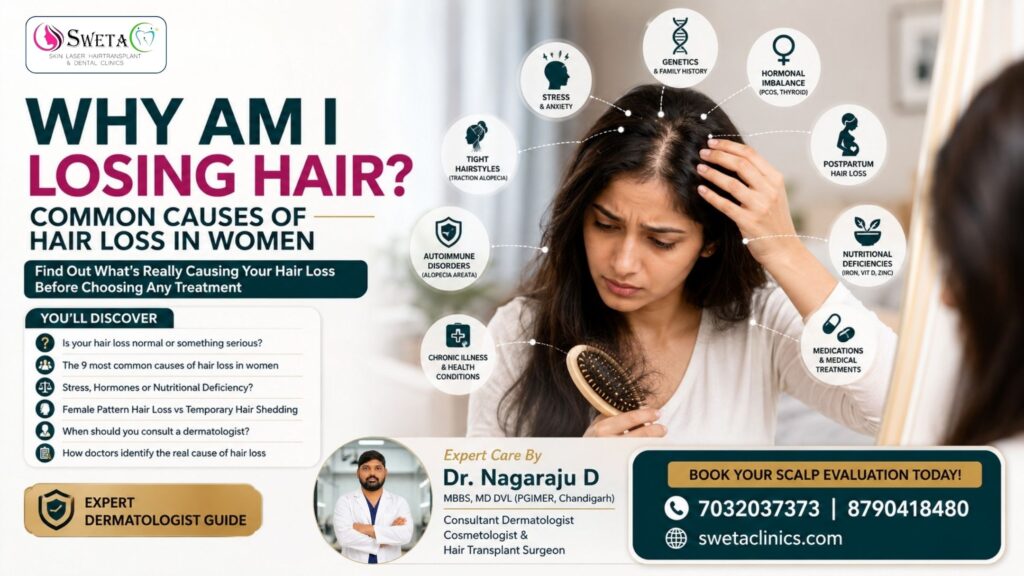
This guide walks through the most common causes of hair loss in women, how to recognize the patterns, and when it’s time to see a dermatologist.
First, Understand the Normal Hair Growth Cycle
Every strand of hair on your scalp moves through three phases:
- Anagen (growth phase): Most of your hair — roughly 85 to 90% at any given time — is actively growing during this phase, which can last anywhere from two to six years.
- Catagen (transition phase): A short phase where the follicle shrinks and growth slows.
- Telogen (resting phase): The hair stops growing and eventually sheds, usually after about three months, to make way for a new strand.
Understanding this cycle matters because many causes of hair loss work by disrupting it — pushing too many hairs into the resting or shedding phase at once, or shrinking follicles so they can no longer produce visible hair at all.
The Most Common Causes of Hair Loss in Women
1. Female Pattern Hair Loss (Androgenetic Alopecia)
This is the most common cause of hair loss in both men and women. In women, it typically shows up as gradual thinning along the top of the scalp and a widening part, rather than the receding hairline more commonly seen in men. It’s largely genetic, driven by hair follicles becoming progressively more sensitive to hormones over time, causing them to shrink (miniaturize) with each growth cycle. The American Academy of Dermatology notes that this hereditary form of hair loss is the most common cause of hair loss worldwide, affecting both men and women.
2. Telogen Effluvium (Stress-Related Shedding)
Telogen effluvium is a temporary but often alarming type of diffuse hair shedding. It happens when a significant physical or emotional stressor — surgery, high fever, illness, extreme dietary changes, or major emotional stress — pushes an unusually large number of hair follicles into the resting (telogen) phase all at once. According to a detailed review published in the Journal of Clinical and Diagnostic Research, this diffuse shedding typically becomes noticeable three to four months after the triggering event, which is why many women struggle to connect the hair loss back to what actually caused it. The good news: telogen effluvium is usually self-limiting, and hair regrowth typically resumes once the underlying trigger resolves.
3. Postpartum Hair Loss
Many new mothers are caught off guard by a wave of hair shedding a few months after giving birth. This is a specific form of telogen effluvium, driven by the sharp drop in estrogen and progesterone after delivery. Johns Hopkins Medicine explains that this hair thinning happens as hormone levels return to their pre-pregnancy baseline, and while it can be distressing, it’s usually temporary, with hair density returning to normal within several months.
4. Hormonal Imbalances (PCOS, Thyroid Disorders, Menopause)
Hormones play a central role in hair growth, so it’s no surprise that hormonal conditions are a major cause of hair loss in women:
- Polycystic Ovary Syndrome (PCOS) can cause elevated androgen levels, leading to thinning at the crown similar to female pattern hair loss, often alongside other symptoms like irregular periods and acne.
- Thyroid disorders — both an underactive (hypothyroid) and overactive (hyperthyroid) thyroid — can disrupt the hair growth cycle, leading to diffuse thinning across the scalp.
- Menopause brings declining estrogen levels, which can unmask or accelerate genetic hair thinning that may have been present but not yet visible.
5. Nutritional Deficiencies
Hair follicles are metabolically active and sensitive to nutrient shortages. Low iron (ferritin) levels, insufficient protein intake, vitamin D deficiency, and zinc deficiency have all been associated with increased shedding, particularly in cases of telogen effluvium. This is one of the most easily correctable causes of hair loss — but it requires proper blood work to confirm, rather than guessing which supplement to try.
6. Traction Alopecia (Hairstyle-Related Hair Loss)
Tight hairstyles — high ponytails, tight braids, buns, or hair extensions worn repeatedly — place constant tension on hair follicles, particularly along the hairline and temples. Over time, this can cause a distinct pattern of thinning right at the areas under the most tension. Caught early, traction alopecia is often reversible simply by changing hairstyling habits; left unaddressed for years, it can lead to permanent follicle damage.
7. Alopecia Areata
This is an autoimmune condition where the body’s immune system mistakenly attacks hair follicles, leading to sudden, often coin-shaped patches of hair loss. Unlike the gradual thinning seen in pattern hair loss, alopecia areata tends to appear abruptly and can affect any hair-bearing area of the body. It’s unpredictable — some cases resolve on their own, while others require dermatological treatment.
8. Medications and Medical Treatments
Certain medications list hair loss as a side effect, including some used for blood pressure, depression, arthritis, and hormonal birth control (particularly when starting or stopping it). Chemotherapy and radiation therapy are well-known causes of more dramatic, temporary hair loss as well.
9. Chronic Illness and Autoimmune Conditions
Ongoing health conditions — including diabetes, autoimmune diseases, and chronic scalp infections — can also contribute to hair thinning. Notably, the American Academy of Dermatology has highlighted research connecting hair loss in women to other underlying health conditions, which is one reason dermatologists often recommend a broader health evaluation rather than treating hair loss in isolation.
How to Tell the Difference: Pattern Thinning vs. Sudden Shedding
One of the most useful things you can do before your appointment is pay attention to how your hair loss is happening:
| Sign | Likely Pointing Toward |
|---|---|
| Gradual widening of the part, thinning at the crown | Female pattern hair loss (androgenetic alopecia) |
| Sudden, heavy shedding all over, 2–4 months after an illness, surgery, or major stress | Telogen effluvium |
| Round or oval bald patches appearing abruptly | Alopecia areata |
| Thinning concentrated at the hairline or temples | Traction alopecia |
| Hair loss alongside fatigue, weight changes, or irregular periods | Possible hormonal or thyroid cause |
| Heavy shedding a few months after childbirth | Postpartum telogen effluvium |
This isn’t a substitute for a proper diagnosis, but it can help you describe your symptoms more precisely to your dermatologist — which speeds up getting to the right answer.
When Should You See a Dermatologist?
While some hair loss (like mild postpartum shedding) resolves on its own, it’s worth booking a consultation if you notice:
- Hair loss that continues for more than six months without improvement
- Visible bald patches, rather than diffuse thinning
- Scalp itching, redness, pain, or scaling alongside the hair loss
- Hair loss accompanied by other symptoms like fatigue, weight changes, or irregular periods
- A family history of hair loss combined with your own noticeable thinning
Early evaluation matters because some causes — like traction alopecia or certain autoimmune conditions — can lead to permanent follicle damage if left untreated for too long. Catching the cause early generally means more treatment options and better outcomes.
How Hair Loss in Women Is Diagnosed
A proper diagnosis typically goes well beyond a quick look at your scalp. At Sweta Clinics, evaluating hair loss usually involves:
- A detailed history, including onset, family history, recent illnesses, medications, and stress events
- A close scalp examination to assess the pattern and extent of thinning
- Relevant blood tests where indicated, such as thyroid function, iron/ferritin levels, and hormonal panels
- Trichoscopy (magnified scalp examination) to assess follicle health and miniaturization
This diagnostic-first approach matters because treatments differ significantly depending on the cause — what helps hormonal thinning won’t necessarily help traction alopecia, and vice versa.
Frequently Asked Questions (FAQs)
Is it normal to lose hair every day?
Yes. Losing 50–100 hairs a day is considered normal as part of the natural growth cycle. It’s a sudden increase in shedding, or visible thinning and patches, that signals something worth investigating.
Can stress really cause hair loss?
Yes. Significant physical or emotional stress can trigger telogen effluvium, pushing more hair follicles than usual into the shedding phase, typically becoming noticeable a few months after the stressful event.
Will my postpartum hair loss grow back?
In most cases, yes. Postpartum shedding is usually temporary, with hair density gradually returning to normal within several months as hormone levels stabilize.
Can hair loss from PCOS or thyroid issues be reversed?
Often, yes — particularly when the underlying hormonal imbalance is properly managed. This is why blood work and a hormonal evaluation are often part of diagnosing hair loss in women.
Is female pattern hair loss the same as male pattern baldness?
They share the same underlying process (androgenetic alopecia), but the pattern differs. Women typically experience diffuse thinning and a widening part, while men more often see a receding hairline and crown balding.
Should I try supplements before seeing a dermatologist?
It’s best to get blood work done first. Taking supplements for deficiencies you don’t actually have won’t help, and in some cases excessive supplementation can cause its own problems.
Get to the Root of Your Hair Loss at Sweta Clinics, Kukatpally
Hair loss can feel confusing precisely because so many different things can cause it — genetics, hormones, stress, nutrition, hairstyling habits, or an underlying health condition. Guessing at the cause, or trying treatment after treatment without a diagnosis, often wastes time you don’t need to lose.
Dr. Nagaraju D brings specialized training in dermatology, venereology, and leprosy (DVL) from PGIMER Chandigarh, along with focused expertise in cosmetology and hair transplant surgery, offering a proper diagnostic evaluation before recommending any hair loss treatment — whether that’s addressing an underlying hormonal cause, PRP therapy, or a more advanced intervention.
📍 Sweta Clinics Ground Floor, VC Plaza, Landmark: SBI and Jio Building, Opposite Metro Pillar 818 and BJP Office, Vivek Nagar, Kukatpally, Hyderabad – 500072 🌐 www.swetaclinics.com
Dr. Nagaraju D MBBS, MD DVL (PGIMER, Chandigarh) Consultant Dermatologist, Cosmetologist & Hair Transplant Surgeon
📞 Call or WhatsApp to book a consultation: +91 87904 18480 | +91 70320 37373
Don’t wait for the thinning to become undeniable. Book a scalp evaluation at Sweta Clinics and find out exactly what’s causing your hair loss — and what to do about it.