If you’ve spent time Googling your skin concerns late at night, you already know how overwhelming it gets. One search leads to ten product recommendations, three conflicting home remedies, and a comment section full of people swearing by things that contradict each other entirely.
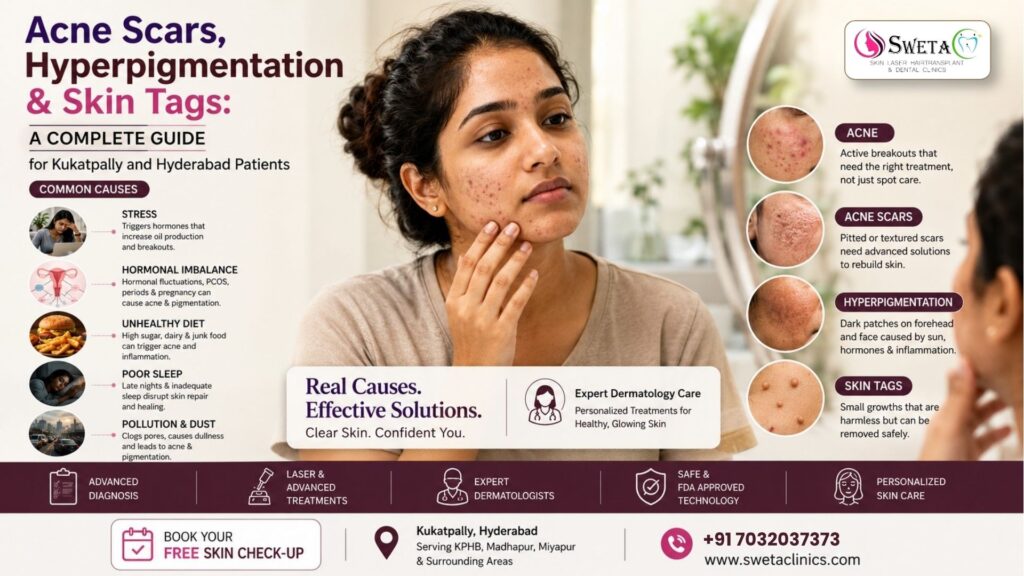
Here’s the truth: most skin concerns — acne scars, dark patches on the forehead, small growths on the neck — are very treatable. But what works depends entirely on what’s actually causing your specific problem. And that’s something no cream, no YouTube tutorial, and no well-meaning friend can tell you with any accuracy.
This guide is written for people in Kukatpally, KPHB, Madhapur, and across Hyderabad who want straight answers — not a sales pitch.
Let’s Start With What You’re Actually Dealing With
Acne: Why It Keeps Coming Back
Acne happens when your hair follicles get blocked with oil and dead skin cells. Bacteria multiply in that environment, causing the redness, swelling, and breakouts you’re familiar with. But here’s what most people miss — acne is rarely just a skin-surface problem.
Adult acne, particularly in women, is very often tied to hormonal shifts, stress levels, or underlying conditions like PCOS. When you treat acne with a spot cream and nothing else, you’re addressing the visible result, not the trigger. That’s why it keeps coming back.
If your breakouts are persistent — especially along your jawline or chin — it’s worth speaking to a dermatologist in Kukatpally who can look at the full picture before recommending a treatment path.
Acne Scars vs. Acne Marks — These Are Not the Same Thing
This is one of the most common points of confusion, and it matters because the treatment is completely different.
Post-acne marks are flat, dark, or reddish spots left behind after a pimple heals. They look like scars but they’re not — they’re just discolouration, and they usually fade on their own over a few weeks to months. A good topical product can help speed that up.
Acne scars are a different story. These are permanent changes in skin texture — the pitted, sunken, or raised marks that result from damage to the deeper layers of skin during severe acne or from repeatedly picking at breakouts. Ice-pick scars, boxcar scars, rolling scars — none of these can be faded with a cream because the issue isn’t colour, it’s structure.
No matter how good the marketing sounds, the best acne marks removal cream for oily skin will not fill in a pitted scar. That requires procedures that rebuild collagen from the inside — like microneedling radiofrequency (MNRF) or fractional laser resurfacing. TheAmerican Academy of Dermatology confirms that depressed acne scars require in-office procedures to see real improvement.
Hyperpigmentation on the Forehead — A Very Hyderabad Problem
Dark patches on the forehead are incredibly common here, and it’s not a coincidence. Between the heat, humidity, and the amount of time most people spend commuting outdoors — on two-wheelers through Kukatpally, JNTU, Hitech City, and Madhapur — the forehead takes a lot of unprotected sun exposure every single day.
UV rays trigger melanin production as a protective response. In people who are prone to pigmentation, that response becomes excessive, uneven, and persistent.
But not all forehead pigmentation is the same:
Melasma tends to appear as symmetrical brown or grey-brown patches and is strongly linked to hormonal changes — pregnancy, contraceptive use, or hormonal imbalances. Sun exposure makes it significantly worse.
Post-inflammatory hyperpigmentation (PIH) is the dark mark left behind after acne, a waxing session that went wrong, or even aggressive threading near the hairline.
Sun-induced pigmentation is more diffuse — general darkening or freckling from years of cumulative UV exposure without adequate sunscreen.
These three can look almost identical to the untrained eye but respond very differently to treatment. Treating melasma the same way you’d treat sun spots, for example, can make things worse — which is exactly why a proper skin check-up at Sweta Clinics matters before starting any treatment.
Skin Tags — Harmless, But Worth Getting Checked
Skin tags are those small, soft, skin-coloured growths that tend to appear on the neck, underarms, eyelids, or anywhere skin rubs against skin or clothing. They’re extremely common. They’re almost always harmless. And they tend to increase with age, weight changes, and in people with insulin resistance or diabetes.
Most people searching for skin tag removal near me aren’t panicking about something serious — they just want the growth gone because it keeps catching on a chain, a collar, or a razor blade.
That said, the only way to be absolutely certain a skin growth is a simple skin tag — and not something that warrants closer attention — is to have a dermatologist examine it. TheSkin Care Foundation notes that while skin tags are benign, any growth that changes in size, colour, or shape should always be professionally evaluated.
What’s Actually Causing Your Skin Concerns?
Treating the surface without understanding the cause is the number one reason skin treatments fail or the problem comes right back. Here’s what’s typically driving things:
Hormones are the single biggest factor for both acne and pigmentation. Androgens increase oil production and push breakouts — especially along the jawline in adult women. Conditions like PCOS and thyroid imbalances directly affect both how often you break out and how likely your skin is to develop melasma-type pigmentation.
Genetics plays a real role too. If your parents were prone to acne scarring, keloid formation, or persistent pigmentation, your skin is statistically more likely to behave similarly. This doesn’t mean treatment won’t work — it just means your plan needs to account for how your skin specifically heals.
Your daily environment matters more than most people realise. Pollution, dust, and humidity in high-traffic areas like Kukatpally and Madhapur clog pores, irritate skin, and contribute to persistent breakouts — particularly for people who spend significant time outdoors without skin protection.
Sun exposure — even indirect, even on cloudy days — is the primary driver of hyperpigmentation for most Hyderabad patients. The World Health Organization is unequivocal about UV radiation’s role in skin damage, including pigmentation changes.
Skincare mistakes quietly make things worse. Picking at pimples is probably the single most common way mild acne becomes permanent scarring. Skipping sunscreen undoes whatever pigmentation treatment you’re doing in-clinic. Using too many strong actives at once — retinoids, acids, brightening serums — without professional guidance can damage your skin barrier and cause the very inflammation you’re trying to treat.
What Treatment Actually Looks Like
For Acne
Effective acne treatment combines topical medications to reduce oil and bacterial activity, oral medications when breakouts are moderate to severe, and in-clinic options like laser pimple reduction therapy for stubborn or inflamed lesions. Most patients see a meaningful reduction in new breakouts within 4–8 weeks of consistent treatment.
More importantly, a good treatment plan addresses why you’re breaking out — not just the visible result. Explore our acne treatment page to understand what a full protocol looks like.
For Acne Scars
This is where people often feel stuck — they’ve waited for scars to fade and they haven’t. That’s because, structurally, they won’t without intervention.
The right approach depends on scar depth:
| Treatment | Best For | Downtime | Sessions |
| Chemical Peel | Surface marks, mild texture | 1–2 days | 4–6 |
| Fractional Laser | Moderate to deep pitted scars | 2–4 days | 3–6 |
| MNRF | Deep, textured scars | 2–5 days | 3–5 |
| PRP | Combined with above for enhanced healing | Minimal | 3–4 |
Results are gradual — most patients see real improvement after 3–4 sessions, with continued skin remodelling for months after the last session as collagen continues to rebuild. Learn more about acne scar treatment at Sweta Clinics.
For Hyperpigmentation on the Forehead
For forehead pigmentation specifically, a layered approach consistently works better than any single treatment:
First, the type of pigmentation needs to be correctly identified — because melasma and sun-induced pigmentation look similar but respond very differently. Second, any active trigger (hormonal imbalance, ongoing irritation from threading or waxing) needs to be addressed alongside the cosmetic treatment. Then a combination of chemical peels, topical brightening agents, and laser toning works progressively to lighten existing pigmentation and even out skin tone.
And throughout all of it — daily sunscreen. Without it, even the most effective laser treatment will see pigmentation return within weeks on a sun-exposed area like the forehead. This isn’t optional advice; it’s the foundation the entire treatment rests on.
Visible lightening typically begins after 2–3 sessions, with continued improvement over 2–3 months. See our pigmentation treatment options for a full breakdown.
For Skin Tags
Skin tag removal is one of the more straightforward procedures in dermatology. Tags are typically removed using electrosurgery — a quick, controlled procedure using heat — or simple excision under local anaesthesia. Most people are back to their normal routine the same day, with a small scab that heals within a week to ten days. Permanent removal, single session.
Laser, Chemical Peels & PRP — A Quick Overview
Laser treatments use focused light energy to target pigment, redness, or deeper tissue to stimulate collagen. The key here — particularly for Indian skin — is that US-FDA approved devices with settings calibrated for melanin-rich skin are non-negotiable. Incorrect laser parameters on darker skin tones can cause post-treatment pigmentation that’s harder to treat than the original problem.
Chemical peels use controlled acid application to exfoliate the outer skin layers, improving texture, mild pigmentation, and dullness over a course of 4–6 sessions.
PRP (Platelet-Rich Plasma) uses growth factors from your own blood to support collagen production and skin healing. It’s most effective as part of a combined protocol — alongside microneedling or laser resurfacing — rather than as a standalone treatment.
Why You Shouldn’t Wait on This
The longer acne goes untreated, the greater the risk of permanent scarring. The longer pigmentation goes without sunscreen and proper management, the deeper it becomes and the harder it is to treat. And the longer you spend trying random OTC creams — some of which, according to the WHO, may contain undisclosed steroids or unsafe levels of certain ingredients — the more time you lose on an approach that may be making things worse.
A proper dermatology evaluation costs you nothing to start. At Sweta Clinics, a free skin check-up gives you a clear, honest picture of what’s happening with your skin — no commitment to a treatment plan required.
Why Patients Across Kukatpally & KPHB Choose Sweta Clinics
Sweta Clinics, based in Kukatpally, brings together dermatology, hair restoration, and dental care under one roof — led by Dr. Nagaraju D (MBBS, MD-DVL), a Consultant Dermatologist and Hair Transplant Surgeon with over a decade of hands-on experience, alongside Dr. Sweta Bingi (BDS, FCE) for dental care.
Patients across Kukatpally, KPHB, Madhapur, Hitech City, JNTU, Miyapur, Nizampet, and Pragathi Nagar come here because:
The approach starts with a 5-step diagnostic protocol — history, clinical examination, dermoscopy or trichoscopy, a personalised treatment plan, and thorough counselling. You understand exactly what’s causing your concern and what the treatment will involve before anything begins.
Every laser and device used is US-FDA approved and calibrated for Indian skin types — because the risk of post-treatment pigmentation on melanin-rich skin is real, and device quality isn’t something to compromise on.
And the location matters too — right in Kukatpally, easily accessible from KPHB, JNTU, and Moosapet, without needing to travel into the busier, more expensive clinic corridors of Banjara Hills or Jubilee Hills.
Common Questions Answered
Can hyperpigmentation on the forehead actually be removed?
Significantly lightened, yes — with the right combination of treatments and consistent sunscreen use. Conditions like melasma tend to need ongoing maintenance rather than a one-time fix, because they’re linked to hormonal activity and sun exposure that continues after treatment.
How many laser sessions will I need for pigmentation?
Most patients need multiple sessions spaced 2–4 weeks apart. Visible lightening usually starts after 2–3 sessions, with the total number depending on pigment depth and how your skin responds.
Is it safe to combine skin and dental treatments at the same clinic?
Absolutely — as long as each specialty is handled by a separately qualified doctor, which is the case at Sweta Clinics. Many patients find it genuinely convenient to address both at a single location.
What does a first consultation at Sweta Clinics actually involve?
A thorough review of your medical and skin history, a clinical examination of the affected area, dermoscopy where needed, and a clear, honest explanation of what treatment options suit your concern — with realistic timelines and no pressure to commit on the spot.
Ready to understand what your skin actually needs? Book your free skin check-upat Sweta Clinics, Kukatpally — call us on 7032037373or 8790418480.