
You notice it while getting dressed. A pale patch on your back, or along your neck, that wasn’t there last summer. Maybe a relative points it out first. Maybe it shows up in a photo, and suddenly you can’t unsee it.
So you search online, and the first words you read are scary. Many families also have their own theories, and some of them are plain wrong. Meanwhile, the patch just sits there, and you wonder what to do.
Here’s the good news. Most pale patches turn out to be one of two things: vitiligo or tinea versicolor. They look alike at first, but they’re very different underneath. This guide explains vitiligo vs tinea versicolor in plain words, so you know what to look for and what to ask your doctor.
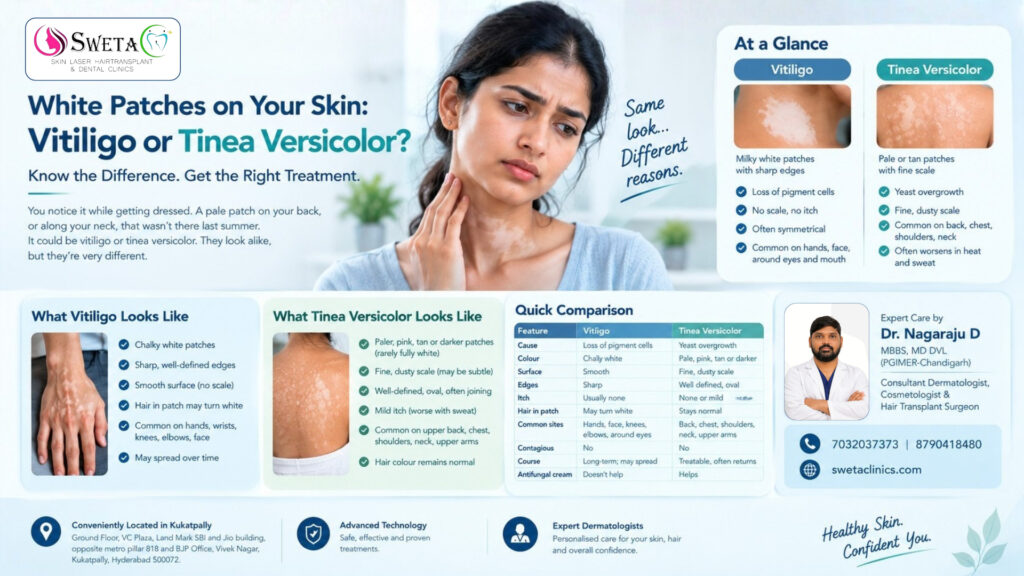
Vitiligo vs Tinea Versicolor: The Core Difference
Vitiligo is a loss of pigment. The skin’s colour-making cells, called melanocytes, stop working or disappear from the patch. StatPearls calls vitiligo the commonest cause of depigmentation. Without those cells, the skin turns white. Doctors link the most common type to the immune system and to other autoimmune conditions.
Tinea versicolor is a different story. It’s a harmless overgrowth of a yeast called Malassezia, which already lives on most people’s skin. According to StatPearls, it causes pale or dark scaly patches. The pigment cells aren’t destroyed, and colour normally returns once the yeast is under control.
So vitiligo takes the colour cells away, while tinea versicolor only interferes with them. That’s why the treatment, the outlook and the follow-up differ so much.
What Vitiligo Looks Like
Vitiligo patches are usually a stark, milky white. The colour is gone, not just faded. The borders are sharp, so you could almost trace the edge with a pen. The surface feels normal, with no scale, and there’s usually no itch.
Hair growing inside a patch may turn white too. Patches often appear on both sides of the body in a matching pattern. Common sites include the hands, fingers, wrists, knees and elbows. The skin around the mouth and eyes, and the skin folds, are other favourites.
It often begins in young adulthood. Over time, patches may slowly enlarge before settling. Some people also notice new patches at spots of injury, such as a scratch or a rubbing strap. And because the patch has no pigment, it burns easily in the sun.
There’s also a segmental type, which affects one area of the body and tends to behave differently from the common type. A dermatologist can tell you which kind you have.
What Tinea Versicolor Looks Like
The patches are paler than your normal skin, but usually not fully white. They can also look pink, tan or even darker than the surrounding skin. The edges are well defined and oval. Neighbouring patches often join into larger, map-like areas.
Here’s the clue most people miss: the surface carries a fine, dusty scale. You may not see it. But if you scratch the patch lightly with a nail, it flakes. Doctors call this the evoked scale sign.
Tinea versicolor prefers oily, sweaty areas. The upper back, chest, shoulders, neck and upper arms are typical. The itch is absent or mild, although it can get worse when you’re hot and sweaty. Hair colour inside the patch stays normal.
In summer, the patches become more obvious. The yeast keeps that skin from tanning, so the contrast grows. That’s often when people first notice them.
Quick Comparison
| Vitiligo | Tinea Versicolor | |
| Cause | Loss of pigment cells | Yeast overgrowth on the skin surface |
| Colour | Chalk or milk white | Paler, pink, tan or darker; rarely fully white |
| Surface | Smooth, normal texture | Fine, dusty scale |
| Edges | Sharp | Well defined, oval, often joining up |
| Itch | Usually none | None or mild, worse with sweat |
| Hair in the patch | May turn white | Stays normal |
| Common sites | Hands, wrists, knees, elbows, around eyes and mouth | Upper back, chest, shoulders, neck, upper arms |
| Pattern | Often symmetrical | Often scattered across the trunk |
| Contagious | No | No |
| Course | Long-term; may spread or stay stable | Treatable, but often returns |
| Antifungal medicine | Doesn’t help | Helps |
Why These Two Get Confused
Both leave pale patches, and both become obvious after a few weeks in the sun. Also, the scale of tinea versicolor is faint. If you never scratch the patch, you may never see it. So someone with tinea versicolor can easily believe they have vitiligo.
Other conditions add to the mix-up. For example, pityriasis alba causes pale, dry patches on children’s cheeks. Marks left behind after eczema or a healed rash can also stay pale for months. A fungal ringworm patch can look similar as well, and our guide on eczema vs ringworm covers that lookalike.
One more point deserves a mention. A pale patch that has also lost feeling, so you can’t feel a light touch there, needs a prompt check. That’s rarely the cause, but it’s worth ruling out early.
Are They Contagious?
No, neither one is. Tinea versicolor comes from a yeast that normally lives on everyone’s skin, so it can’t pass from person to person. Vitiligo doesn’t spread through touch, shared food, towels or swimming pools either.
This matters more than it sounds. Vitiligo has nothing to do with leprosy, and many people suffer needless stigma because of that old fear. Similarly, there’s no proof that any food combination, such as fish with milk, causes vitiligo. Cutting out foods won’t cure it, and it may leave you short of nutrients.
What Causes Each One
Vitiligo has several contributors. Genes play a part, and so does the immune system. People with the common type are more likely to have other autoimmune conditions, such as thyroid problems. Skin injury, sunburn, stress and certain chemical exposures may trigger patches in some people. However, the exact trigger often stays unknown. Alopecia areata, which we explain in our alopecia areata guide, is another condition where the immune system plays a part.
Tinea versicolor depends more on the environment. Heat, humidity, sweat and oily skin let the yeast multiply. That’s why it’s so common in warm, humid regions. According to StatPearls, it can reach up to 50% prevalence in tropical countries. Hyderabad’s long, sticky summers fit that picture well.
Some people are simply prone to it, so it keeps coming back. The same yeast family also plays a role in dandruff, and our dandruff treatment guide explains that link.
How a Dermatologist Tells Them Apart
For most patients, a careful look and a few questions are enough. How long has the patch been there? Is there any itch? Does anyone in the family have vitiligo or thyroid problems? Has it changed with the seasons? And what have you applied so far?
Then come a few simple checks. The doctor may scratch the patch gently to look for scale. A Wood’s lamp, a handheld black light, also helps. Under it, tinea versicolor often glows a coppery orange, while vitiligo patches look strikingly white. If the picture stays unclear, the doctor may scrape a little scale and examine it under a microscope. A tiny skin sample is rarely needed.
If vitiligo is likely, your doctor may also ask about thyroid health and suggest blood tests. The reason is simple. The two can travel together in some people.
How Tinea Versicolor Is Treated
Tinea versicolor responds well to treatment. Doctors usually start with antifungal medicines applied to the skin, such as medicated washes, lotions or creams, for a set period. Tablets are kept for widespread, severe or repeated cases, and they need a doctor’s review first.
Please be patient with the colour. The yeast clears before the skin tone evens out. The pale patches may take weeks to months to blend back, especially on skin that tans easily. That doesn’t mean the treatment failed.
There’s also a catch. Tinea versicolor often returns, particularly in humid weather. So your doctor may suggest occasional maintenance treatment. And please avoid steroid creams on these patches, because they can worsen the yeast.
How Vitiligo Is Managed
Vitiligo is a long-term condition, so the plan is about steadiness. Doctors aim to slow the spread and, where possible, bring colour back. Results vary a lot from person to person, and nobody can promise a particular outcome.
Options your dermatologist may discuss include medicines applied to the skin and supervised light therapy. In selected cases with stable patches, surgical options that move pigment cells to the patch are also considered. Each option has its own benefits, limits and side effects, so the right choice depends on your age, your skin, and how active the patches are. You can read a short overview of vitiligo care on our vitiligo page.
Sun protection matters a lot. Patches without pigment burn easily, and sunburn can irritate the skin further. So a broad-spectrum sunscreen and sensible shade are part of the plan. Seeing a doctor early also helps, because treatment can begin while the patches are still few.
Daily Habits That Help
For tinea versicolor, the goal is to keep the skin cool and dry. Wear loose cotton clothes. Shower soon after sweating, and dry skin folds well. Use light, oil-free products, and wash gym clothes after each use.
For vitiligo, protect the skin and look after yourself. Use sunscreen daily, and avoid rubbing or injuring the patches. Also, don’t try harsh home remedies. Lemon, strong plant extracts and bleaching agents can burn the skin and make things worse.
Finally, don’t ignore the emotional side. White patches can weigh on confidence, especially on the face and hands. Talking to your doctor, or to someone you trust, is a real part of care.
Common Myths About White Patches
“It’s leprosy.” No. Vitiligo and tinea versicolor are different conditions, and neither is leprosy.
“It spreads by touch.” Neither one passes from person to person.
“Certain foods cause it.” There’s no proof for food combinations. A balanced diet is enough.
“Any white patch is vitiligo.” Many pale patches turn out to be tinea versicolor, which is much easier to treat.
“Rubbing lemon or turmeric will fix it.” These can irritate the skin and delay a proper diagnosis.
When to See a Dermatologist
Consider a visit if any of these apply:
- The patch has lasted more than a few weeks.
- It’s growing, or new patches keep appearing.
- Hair inside the patch is turning white.
- The patch has lost feeling.
- It sits on your face, hands or genital area.
- Treatment from a pharmacy hasn’t worked, or the patch keeps coming back.
You can also browse the full list of skin treatments before you visit.
Skin Evaluation at Sweta Clinics
Sweta Clinics in Kukatpally is a multi-specialty skin, hair, laser, and dental centre. For pale patches, the evaluation starts with your history and a close look at the skin. Tests are advised only when they’re needed.
The evaluation is led by Dr. Nagaraju D, MBBS, MD (DVL), PGIMER. The clinic is easily reached from KPHB, Miyapur, Nizampet, Pragathi Nagar, Chandanagar, Madhapur, and Hitech City. If your patches look dark instead of pale, our guide on melasma vs sun tan may help.
Frequently Asked Questions
1. What is the main difference between vitiligo and tinea versicolor?
Vitiligo is a loss of pigment cells, so the skin turns chalk white and smooth. Tinea versicolor is a yeast overgrowth that causes paler or darker patches with a fine scale.
2. Is vitiligo contagious?
No. It doesn’t spread through touch, food, towels or shared spaces.
3. Is tinea versicolor contagious?
No. The yeast already lives on normal skin, so you can’t catch it from someone else.
4. Can tinea versicolor turn into vitiligo?
No. They are separate conditions. However, a person can have both.
5. Will the colour come back after treatment?
In tinea versicolor, colour usually returns gradually after the yeast clears. In vitiligo, results vary, and your dermatologist can explain what to expect for your type.
6. Why does tinea versicolor keep coming back?
The yeast is part of normal skin, and heat and sweat favour it. So recurrence is common, and maintenance care often helps.
7. Can children get these conditions?
Yes. Children can get either one. In addition, pityriasis alba is a harmless lookalike that is common in children.
8. Does sun exposure make white patches worse?
Sun makes both more noticeable, because surrounding skin tans while the patches don’t. Also, vitiligo patches burn easily, so sun protection is important.
9. Should I stop eating certain foods?
There’s no proof that any food causes vitiligo. Unless your doctor advises otherwise, a balanced diet is fine.
10. Where can I get white patches diagnosed in Kukatpally?
Sweta Clinics offers dermatologist-led evaluation for pigmentation and skin patches. It serves patients across KPHB, Miyapur, Nizampet, and nearby areas.
Know Which Patch You’re Dealing With
White patches are common, and most of them are manageable once you know the cause. Tinea versicolor is a fungal issue with a clear treatment. Vitiligo needs a longer, steadier plan. A proper look tells you which path you’re on.
For more guides like this, visit the Sweta Clinics blog.
Medically reviewed by: Dr. Nagaraju D, MBBS, MD (DVL), PGIMER. Registered with [Andhra Pradhesh State Medical Council], Registration No. [77603].
This article is for general education. It does not replace a medical consultation.
📞Contact us: 7032037373 / 8790418480
🌐 Website: www.swetaclinics.com
📍 Find us on Google: Sweta Clinics
📍 Address: Ground Floor, VC Plaza, SBI and Jio building, opposite metro pillar 818 and BJP Office, Vivek Nagar, Kukatpally, HYD, 500072