
It usually starts small. A pink patch on the waist, the inner thigh, or the fold of an elbow. It itches, so you scratch it. A week later, it’s bigger. So you pick up a cream from the medical shop, and for three days it feels like magic. Then the itch comes back, and the skin looks angrier than before.
Does that sound familiar? Plenty of people go through the same thing. But the confusing part is that two very different problems can look alike in the early days. One is eczema. The other is ringworm, a fungal infection that has nothing to do with worms. Their treatments pull in opposite directions, so a wrong guess can make things worse.
This guide covers eczema vs ringworm in plain language. First, you’ll see how each one tends to look. Then we’ll cover why people mix them up, and finally how a dermatologist sorts it out.
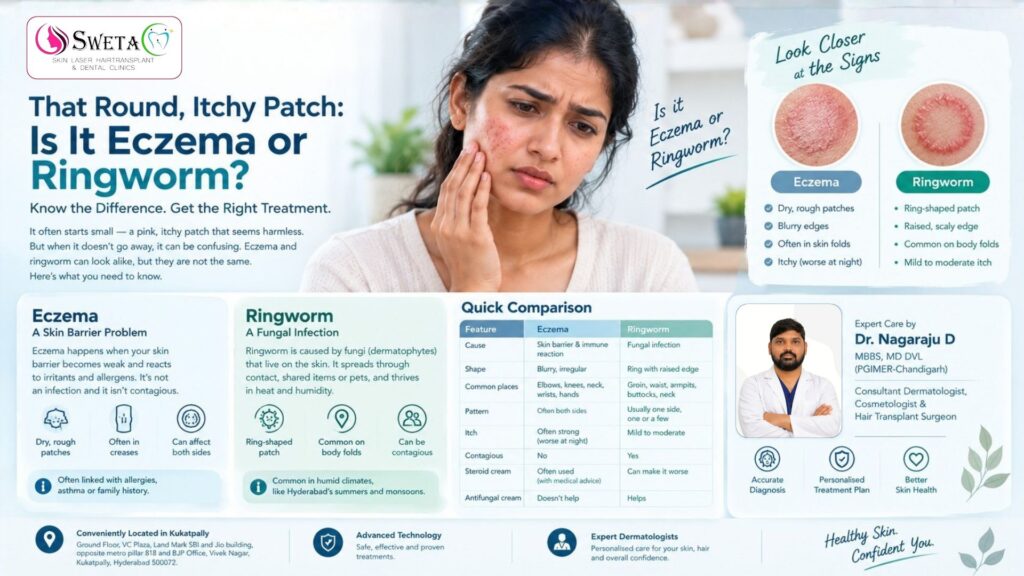
Eczema vs Ringworm: What’s Going On in the Skin
Eczema is mainly a skin barrier problem. Take atopic dermatitis, the most common type. According to StatPearls, the skin barrier is defective, so the skin dries out and reacts quickly to irritants and allergens. The result is inflammation and itch. No germ is behind it, so eczema isn’t contagious. It also often runs in families, alongside asthma or hay fever.
Ringworm is an infection. A group of fungi called dermatophytes feeds on the top layer of the skin. On the body, doctors call it tinea corporis. Heat, humidity and tight clothes help it thrive, which makes Hyderabad’s summers and monsoons a friendly setting. Also, it spreads through skin contact, shared towels and clothes, and sometimes pets.
So one is an overreaction inside the skin. The other is an invader on top of it. That’s why the same cream can’t fix both.
What Ringworm Usually Looks Like
The classic sign is a ring. Its edge is raised, scaly and reddish, while the centre often looks flatter and clearer. Over a few weeks, the patch slowly grows outward. Itching is common, though it’s often mild at first.
Ringworm likes warm, sweaty places. For example, the groin, buttocks, waist, armpits, under the breasts and the neck are common spots. You may see one patch or a few. They usually don’t appear in matching pairs on both sides.
Still, not every patch is a neat circle. Scratching smudges the shape. In addition, some patches join up into wavy outlines. So the ring is a useful clue, but its absence doesn’t rule ringworm out.
What Eczema Usually Looks Like
Eczema rarely makes a clean ring. The patches are dry, rough and itchy, with blurry edges that fade into normal skin. On lighter skin they look red or pink. On brown skin they often look darker, purplish or greyish instead, which is easy to miss.
Location says a lot. For instance, eczema favours the creases of the elbows, the backs of the knees, the neck, the wrists and the hands. It often appears on both sides of the body. Also, years of scratching can thicken the skin and make it leathery. During a bad flare, however, some patches ooze or crust.
The itch tends to peak at night. Many people also notice flares with sweat, dust, harsh soaps, wool or stress. In addition, a long history of dry skin or allergies is another hint.
Then there’s nummular eczema. It forms round, coin-shaped patches, which makes it the best ringworm lookalike of all.
Quick Comparison
| Ringworm | Eczema | |
|---|---|---|
| Cause | Fungal infection | Skin barrier and immune overreaction |
| Shape | Ring with a raised, scaly edge | Dry patches with blurry edges (coin-shaped in nummular eczema) |
| Common places | Groin, waist, buttocks, armpits, neck | Elbow and knee creases, neck, wrists, hands |
| Pattern | Often one side, one or a few patches | Often both sides |
| Itch | Mild to moderate | Often strong, worse at night |
| Contagious | Yes | No |
| Typical background | Sweat, humidity, contact with an infected person or pet | Dry skin, allergies, asthma, family history |
| Course | Keeps spreading until treated | Comes and goes in flares |
| Antifungal cream | Helps | Doesn’t help |
| Steroid cream | Can make it worse | Often used under medical supervision |
Why These Two Get Mixed Up
Both itch, and both scale. On top of that, each can look red and angry. Also, nummular eczema is round, and a scratched ringworm patch can lose its ring. So even doctors sometimes need a closer look.
But the biggest reason for the mix-up happens before anyone sees a doctor. It’s the cream.
The Steroid Cream Trap
Many creams on pharmacy shelves mix a steroid with an antifungal or an antibiotic. Steroids calm redness and itch fast. So when the patch is ringworm, the cream seems to work. As a result, the itch drops, the redness fades, and you feel relieved.
Underneath, though, the steroid quiets the skin’s local defences. Meanwhile, the fungus keeps spreading. The ring turns blurry, the patch grows, and small bumps may appear. Doctors call this tinea incognito, which means ringworm in disguise. A published review of tinea corporis notes that the diagnosis gets harder after earlier use of corticosteroids and similar creams.
Steroids used for too long bring their own trouble. The skin can thin, stretch marks can form, and acne-like bumps can appear. Also, the patch often flares again as soon as you stop.
Here’s a practical tip. Keep the tube, and bring it to your appointment, because the label tells the doctor a lot. And please don’t reuse an old cream on a new patch, even if it looks similar.
Is It Contagious?
Ringworm is. It passes through direct skin contact and through shared towels, clothes, combs and bedding. Cats and dogs can carry it too, and children catch it often. Eczema, on the other hand, isn’t contagious. You can’t pick it up from a hug or a shared towel.
If you suspect ringworm, a few habits protect the people around you. First, use your own towel. Then wash clothes and bedsheets regularly, and dry them fully. Finally, check family members and pets for similar patches.
How a Dermatologist Tells Them Apart
It starts with a conversation and a close look. Where is the patch, and how long has it been there? Is the itch worse at night? Does anyone at home have something similar? Do you have pets? And what have you applied so far?
For many patients, that’s enough. As StatPearls notes, ringworm is usually diagnosed from history and examination. When the picture is unclear, the doctor may gently scrape a little scale from the edge of the patch. Then they check it under a microscope with a special solution. It takes a few minutes and doesn’t hurt. A culture or a tiny skin sample is rarely needed, though.
How Ringworm Is Treated
Ringworm is usually treated with antifungal creams. For a single small patch, the course typically runs about two to three weeks. Finish the full course even when the itch fades, because stopping early is a common reason for relapse.
Wider or stubborn infections, however, may need tablets. These need a doctor’s review first, since they can interact with other medicines.
Daily habits matter just as much. Wear loose cotton clothes. Change out of sweaty ones quickly. Dry skin folds well after a bath. Don’t share towels, and wash clothes in hot water when you can. Otherwise, the fungus can find its way back.
How Eczema Is Managed
Eczema is a long-term condition, so the goal is control, not a one-time fix. First, moisturiser is the foundation. Apply it generously, ideally within a few minutes of a bath, and again through the day. Take lukewarm showers instead of hot ones. Also, choose mild, fragrance-free cleansers.
It also helps to learn your triggers. For some people it’s a particular soap or wool. For others it’s sweat, dust or a stressful week. So a simple diary can reveal the pattern.
During a flare, doctors may prescribe anti-inflammatory creams for a short time. The strength, the site and the duration all matter, so follow the plan exactly. Keep your nails short, too. Besides, newer treatments exist for stubborn eczema, and your dermatologist can tell you whether they suit you.
Hyderabad’s Weather and Your Skin
Climate plays a bigger role than most people realise. In summer, sweat collects in skin folds and under tight clothes, and that’s exactly where ringworm likes to settle. During the monsoon, damp clothes and towels that never fully dry add to the problem. So drying clothes properly and changing out of wet ones quickly both help.
Eczema reacts differently. Air-conditioned rooms and cooler winter air pull moisture out of the skin, and dry skin flares more easily. Hot showers do the same. Therefore, moisturising more often in AC offices and in winter makes a real difference.
The same person can face both problems in a single year. For example, someone with eczema may flare in winter and pick up a fungal infection in the humid months. That’s one more reason to have every new patch looked at, rather than assume it’s “the usual”.
Ringworm and Eczema in Children and Pets
Children get both conditions often. According to StatPearls, ringworm of the body is among the most common fungal infections in children before puberty. They pick it up from classmates, playmates and pets. Eczema, meanwhile, often begins in infancy. Many children see it ease as they grow older, although some carry it into adulthood.
Two cautions apply. First, never use an adult’s cream on a child without medical advice, because children’s skin absorbs medicines more readily. Second, if a pet has bald or scaly spots, take it to a vet. Otherwise, the infection can pass back and forth between pet and family.
When Both Show Up Together
It does happen. Eczema-prone skin breaks easily, so infections find a way in. A patch that suddenly oozes, crusts or hurts may have a bacterial or fungal infection on top.
The scalp is trickier still. Dandruff, scalp psoriasis and fungal infections can all flake. Our dandruff treatment guide shows what ordinary dandruff looks like, and our article on scalp psoriasis vs dandruff covers the other common lookalike.
Common Myths About Rashes
“Ringworm only happens to people who are unclean.” Not true. Sweat, humidity, tight clothing and close contact matter more than how often you bathe. In fact, over-washing can irritate the skin.
“If a cream worked once, it will work again.” Different patches can have different causes. A cream that calmed one rash may worsen another.
“Steroid creams are always harmful.” Not quite. Doctors prescribe them for eczema, and they’re safe when used in the right strength, place and time. The trouble starts when people use them without a diagnosis, or for too long.
“Eczema is just dry skin.” Dry skin is part of it, but the immune system plays a role too. So moisturiser alone often isn’t enough during a flare.
“Home remedies are harmless.” Lemon, raw garlic and toothpaste can burn or irritate the skin, especially when it’s already broken. They can also leave dark marks.
“Ringworm is gone once the itch stops.” The itch often fades before the fungus clears. So finish the course your doctor gave you.
When to See a Dermatologist
Consider a visit if any of these sound like you:
- The patch hasn’t improved after two weeks of proper treatment.
- It’s spreading, or new patches keep appearing.
- You’ve been using a combination cream for a while.
- The skin is painful, oozing, or showing pus.
- The patch is on your face, scalp or groin.
- It keeps coming back.
- You have diabetes, or a child has the patch.
Skin Evaluation at Sweta Clinics
Sweta Clinics in Kukatpally is a multi-specialty skin, hair, laser, and dental centre. For skin rashes, the evaluation starts with your history and a close look at the patch. Tests are advised only when they’re needed.
The evaluation is led by Dr. Nagaraju D, MBBS, MD (DVL), PGIMER. The clinic is easily reached from KPHB, Miyapur, Nizampet, Pragathi Nagar, Chandanagar, Madhapur, and Hitech City.
Frequently Asked Questions
1. Can ringworm look like eczema?
Yes. Scratched or steroid-treated ringworm can lose its ring shape and look like a dry, irritated patch. That’s why a proper examination matters.
2. Can I use an antifungal cream on eczema?
It won’t help, because eczema isn’t caused by fungus. It may also irritate the skin. Get the patch checked first.
3. Will ringworm go away on its own?
It rarely clears completely without treatment. Meanwhile, it can spread to other areas and to other people.
4. Is ringworm caused by worms?
No. The name comes from the ring-shaped rash. A fungus causes it.
5. Can eczema turn into ringworm?
No. They are separate conditions. However, someone can have both at the same time.
6. Is eczema curable?
Eczema is usually a long-term condition that comes and goes. However, with the right care, many people keep it well controlled for long stretches.
7. Where can I get a rash diagnosed in Kukatpally?
Sweta Clinics offers dermatologist-led evaluation for skin rashes. It serves patients across KPHB, Miyapur, Nizampet, and nearby areas.
8. Does ringworm leave dark marks?
Sometimes. After the infection clears, the skin may stay darker for a while, especially on brown skin. This usually fades slowly over time.
9. Can stress make eczema worse?
Yes. Stress is a common trigger for flares in many people. Good sleep and stress management help alongside medical care.
10. Can I go to work or school with ringworm?
Mild cases usually don’t need time off. However, keep the patch covered, avoid sharing towels, and start treatment early. Ask your doctor about swimming and contact sports.
Get the Diagnosis First, Then Pick the Cream
A round, itchy patch deserves a proper look before another tube goes on it. Ringworm needs an antifungal, while eczema needs barrier care and, sometimes, a carefully used steroid. Mixing them up costs time, and sometimes it costs skin too.
Medically reviewed by: Dr. Nagaraju D, MBBS, MD (DVL), PGIMER. Registered with [Andhra Pradhesh State Medical Council], Registration No. [77603].
This article is for general education. It does not replace a medical consultation.
📞 Appointments: 7032037373 / 8790418480
🌐 Website: swetaclinics.com
📍 Address: Ground Floor, VC Plaza, SBI and Jio building, opposite metro pillar 818 and BJP Office, Vivek Nagar, Kukatpally, HYD, 500072