Ketoconazole, zinc pyrithione, coal tar, that one ayurvedic brand your colleague swore by. You’ve tried the rotation most people recommend for stubborn dandruff. For a while, each one seemed to help a little. Then the flaking came right back. Sometimes it returned thicker than before. Other times the patches felt raised under your fingers, not just flaky on the surface.
Here’s a question worth asking honestly: is this actually dandruff? A surprising number of people treating “dandruff” that won’t quit are dealing with something related but genuinely different. Anti-dandruff shampoo was never going to fully fix it, no matter how many brands you rotate through.
Why This Confusion Happens So Often
Dandruff and scalp psoriasis sit on a spectrum of related scalp conditions. That’s exactly why they get mixed up constantly, even by people who’ve dealt with flaking for years. Both cause visible scale, and both can itch. Each one also tends to worsen with stress and weather changes. This overlap is real. It’s why most people reach for the same shampoo, whichever condition they have.
The difference isn’t in how annoying it feels. It’s in what’s happening at the skin level. That changes which treatment will work.
The Quick Checklist: Which One Fits You Better?
Dandruff and scalp psoriasis look similar at a glance, but they behave differently once you know what to look for.
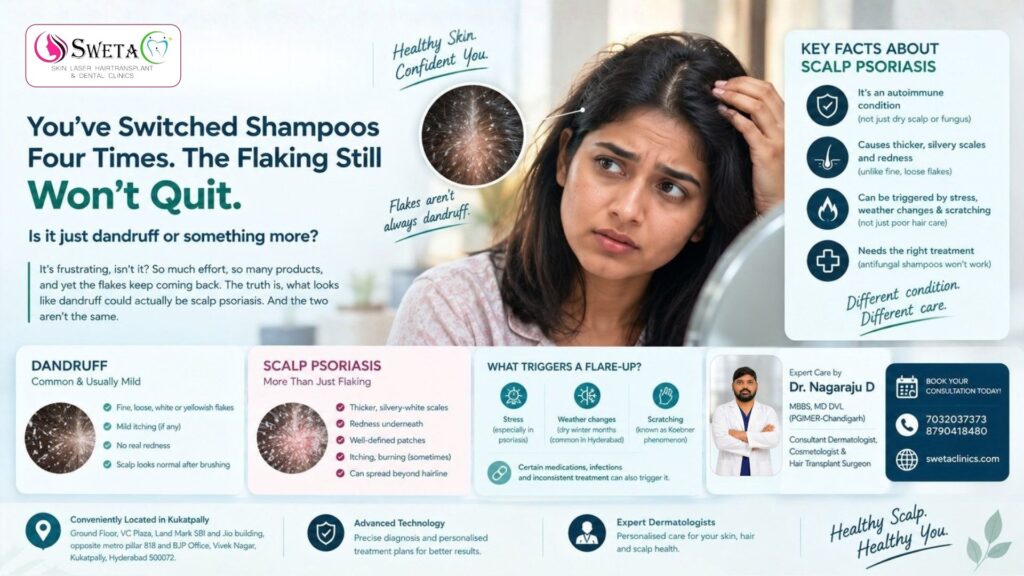
Dandruff usually means: fine, loose, white or yellowish flakes that shed easily. Mild itching, if any. No real redness underneath. The scalp looks basically normal once you brush the flakes away. A recent study on dandruff’s biology confirmed this directly. Dandruff shows scaling but lacks the visible inflammation seen in more serious scalp conditions.
Scalp psoriasis usually means: thicker, drier, silvery-white scales that stick to the scalp rather than shedding freely. Noticeable redness underneath once you part the hair. Patches with clearly defined edges, almost like someone drew a border around them. Itching that ranges from mild to genuinely uncomfortable, sometimes with a burning sensation. It can also extend slightly past the hairline onto the forehead or behind the ears.
If you’re nodding along to the second list more than the first, that’s worth taking seriously rather than buying a fifth shampoo.
What Actually Triggers a Flare-Up
Both conditions share some triggers, which adds to the confusion. Psoriasis, though, tends to respond more dramatically to certain factors. Stress is a well-documented trigger for psoriasis flares specifically, often more so than for ordinary dandruff. Weather shifts matter too. Many patients in Hyderabad notice their scalp psoriasis worsens during the dry winter months. It tends to ease once humidity returns.
Scratching makes both conditions worse. With psoriasis specifically, it does something called the Koebner phenomenon. Physical trauma to the skin can actually trigger new patches to form at the site of injury. This is one more reason aggressive scratching or picking at scale tends to backfire, however tempting it feels in the moment.
Certain medications, infections, and even skipping treatment inconsistently can trigger flare cycles as well. This is why a dermatologist asks about your health history, not just how your scalp looks that day.
Why This Distinction Actually Matters
Scalp psoriasis isn’t a worse version of dandruff. It’s a different condition entirely. Psoriasis is a chronic, immune-driven condition that happens to show up on the scalp. In India, it accounts for a meaningful share of dermatology visits. Anti-dandruff shampoos target fungus and oil, the usual drivers of ordinary dandruff. They simply aren’t built to calm an immune-driven process. That’s exactly why they stop working the way you’d expect.
Treating scalp psoriasis like stubborn dandruff doesn’t just waste time. It can leave the condition untreated for months. A dermatologist could often identify it in a single visit.
What Actually Treats Scalp Psoriasis
Dermatologists typically approach scalp psoriasis in stages, starting gentler and escalating only if needed.
Medicated shampoos built for psoriasis specifically often contain coal tar or salicylic acid. They help loosen thick scale and calm surface inflammation as a first step. From there, topical treatments like vitamin D derivatives or prescription corticosteroid solutions target the underlying inflammation directly. An ordinary anti-dandruff formula was never designed to do that. According to IJDVL’s review of scalp psoriasis management, combination treatments tend to outperform single ones. These pair a corticosteroid with a vitamin D derivative.
For extensive or stubborn cases, dermatologists may add systemic treatment. It manages the condition from within, so you don’t depend on topical products forever. Treatment also isn’t a one-time fix. Because psoriasis is chronic, most patients move to a maintenance routine once the flare clears. Lighter treatment keeps it under control long-term.
It’s Not Just a Scalp Thing
One more reason this is worth getting checked properly: psoriasis can affect more than the scalp. You might also notice similar patches on your elbows, knees, or lower back. A family history of psoriasis matters too, since that context changes how your dermatologist approaches treatment. Sometimes the scalp is the first place it appears. That makes early, accurate diagnosis useful beyond comfort.
Living With It Day to Day
Managing scalp psoriasis isn’t only about prescriptions. A few habits support whatever treatment your dermatologist recommends. Gentle hair handling matters, since vigorous towel-drying or rough brushing can irritate already-inflamed skin. Loosening scale gradually, rather than picking it off in one go, avoids triggering the Koebner response mentioned earlier. Keeping a simple record of your triggers helps too. Note whether a flare followed a stressful week or a change in weather. Share that pattern with your dermatologist so they can fine-tune your plan.
Getting the Right Diagnosis at Sweta Clinics
At Sweta Clinics in Kukatpally, we start by actually examining the scalp rather than assuming based on symptoms alone. Dr. Nagaraju D (MBBS, MD DVL, PGIMER) leads this evaluation. He has over 10 years of experience telling scalp psoriasis apart from dandruff, seborrheic dermatitis, and other look-alike conditions.
If your flaking turns out to be stubborn dandruff, our dedicated dandruff treatment guide covers it in depth. You can also see real patient scalp and hair results on our Instagram page. Our YouTube channel also has patient experiences and procedure walkthroughs. They show what treatment looks like before you book.
Sweta Clinics is a multi-specialty skin, hair, laser, and dental centre. It’s easily reached from KPHB, Miyapur, Nizampet, Pragathi Nagar, Chandanagar, Madhapur, and Hitech City.
Frequently Asked Questions
1. Can scalp psoriasis be cured completely?
It’s a chronic condition that’s managed rather than permanently cured, similar to psoriasis elsewhere on the body. Good treatment keeps it well-controlled for long stretches, often with minimal visible symptoms.
2. Why did my anti-dandruff shampoo stop working?
If it worked briefly then stopped, the underlying issue may not be ordinary dandruff at all. This pattern, temporary relief followed by return, is one of the clearest signs worth getting checked.
3. Is scalp psoriasis contagious?
No. It’s an immune-driven condition, not an infection, so it can’t spread to other people through contact, shared combs, or towels.
4. Does scalp psoriasis cause hair loss?
Scratching and inflammation can contribute to temporary shedding in affected areas, though hair typically regrows once the condition is controlled. Hair loss from psoriasis itself, without scratching, is uncommon.
5. Does diet affect scalp psoriasis?
There’s no single proven diet that cures psoriasis, but some patients notice their flares correlate with specific foods or alcohol. Tracking your own pattern is more useful than following a generic diet plan.
6. How long does it take to see improvement with treatment?
Many patients notice less scaling and itching within two to four weeks of starting the right treatment. Full control of a flare can take longer, depending on severity.
7. Where can I get this properly diagnosed in Kukatpally?
Sweta Clinics offers dermatologist-led diagnosis for scalp psoriasis and dandruff, serving patients across KPHB, Miyapur, Nizampet, and nearby areas.
Stop Guessing With the Next Shampoo
If you’ve tried the usual dandruff rotation and nothing’s holding, get an actual diagnosis instead of buying a sixth bottle. The right treatment depends on which condition you have. A shampoo aisle can’t tell you that.
📞 Call us: 7032037373 / 8790418480
🌐 Visit: swetaclinics.com
📍 Location: Ground Floor, VC Plaza, SBI and Jio building, opposite metro pillar 818 and BJP Office, Vivek Nagar, Kukatpally, HYD, 500072