
It’s a specific kind of unsettling. You’re nowhere near the age you associated with grey hair growing up, and yet here you are, parting your hair differently in the mirror to check if there are more. Someone probably told you to just pluck it. Someone else probably told you plucking makes it worse. At this point, you don’t know who to believe, and you’d genuinely like a straight answer.
So here’s one. Premature greying, called canities in dermatology, has a real, specific definition in Indian patients: hair turning grey before the age of 25. Multiple things can cause it, some you can influence and some you genuinely can’t, and knowing the difference matters more than any home remedy you’ve tried so far.
Let’s go through what’s actually true, starting with the myths everyone’s heard.
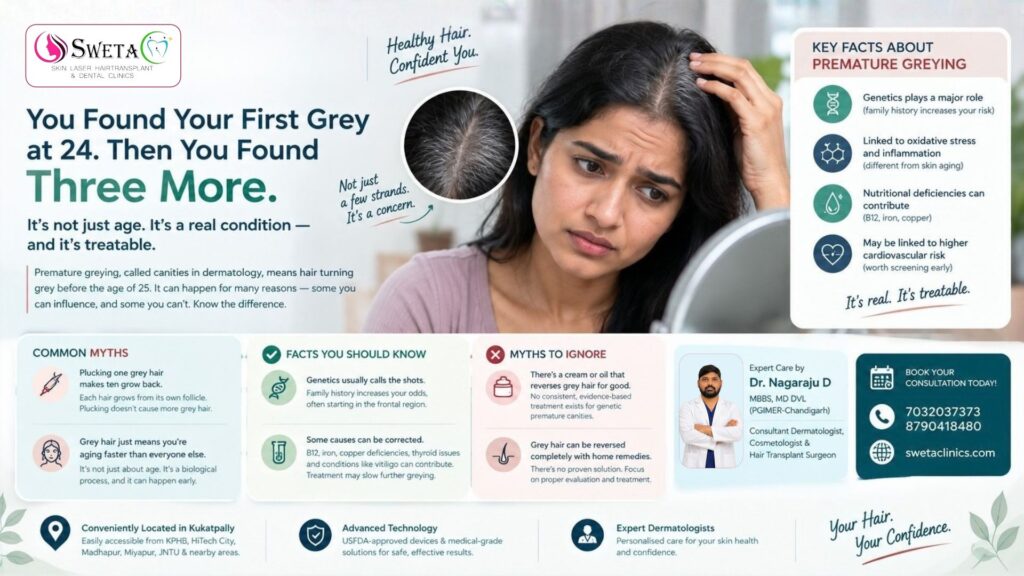
Myth: Plucking One Grey Hair Makes Ten Grow Back
This one refuses to die, and it makes no biological sense when you actually look at it. Each hair grows from its own individual follicle. Plucking a hair from one follicle has zero effect on the follicles around it, so new grey hairs appearing nearby are a coincidence of timing, not cause and effect.
The real downside of plucking isn’t regrowth math. Repeated plucking from the same spot can damage the follicle over time, occasionally leading to scarring or thinning in that exact area. It’s a cosmetic habit worth dropping for a different reason than the one you’ve heard.
Myth: Grey Hair Just Means You’re Aging Faster Than Everyone Else
Not quite, and this is actually one of the more interesting parts of the biology. Greying happens when melanocyte stem cells, the pigment-producing cells at the base of your hair follicle, gradually deplete. According to Indian Journal of Dermatology, Venereology and Leprology research, this process runs on oxidative stress and inflammation, a biological pathway that’s distinct from how your skin ages.
In other words, your hair’s “clock” and your skin’s “clock” aren’t the same clock. Plenty of people grey early while their skin shows no comparable signs of ageing, and the reverse happens too.
Fact: Genetics Usually Calls the Shots
If a parent or grandparent greyed early, your odds climb significantly. An IJDVL study on Indian patients with premature canities found a strong family history pattern, with greying most often starting in the frontal region first. If this sounds like your situation, genetics is very likely your main driver, and that’s worth knowing before you spend money chasing a “fix.”
Fact: A Few Specific, Correctable Causes Do Exist
Here’s where it gets genuinely useful. Vitamin B12 deficiency, low iron, and low copper levels have all been linked to premature greying in Indian patients. Thyroid disorders and conditions like vitiligo also show up more often in people with early greying than in the general population.
This is the one category where “treatment” means something real. Correcting an actual deficiency, through diet or supplementation guided by blood work, can sometimes slow further greying, and in cases where the cause was purely nutritional, occasionally allow some natural colour to return. This only works when a real, identifiable deficiency exists, which is exactly why guessing at supplements without testing rarely helps.
Myth: There’s a Cream or Oil That Reverses Grey Hair for Good
This is the one worth being honest about, even though it’s not what most product ads want you to hear. The IJDVL has been direct on this point: despite extensive research into the biology of greying, no consistently effective, evidence-based treatment currently exists for genetic premature canities. Reports of hair “repigmenting” are largely anecdotal and haven’t held up across repeated studies.
This doesn’t mean nothing can help. It means the honest starting point is ruling out correctable causes first, rather than buying into a product that promises to reverse something genetics is driving.
A Finding Worth Taking Seriously
Here’s something most people haven’t heard, and it’s genuinely important. IJDVL research has found abnormalities in cardiovascular risk markers among patients with premature canities, and the researchers specifically recommend screening and counselling for cardiovascular risk in people who grey early. Premature greying isn’t just a cosmetic concern. For some patients, it’s worth mentioning to a doctor as part of a broader health picture, not only a hair one.
So What Should You Actually Do About It?
Start with a proper evaluation rather than a product. A dermatologist can check for the correctable causes, B12, iron, thyroid, and rule out associated conditions, before you spend time and money on anything else.
If no correctable cause turns up, your options shift toward management rather than reversal: quality hair colour or henna for camouflage, gentle hair care to protect existing pigment, and addressing any related health screening your results suggest.
When It’s Worth Getting Checked
A few situations are worth a proper look rather than waiting it out:
- Greying that started well before 25, especially with a family history that doesn’t quite match the timing
- Greying alongside fatigue, pale skin, or other signs that could point to anaemia or B12 deficiency
- Patchy or unusual greying patterns, rather than gradual, even greying
- Greying in a child or teenager, which always warrants a proper look rather than assumption
Getting Evaluated at Sweta Clinics
At Sweta Clinics in Kukatpally, a premature greying consultation starts with understanding your specific pattern and family history, followed by relevant blood work where it’s genuinely indicated. Dr. Nagaraju D (MBBS, MD DVL, PGIMER) leads this evaluation, bringing over 10 years of experience in diagnosing hair and scalp conditions across Kukatpally and the surrounding areas.
We’ll tell you honestly if your greying looks purely genetic, since that’s not something a cream reverses, and we’ll flag it clearly if your pattern suggests something worth testing for instead. If hair thinning is part of your concern alongside the greying, our general hair fall treatment guide covers that separate category of causes.
Sweta Clinics is a multi-specialty skin, hair, laser, and dental centre, easily reached from KPHB, Miyapur, Nizampet, Pragathi Nagar, Chandanagar, Madhapur, and Hitech City.
Quick Answers
Can grey hair really turn black again? Rarely, and only when a correctable cause like a vitamin deficiency was behind it. Genetic greying generally doesn’t reverse.
Is stress actually a cause? Chronic stress contributes to the same oxidative pathways involved in greying, but it’s rarely the sole cause. Genetics usually plays the bigger role.
Should I get blood tests done even if I think it’s genetic? It’s worth ruling out correctable causes at least once, especially if your family history doesn’t clearly explain the timing.
Does plucking grey hair actually cause more greys? No. It can damage the follicle over time with repeated plucking, but it doesn’t trigger greying in nearby hairs.
Where can I get this properly evaluated in Kukatpally? Sweta Clinics offers dermatologist-led evaluation for premature greying, serving patients across KPHB, Miyapur, Nizampet, and nearby areas.
The Straight Answer You Were Looking For
Grey hair in your twenties or thirties isn’t automatically something wrong with you, but it’s also not something to guess about. A proper evaluation tells you which category you’re actually in, genetic, correctable, or worth a broader health check, and that’s a far better starting point than another product.
📞 Call us: 7032037373 / 8790418480 🌐 Visit: swetaclinics.com 📍 Location: Ground Floor, VC Plaza, SBI and Jio building, opposite metro pillar 818 and BJP Office, Vivek Nagar, Kukatpally, HYD, 500072