
There’s no story behind it. You didn’t pull your hair tight, and you didn’t use a new product. Nobody pointed it out until a friend noticed, or you caught it in a mirror by accident. A smooth, perfectly round patch, completely bare, sitting somewhere on your scalp that was full of hair just days ago.
This kind of hair loss confuses people precisely because it breaks the usual rules. It isn’t gradual, and it isn’t thinning. There’s no slow retreat here, the kind you’d expect from ageing or genetics. One day it’s simply there, and the suddenness is often what frightens people more than the patch itself.
Here’s the reassuring part first: this is a recognised, well-studied condition. It has a name, alopecia areata, and dermatologists understand its pattern far better than its sudden appearance might suggest.
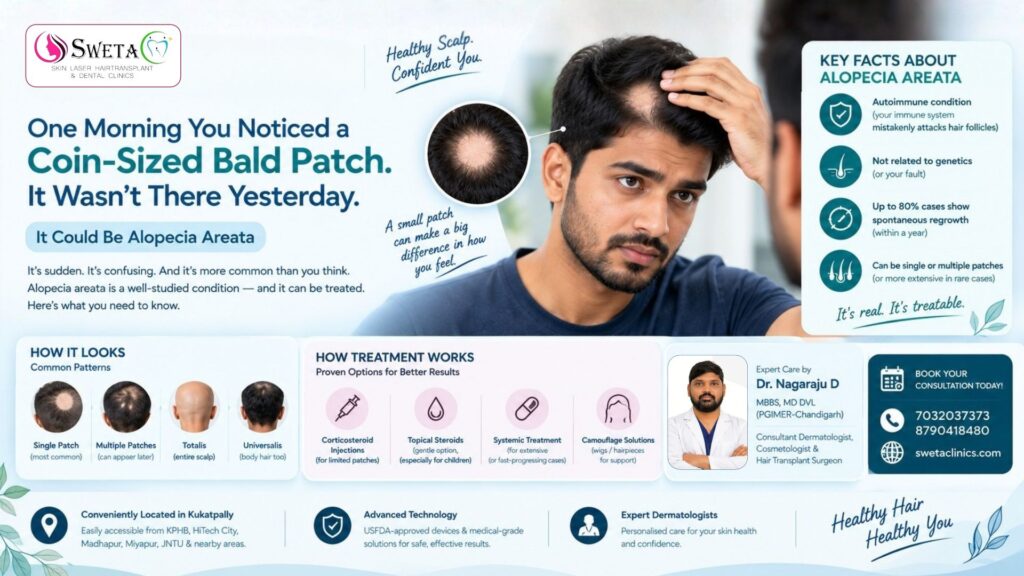
This Isn’t Pattern Baldness, and It Isn’t Your Fault
Alopecia areata is an autoimmune condition. Your immune system, usually focused on fighting infection, mistakenly targets your hair follicles instead. It doesn’t damage the follicle permanently in most cases. It simply pauses hair growth at that spot, which is why the patch appears smooth rather than scarred or scabbed.
This is a completely different mechanism from androgenetic alopecia, the gradual, hormone-driven thinning most people associate with “going bald.” Nothing about your lifestyle caused this patch. Nothing you did triggered it, and nothing you’re currently doing wrong is making it worse.
The Unpredictable Part Is Actually Common Knowledge Among Dermatologists
Here’s something genuinely useful to know early: according to the Indian Journal of Dermatology, Venereology and Leprology, spontaneous regrowth happens in up to 80% of limited alopecia areata cases within a year, even without treatment. That statistic surprises most patients, because the patch feels alarming in the moment.
This doesn’t mean treatment is pointless. Treatment speeds up regrowth considerably and reduces the emotional toll of waiting it out. But it does mean a single patch isn’t automatically a sign of something severe or permanent.
When It’s More Than Just One Patch
Alopecia areata can show up differently from person to person. Some people get one patch that resolves and never returns. Others develop multiple patches, or patches that merge into larger areas. In rarer cases, it progresses to alopecia totalis, complete scalp hair loss, or alopecia universalis, affecting hair across the entire body.
The IJDVL notes that routine blood tests usually aren’t necessary for typical, limited cases. Thyroid screening becomes relevant mainly in long-standing cases, in women with persistent patches, or when symptoms suggest a thyroid condition alongside the hair loss. This is exactly the kind of judgment call a dermatologist makes after actually examining your specific pattern, not something to self-diagnose from a symptom list online.
How Treatment Actually Works
Corticosteroids form the backbone of alopecia areata treatment. Dermatologists choose the form based on your age and how much scalp the condition involves.
For limited patches, intralesional corticosteroid injections directly into the affected area often work well, sometimes showing visible regrowth within weeks. Topical corticosteroids serve as a gentler first option, particularly in young children who may not tolerate injections comfortably. The IADVL’s pediatric dermatology guidelines specifically recommend topical therapy as the first-line approach in children, moving to combination treatment if needed, and reserving systemic therapy for more extensive cases.
For rapidly progressing or extensive alopecia areata, affecting more than 30% of the scalp, dermatologists sometimes use systemic treatment to bring the immune response under control faster. This decision depends heavily on how quickly the condition is spreading and how much scalp involvement you’re dealing with.
For patients with long-standing, treatment-resistant patches, camouflage options like wigs or hairpieces offer a practical, dignified option while other treatment continues in the background.
Why Seeing a Dermatologist Early Still Matters
Even with that reassuring 80% spontaneous remission statistic, waiting without any evaluation isn’t the ideal approach. A few things genuinely benefit from early professional input:
- Confirming it’s actually alopecia areata, and not a fungal scalp infection or another condition with a similar appearance
- Starting treatment that measurably speeds up regrowth, rather than just hoping for the best
- Catching early signs of progression toward more extensive involvement
- Getting guidance on realistic expectations, since the emotional weight of patchy hair loss is real and worth addressing directly
Getting Evaluated at Sweta Clinics
At Sweta Clinics in Kukatpally, an alopecia areata consultation starts with a scalp examination. We confirm the diagnosis and assess how much area the condition covers. Dr. Nagaraju D (MBBS, MD DVL, PGIMER) leads this evaluation, bringing over 10 years of experience diagnosing and managing autoimmune and inflammatory hair conditions across Kukatpally and the surrounding areas.
We tailor treatment to your specific pattern, your age, and how the condition has progressed so far. We never apply a single default protocol regardless of severity. If your hair loss doesn’t match this patchy pattern and looks more like gradual, overall thinning instead, our hair fall treatment guide covers that different category of causes in more depth.
Sweta Clinics is a multi-specialty skin, hair, laser, and dental centre in Kukatpally, easily reached from KPHB, Miyapur, Nizampet, Pragathi Nagar, Chandanagar, Madhapur, and Hitech City.
Quick Answers
Will my hair definitely grow back? For limited patches, the odds are genuinely good, with spontaneous regrowth common within a year. Treatment improves those odds further and speeds up the timeline.
Can alopecia areata come back after regrowing? Yes, it can recur, sometimes in the same spot or elsewhere. This is part of why ongoing monitoring matters even after a patch resolves.
Is this linked to stress? Stress is sometimes discussed as a possible trigger, but the underlying cause is autoimmune. It isn’t something you caused through stress alone.
Do I need blood tests to diagnose this? Usually not for typical, limited cases. Your dermatologist may suggest specific tests only if your pattern or history suggests a reason to look further.
Where can I get this evaluated in Kukatpally? Sweta Clinics offers dermatologist-led diagnosis and treatment for alopecia areata, serving patients across KPHB, Miyapur, Nizampet, and nearby areas.
Don’t Wait Out the Uncertainty Alone
A sudden bald patch is unsettling, but it’s also one of the more treatable, well-understood conditions in dermatology. Getting it properly diagnosed turns an alarming mystery into a manageable, time-bound plan.
📞 Call us: 7032037373 / 8790418480 🌐 Visit: swetaclinics.com 📍 Location: Ground Floor, VC Plaza, SBI and Jio building, opposite metro pillar 818 and BJP Office, Vivek Nagar, Kukatpally, HYD, 500072