Hair loss doesn’t just change how you look. It can quietly chip away at your confidence, day after day.
So you decide to do something about it. But then you hit a wall of options: serums, tablets, PRP, hair transplants, and clinics all claiming to have the “best” fix.
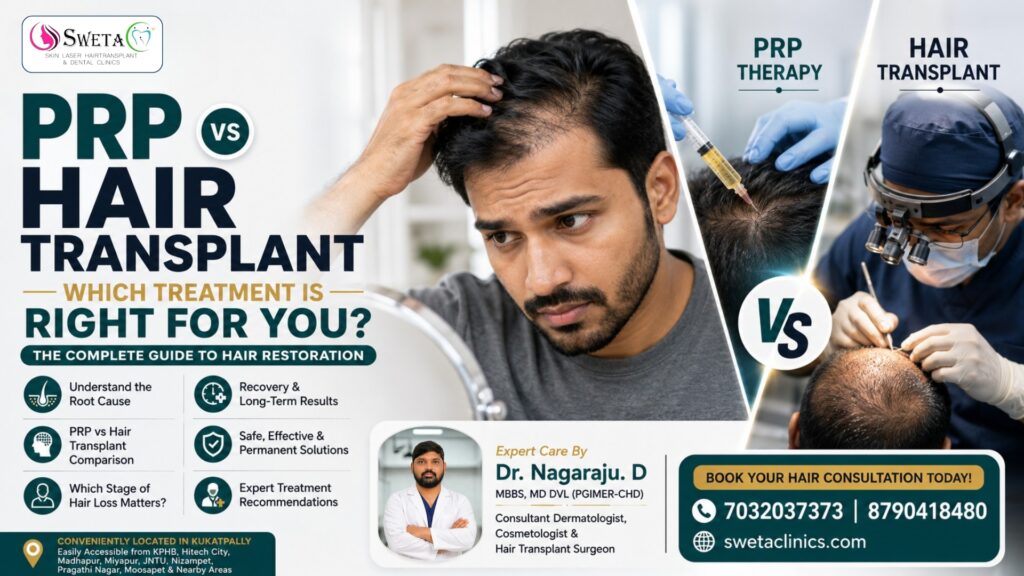
Two treatments come up again and again: PRP (Platelet-Rich Plasma) therapy and hair transplant surgery. Both are backed by real science. Both can genuinely help. But they work in very different ways, suit different stages of hair loss, and come with different costs and timelines.
At Sweta Clinics, Kukatpally, patients ask this question almost daily: “PRP or transplant, which one is right for me?” Under the care of Dr. Nagaraju D (MBBS, MD DVL — PGIMER, Chandigarh), Consultant Dermatologist, Cosmetologist & Hair Transplant Surgeon, every patient gets a proper scalp evaluation first as part of our hair loss treatment services. That’s because the honest answer almost always depends on one thing: how advanced your hair loss already is.
This guide breaks down what each treatment does, who it suits, what results to expect, and how to decide which path makes sense for you.
Understanding Hair Loss Before Choosing a Treatment
Before comparing treatments, it helps to understand what’s actually happening on your scalp.
Most hair loss follows a pattern. Gradual thinning at the crown. A receding hairline. This is called androgenetic alopecia, better known as male or female pattern baldness. It’s genetic. Over time, hair follicles become more sensitive to hormones and shrink, until they eventually stop producing visible hair.
Here’s the key detail: a follicle that has shrunk can often be revived. A follicle that has fully died cannot. This one fact separates PRP from hair transplant surgery, and it’s why the “right” treatment depends entirely on how far your hair loss has progressed.
What Is PRP Therapy for Hair Loss?
PRP therapy is a non-surgical, regenerative treatment. It uses your own blood to stimulate weakened hair follicles.
How PRP Works
- A small sample of your blood is drawn, much like a routine blood test.
- It’s spun in a centrifuge, which separates and concentrates the platelets — the components rich in growth factors.
- This concentrated plasma is injected directly into the thinning areas of your scalp.
According to the American Hair Loss Association, the growth factors in PRP encourage new blood vessel formation and cell growth around hair follicles. This can extend the hair’s active growth phase and calm scalp inflammation. In simple terms, PRP doesn’t create new follicles. It wakes up and strengthens follicles that are still alive but underperforming.
What to Expect from PRP
- You’ll usually need an initial series of sessions, often monthly for the first few months, followed by periodic maintenance visits.
- Results build up gradually: less shedding, thicker-feeling hair, and better density in areas that still have living follicles.
- It’s a same-day, walk-in-walk-out procedure. Downtime is minimal, and most people return to normal activities right away.
- PRP works best in the early-to-moderate stage of hair loss. It’s also a great add-on treatment alongside a hair transplant.
Who PRP Is Best Suited For
- People in the early stages of thinning, where follicles are weakening but not yet dormant
- Anyone looking to slow down or stabilize ongoing hair loss
- People who aren’t ready for, or aren’t candidates for, surgery
- Transplant patients who want to strengthen their results
What Is a Hair Transplant?
A hair transplant is a surgical procedure. It moves healthy, permanently growing hair follicles from a donor area — usually the back or sides of the scalp — into thinning or bald areas.
Why the back and sides? That hair is genetically resistant to balding. And because transplanted follicles keep the genetic traits of the donor site, they continue growing in their new spot for life. This is called donor dominance.
The Two Main Techniques
FUE (Follicular Unit Extraction): Individual follicles are extracted one at a time using a small micro-punch tool, then implanted into the recipient area. According to the International Society of Hair Restoration Surgery (ISHRS), FUE now makes up the vast majority of hair transplants performed worldwide. Why? It doesn’t leave a linear scar, and recovery is shorter than older methods.
FUT (Follicular Unit Transplantation): A thin strip of scalp is surgically removed from the donor area. Individual follicular units are then dissected from it under a microscope before being implanted. FUT can yield more grafts in a single session, but it leaves a linear scar and needs a longer recovery.
What to Expect from a Hair Transplant
- It’s a surgical, one-time procedure, done under local anesthesia. Some patients choose a second session years later for extra density.
- Transplanted hair usually sheds within the first few weeks. This is normal. Regrowth follows gradually over the next several months.
- Final results are typically visible 9 to 12 months after the procedure.
- Because transplanted follicles resist the hormone-driven shrinking that caused the original hair loss, results are considered permanent.
- Expect some real recovery time: mild swelling or scabbing, and a higher upfront cost than PRP.
Who a Hair Transplant Is Best Suited For
- People with stable, advanced hair loss and clearly bald or heavily thinned areas
- Anyone who has already tried non-surgical treatments without enough results
- Those who want a permanent, one-time solution instead of ongoing maintenance
- Patients with a healthy, sufficient donor area at the back or sides of the scalp
PRP vs Hair Transplant: A Side-by-Side Comparison
| Factor | PRP Therapy | Hair Transplant |
|---|---|---|
| Type of treatment | Non-surgical, injection-based | Surgical procedure |
| Best for | Early-to-moderate thinning, weakened but living follicles | Advanced, stable bald patches or hairlines |
| Downtime | Minimal to none | A few days to a couple of weeks |
| Results timeline | Gradual, over several months of sessions | Gradual regrowth, full results in 9–12 months |
| Permanence | Needs ongoing maintenance sessions | Permanent, one-time procedure |
| Works on fully bald areas? | No — needs living follicles to work on | Yes — relocates active follicles into bald zones |
| Often paired with | Medication, post-transplant recovery | PRP (boosts graft survival and hair health) |
Can PRP and Hair Transplant Be Combined?
Yes. In many cases, combining both gives the best overall result.
More and more dermatologists now recommend PRP sessions before and after a hair transplant. Before surgery, PRP helps strengthen the scalp environment. Afterward, it supports faster healing and can improve the density of both the transplanted grafts and your existing natural hair.
This is where having one specialist, instead of separate providers, makes a real difference. Dr. Nagaraju D treats both dermatology cases and hair transplant surgeries. So treatment plans at Sweta Clinics aren’t built around a single technique — they’re built around what your scalp actually needs, whether that’s PRP alone, a transplant alone, or both together.
Which One Should You Choose?
There’s no universal “better” option. The right choice comes down to three things:
- Stage of hair loss. Early thinning usually responds well to PRP. Well-established bald patches usually need a transplant.
- Goals and timeline. Want a permanent, one-and-done result? A transplant makes more sense. Comfortable with periodic maintenance to slow progression? PRP may be enough.
- Donor hair availability. A transplant needs enough healthy donor hair. PRP doesn’t — it works with the follicles you already have.
The only reliable way to know where you stand is a proper scalp evaluation. This should include a close look at hair density, follicle miniaturization, and donor area health — not a guess based on how your hair loss looks in the mirror. You can book a scalp evaluation at Sweta Clinics to get a clear answer specific to your hair.
Why Consultation Matters More Than the Treatment Name
Here’s a common mistake: walking into a clinic already fixated on one treatment, without an actual diagnosis.
PRP won’t work on completely bald skin, since there are no living follicles left to stimulate. On the flip side, jumping straight to a transplant — when PRP or medical therapy could have preserved your existing hair — means having surgery earlier than necessary.
That’s exactly why the evaluation matters as much as the treatment itself. Dr. Nagaraju D’s background in dermatology, venereology, and leprosy (DVL) from PGIMER Chandigarh, combined with focused training in cosmetology and hair transplant surgery, supports a diagnosis-first approach. The type and stage of your hair loss come first. The treatment recommendation — PRP, transplant, or both — comes second.
Frequently Asked Questions (FAQs)
Is PRP painful?
Most patients feel mild discomfort during the injections, similar to small pinpricks. Topical numbing can help reduce this.
How many PRP sessions will I need?
This varies by individual. Most protocols start with monthly sessions, then move to maintenance treatments every few months.
Is a hair transplant permanent?
Yes. Transplanted follicles come from areas that are genetically resistant to hair loss. They keep growing in their new spot for life — this is the principle of donor dominance.
Does hair transplant surgery hurt?
The procedure uses local anesthesia, so you shouldn’t feel pain during surgery. Mild soreness or tightness afterward is normal.
Can women get PRP or hair transplants?
Yes. Both treatments work for female pattern hair loss too, though the exact plan may differ based on your specific pattern and cause of hair loss.
Will PRP work if I already have completely bald patches?
No. PRP needs living, even if weakened, follicles to work on. Fully bald areas with no active follicles usually need a hair transplant instead.
How do I know which treatment is right for me?
Book an in-person scalp and hair evaluation with a qualified dermatologist or hair transplant surgeon. They can assess your stage of hair loss and recommend PRP, a transplant, or a combined approach.
Book a Hair Loss Consultation at Sweta Clinics, Kukatpally
Noticing the first signs of thinning? Or have you been dealing with a receding hairline for years? Either way, the right treatment starts with an accurate diagnosis, not a guess.
Dr. Nagaraju D brings specialized dermatology training from PGIMER Chandigarh, along with focused expertise in cosmetology and hair transplant surgery. Both PRP therapy and surgical hair restoration are available under one roof at Sweta Clinics.
📍 Sweta Clinics Ground Floor, VC Plaza, Landmark: SBI and Jio Building, Opposite Metro Pillar 818 and BJP Office, Vivek Nagar, Kukatpally, Hyderabad – 500072 🌐 www.swetaclinics.com
Dr. Nagaraju D MBBS, MD DVL (PGIMER, Chandigarh) Consultant Dermatologist, Cosmetologist & Hair Transplant Surgeon
📞 Call or WhatsApp to book a consultation: +91 87904 18480 | +91 70320 37373
Don’t let uncertainty hold you back. Get a proper diagnosis and a treatment plan built around your hair, not a one-size-fits-all package. Schedule your consultation with Dr. Nagaraju D today.