
Shampoos didn’t work. Oils didn’t work either. Supplements didn’t move the needle.
That’s usually the point where the search changes to something more specific: “PRP hair treatment near me in Kukatpally.”
PRP has become one of the most talked-about options for hair thinning, and for good reason. It’s minimally invasive. It uses your own blood. And it has a growing body of research behind it.
But PRP isn’t magic. It isn’t right for every kind of hair loss either. Understanding what it actually does, and doesn’t do, helps you set realistic expectations before you start.
This guide is for anyone in Kukatpally, KPHB, or Madhapur trying to figure out whether PRP is worth considering for their hair fall.
What Is PRP Hair Treatment?
The Basic Idea
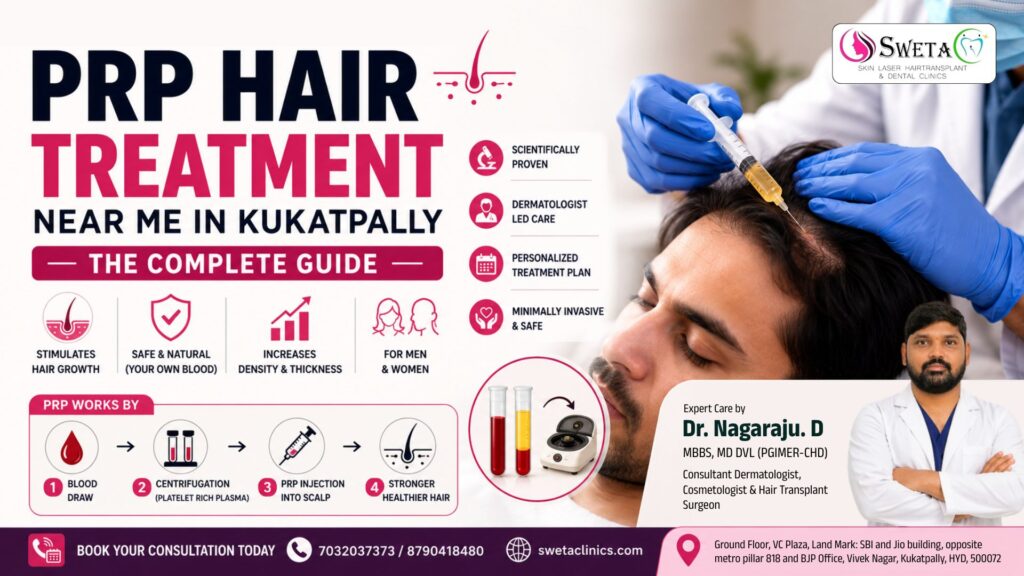
PRP stands for Platelet-Rich Plasma. We draw a small sample of your own blood, then spin it in a centrifuge to concentrate the platelets. We then inject that concentrated plasma into areas of the scalp where hair is thinning.
Why Platelets Matter
Platelets contain growth factors. These help stimulate cell activity and blood supply. In hair restoration, this is thought to support hair follicles that are still alive but underperforming, encouraging thicker, healthier growth.
Why It’s Considered Safe
PRP uses your own blood. So there’s no risk of an allergic reaction or disease transmission from an external product. That’s a big part of why it’s grown so popular as a hair loss treatment.
Does PRP Actually Work?
What the Research Shows
A comprehensive review published in PubMed Central looked closely at this question. Most studies showed a clear pattern: PRP effectively increases hair density and thickness. This held true specifically for patients with androgenetic alopecia, the most common type of genetic hair loss.
Results Can Vary
Outcomes depend on a few factors. PRP preparation method. Platelet concentration. How many sessions are done. A meta-analysis on PRP for women’s hair loss found the same thing: it effectively improves hair density and thickness. Results still vary with dosage and treatment protocol.
PRP Works Better in Combination
Several studies found something worth noting. Combining PRP with other treatments, like microneedling or topical minoxidil, improved results compared to PRP alone. This is often why dermatologists recommend PRP as part of a broader treatment plan, not a standalone fix.
Who Is a Good Candidate for PRP?
Best Suited For
PRP tends to work best for early-to-moderate hair thinning. This means follicles are still present and active, but producing weaker, finer hair than before.
Less Effective For
Areas of long-standing, complete hair loss don’t respond as well. Once follicles have gone dormant for years, there’s less active follicle activity left to stimulate.
Works for Both Men and Women
PRP is commonly used for androgenetic alopecia in men and female pattern hair loss in women. Research also shows it can help with certain cases of chronic telogen effluvium.
What Happens During a PRP Session
Step 1: Blood Draw
We draw a small amount of blood from your arm. It’s similar to a routine blood test.
Step 2: Centrifugation
We spin the blood in a centrifuge. This separates and concentrates the platelet-rich plasma from the rest of the blood components.
Step 3: Scalp Preparation
We often apply a topical numbing agent to the scalp beforehand. This helps minimise discomfort during the injections.
Step 4: Injection
We inject the concentrated PRP into the thinning areas of the scalp using a fine needle. Injections target the specific zones identified during your consultation.
Step 5: Aftercare
Most people can resume normal activities the same day. Your dermatologist may still advise avoiding hair washing or strenuous exercise for the first 24 hours.
What to Expect: Timeline and Results
How Many Sessions You’ll Need
PRP is typically done as a course of sessions. Often monthly for the first 3 to 4 sessions, followed by maintenance sessions every few months depending on your response.
When You’ll See Results
Hair growth is a slow process. Most people start noticing reduced shedding within 8 to 12 weeks. Visible improvements in density usually become clearer around the 4 to 6 month mark.
Is It Painful?
PRP involves a blood draw and scalp injections, which can cause mild discomfort. Topical numbing helps manage this. Most people describe it as tolerable rather than particularly painful.
Are There Side Effects?
PRP uses your own blood, so serious side effects are uncommon. Mild swelling, tenderness, or minor bruising at injection sites can occur, but this usually resolves within a day or two.
Common PRP Myths
“One Session Is Enough”
PRP works cumulatively. A single session rarely produces noticeable change. That’s why a proper protocol involves multiple sessions spaced weeks apart, followed by periodic maintenance.
“PRP Can Regrow Hair on a Bald Scalp”
PRP supports existing, active follicles. It can’t create new follicles where there are none left. That’s why it works best for thinning rather than areas of complete, long-standing baldness.
“PRP Alone Fixes Every Type of Hair Loss”
PRP is one tool among several. For hair loss driven by thyroid issues, nutritional deficiencies, or untreated scalp conditions, addressing the underlying cause matters just as much as the PRP itself.
“Any Clinic Offering PRP Gets the Same Results”
Preparation method and platelet concentration significantly affect outcomes. A dermatologist-led PRP protocol makes a real difference here. Done with proper technique and follow-up, it tends to produce more consistent results than a quick, unsupervised session.
Signs PRP Might Be the Right Next Step
- You’ve tried topical treatments or shampoos for several months without meaningful improvement
- Your hair thinning is in the early-to-moderate stage, with follicles still visibly present
- You’re looking for a minimally invasive option before considering surgical hair restoration
- A dermatologist has confirmed your hair loss type is one that generally responds well to PRP
A proper scalp evaluation is the best way to confirm whether PRP suits your specific case before starting. Trichoscopy, in particular, gives a clear picture of what’s happening beneath the surface.
How PRP Treatment Works at Sweta Clinics
Step 1: The Consultation
Every PRP journey starts with a detailed history and scalp examination. This confirms the type and stage of hair loss, since PRP isn’t the right fit for every case.
Step 2: Trichoscopy
A magnified scalp and follicle examination helps assess follicle density and health. This gives a clearer picture of how well PRP is likely to work for your specific pattern of thinning.
Step 3: Addressing Underlying Causes
Where relevant, we address contributing factors alongside PRP. This might mean thyroid imbalance, nutritional deficiency, or an active scalp condition. Treating the root cause improves overall results.
Step 4: The PRP Protocol
We plan a tailored course of PRP sessions based on your hair loss stage. This typically starts monthly, then moves to maintenance sessions as your scalp responds.
Step 5: Progress Tracking
Follow-up visits use photos and density assessments to track real progress over time. So the plan can be adjusted if results aren’t tracking as expected.
Home Care That Supports PRP Results
Quick checklist
- Avoid washing your hair for 24 hours after each session
- Skip strenuous exercise and excessive sweating on treatment days
- Avoid colouring or chemical treatments close to a PRP session
- Eat a balanced diet to support what PRP is trying to stimulate
- Stick to your session schedule, since consistency matters more than any single visit
Why Choose Sweta Clinics in Kukatpally for PRP
Sweta Clinics is a multi-specialty skin, hair, laser, and dental clinic in Kukatpally. It’s easily reached from KPHB, Hitech City, Madhapur, Miyapur, JNTU, Nizampet, Pragathi Nagar, and Moosapet.
Dr. Nagaraju D’s Credentials
PRP treatments are led by Dr. Nagaraju D, MBBS, MD DVL (PGIMER-CHD), Consultant Dermatologist, Cosmetologist & Hair Transplant Surgeon. He has extensive experience in PRP protocols for both male and female pattern hair loss. Read more on our about the doctor page.
A Diagnosis-First Approach to PRP
PRP is never offered as a default. Every patient goes through a proper scalp evaluation first. That way, PRP is recommended only when it’s genuinely the right fit for the type and stage of hair loss involved.
Areas We Serve
Patients regularly travel to us from across Kukatpally and neighbouring areas for PRP consultations. Most commutes stay well under 30 minutes, given our central Kukatpally location.
Frequently Asked Questions
How many PRP sessions will I need?
Most protocols start with 3 to 4 monthly sessions. After that, maintenance sessions continue every few months depending on how your scalp responds.
Is PRP a permanent solution?
PRP requires ongoing maintenance sessions to sustain results, since it supports existing follicles rather than permanently altering hair growth. Stopping treatment entirely can lead to results gradually fading over time.
Can PRP be combined with other hair fall treatments?
Yes. PRP is often combined with topical minoxidil or other medical treatments. Research shows this combination frequently produces better results than PRP alone.
Is PRP suitable for women?
Yes. PRP is commonly used to treat female pattern hair loss. Research shows it effectively improves hair density and thickness in women.
What does a PRP session cost?
Cost varies based on the number of sessions needed and your specific treatment plan. A consultation will give you a clear, transparent breakdown before you commit to anything.
How soon can I see results after starting PRP?
Reduced shedding is often noticeable within 8 to 12 weeks. Visible improvements in hair density typically take 4 to 6 months to become clear.
Ready to find out if PRP is right for you? If you’re searching for PRP hair treatment near me in Kukatpally, book a consultation with Dr. Nagaraju D at Sweta Clinics.
📞 7032037373 / 8790418480 🌐 swetaclinics.com