
It usually starts small. A few flakes on your shoulder, a bit of itching, nothing serious. Then it becomes a pattern, and that’s when the late-night Googling begins: “dandruff treatment near me,” “dermatologist near KPHB metro.”
If that sounds familiar, you’re not alone. Dandruff affects nearly half of all adults at some point, and Hyderabad’s heat, humidity, and pollution push that number even higher.
What makes it frustrating is that dandruff is rarely just one thing. A shampoo that works brilliantly for one person can do nothing for someone else, and sometimes it makes things worse.
This guide is for anyone in Kukatpally, KPHB, or Madhapur who wants to understand what’s actually happening on their scalp, not just which bottle to buy next.
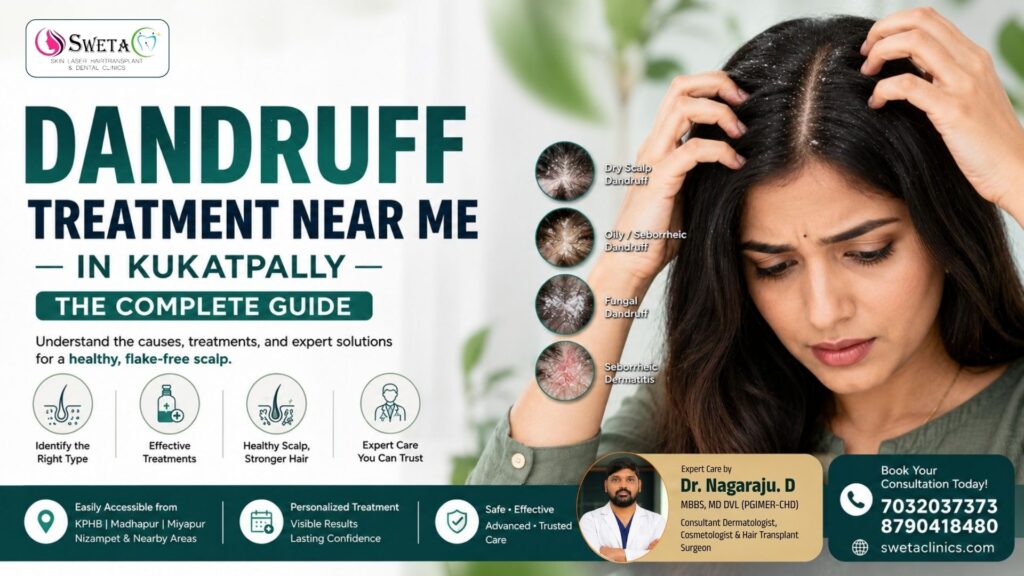
Not All Dandruff Is the Same
Most people treat dandruff as one condition. It isn’t. It’s a symptom that can come from several different causes, which is exactly why one shampoo can fail while another works.
The American Academy of Dermatology notes that dandruff can range from mild flaking to a more inflamed scalp condition, and the right treatment depends entirely on which type you’re dealing with.
Dry-Scalp Dandruff
How to Spot It
Fine, white flakes with mild itching, usually worse in winter or after hot showers. There’s little to no redness, and the scalp often feels tight rather than greasy.
What Helps
A gentle, moisturising shampoo used two to three times a week, along with lukewarm rather than hot water, is often enough to bring this under control.
Oily or Seborrheic Dandruff
How to Spot It
Larger, yellowish flakes that stick to the hair rather than falling off, often with redness near the hairline or eyebrows. It’s linked to excess oil production.
What Helps
This type thrives in warm, humid weather, which Hyderabad has for most of the year, and usually needs a shampoo that controls oil rather than just moisturises.
Fungal Dandruff
How to Spot It
Persistent flaking that returns within days of washing, often with itching that doesn’t fully go away between washes. This is what makes dandruff feel chronic for so many people.
What Helps
A yeast called Malassezia lives on every scalp in small amounts, but in some people it overgrows. Regular shampoos may reduce visible flakes temporarily, but the overgrowth needs to be directly targeted with antifungal treatment to fully resolve, as outlined by MedlinePlus.
Seborrheic Dermatitis
How to Spot It
Thick, greasy scales, noticeable redness, and flaking that can spread beyond the scalp to the eyebrows, ears, and chest.
What Helps
This is the more serious end of the spectrum and usually needs medical-grade treatment rather than a shampoo from a pharmacy shelf. Using the wrong product here doesn’t just fail, it can make the inflammation worse.
What’s Really Causing Your Dandruff in Hyderabad’s Climate
Local weather plays a bigger role than most people realise. A few factors tend to show up again and again in scalp consultations.
A Dry Scalp
Hot showers, air-conditioned offices, and harsh shampoos strip the scalp’s natural moisture. The result is fine white flakes without much redness, often mistaken for classic dandruff when the scalp actually just needs gentler care.
An Oily Scalp
Excess sebum, the scalp’s natural oil, creates the exact warm, moist environment Malassezia yeast needs to thrive. Hormones, diet, and Hyderabad’s humidity all play a part here.
Fungal Overgrowth
This is the single most common reason dandruff becomes chronic. Without antifungal treatment, the condition tends to recur regardless of how often you wash your hair.
Hair Care Habits
Not washing often enough lets oil and dead skin build up. But over-washing with harsh shampoos strips the scalp’s protective barrier and triggers a rebound increase in oil production, so both extremes create problems.
Stress and Lifestyle
Stress doesn’t cause dandruff directly, but it worsens existing scalp conditions by affecting hormone levels and immune response. Poor sleep, low zinc, and inadequate B-vitamins all make the scalp more prone to flaring.
Hard Water
Many parts of Kukatpally and the wider Hyderabad region deal with hard, mineral-heavy water, which can leave a residue on the scalp over time. That residue makes it easier for oil and dead skin to build up, which in turn gives dandruff-causing yeast more to feed on.
Common Dandruff Myths in Hyderabad
A lot of the confusion around dandruff comes from advice that sounds reasonable but isn’t backed by how the scalp actually works. A few myths come up constantly in consultations.
“Dandruff Means You’re Not Washing Enough”
This is one of the most persistent myths, and it’s simply not true. Dandruff is driven by scalp type, oil production, and yeast overgrowth, not hygiene. In fact, over-washing with harsh shampoos can strip the scalp and make flaking worse, not better.
“Oiling Your Hair Prevents Dandruff”
Champi oil massages are common practice across Hyderabad, and while they can feel relaxing, heavy oiling before a wash can actually feed oily and fungal dandruff by adding to the sebum the yeast already thrives on. Light, non-comedogenic oils used sparingly are a safer bet if you enjoy the ritual.
“Switching Shampoos Every Few Weeks Helps”
Constantly rotating products is one of the most common mistakes we see. It takes at least 3 to 4 weeks of consistent use to judge whether a shampoo is actually working, and switching too soon just resets the clock without ever solving anything.
“Dandruff Is Just Cosmetic, Not a Real Skin Condition”
For dry-scalp dandruff, that’s mostly true. But fungal dandruff and seborrheic dermatitis are genuine inflammatory conditions that can worsen over time if left untreated, sometimes spreading beyond the scalp. Treating them like a purely cosmetic issue often delays proper care.
Home Remedies vs Professional Treatment: What Actually Works
Home remedies have a real place in managing mild dandruff, but it helps to know where their limits are before relying on them for weeks on end.
Where Home Remedies Genuinely Help
Diluted tea tree oil, aloe vera, and consistent use of a mild anti-dandruff shampoo can meaningfully reduce flaking for dry-scalp or mild oily dandruff. Keeping the scalp clean and avoiding heavy, greasy products also supports whatever treatment you’re using.
Where Home Remedies Fall Short
Fungal dandruff and seborrheic dermatitis rarely respond to home remedies alone, because the yeast overgrowth or inflammation driving them needs targeted, often prescription-strength, treatment. Continuing home remedies alone for months when they aren’t working just delays the point where you get a proper diagnosis.
The Practical Middle Ground
For most people, a sensible approach is trying a good over-the-counter anti-dandruff shampoo consistently for 3 to 4 weeks first. If there’s no meaningful improvement by then, that’s the signal to move from guessing to getting a scalp evaluation.
Can Dandruff Cause Hair Fall?
This is one of the most common questions people bring into a scalp consultation, and the honest answer is: indirectly, yes.
Dandruff itself doesn’t destroy hair follicles. But the chronic inflammation and repeated scratching that come with severe dandruff or seborrheic dermatitis create conditions that aren’t good for hair growth.
Research on scalp inflammation, including findings summarised in PubMed Central, has linked long-term inflammatory scalp conditions to hair thinning, since inflamed follicles become weakened and are pushed into the shedding phase earlier than they should be.
That said, dandruff is rarely the only cause of significant hair loss. Genetics, hormones, and nutrition usually play bigger roles. But if you’re noticing hair fall alongside persistent dandruff, the two are worth evaluating together rather than separately, and ourhair fall treatment page covers this connection in more detail.
Signs You Need a Dermatologist, Not Another Shampoo
Most people search “dandruff treatment near me” only after trying multiple shampoos without success. Here are the signs that another product isn’t the answer.
- Flaking that hasn’t improved after 3 to 4 weeks of consistent use of an appropriate shampoo
- Severe itching that disrupts sleep or leaves visible scratch marks
- Noticeable hair thinning alongside ongoing scalp issues
- Pus-filled bumps, crusting, or a foul odour on the scalp
- Flaking that clears briefly with OTC products but returns within days or weeks
A dermatologist can examine your scalp using trichoscopy, a magnified scalp check that reveals inflammation and follicle health that isn’t visible to the naked eye. It’s the difference between treating a guess and treating a diagnosis.
How Dandruff Treatment Works at Sweta Clinics
Step 1: The Consultation
Every visit starts with understanding your history, how long the flaking has lasted, your hair-washing routine, and any family history of skin conditions like eczema or psoriasis.
Step 2: Scalp Examination
A close visual examination, sometimes with trichoscopy, helps determine whether the cause is dry skin, oil imbalance, fungal overgrowth, or an inflammatory condition like seborrheic dermatitis.
Step 3: Medicated Treatment
Based on the diagnosis, treatment may include medicated antifungal formulations and topical solutions to calm inflammation, tailored to your specific scalp type rather than a one-size-fits-all product.
Step 4: In-Clinic Scalp Therapy
Deep-cleansing and gentle exfoliation sessions remove built-up flakes and oil that home washing doesn’t fully clear, creating a better baseline for medicated treatment to work effectively.
Step 5: PRP for Related Hair Thinning
If hair thinning is present alongside dandruff, the plan may also includePRP therapy once the scalp environment is calmer, since regrowth treatments work better on a healthy scalp than an inflamed one.
What to Expect at Your First Visit
Walking into a dermatology consultation for the first time can feel unfamiliar if you’ve only ever dealt with dandruff through shampoo aisles. Here’s a realistic idea of how it usually goes.
Before the Consultation
You’ll typically be asked about how long you’ve had symptoms, your current hair-washing routine, any products you’re using, and whether anyone in your family has skin conditions like eczema, psoriasis, or seborrheic dermatitis.
During the Examination
The dermatologist examines your scalp closely, often with a handheld dermoscope, to check the flaking pattern, look for redness or greasiness, and assess whether there’s any early hair thinning alongside the dandruff.
After the Diagnosis
You’ll be given a clear explanation of what type of dandruff or scalp condition you have, why it’s happening, and what the treatment plan involves, including how long it typically takes to see improvement.
Follow-Up
Most dandruff cases need at least one follow-up visit around 3 to 4 weeks in, to check how the scalp is responding and adjust treatment if needed. This is where having a clinic nearby in Kukatpally makes ongoing care genuinely easier to stick to, rather than something you keep postponing.
Simple Habits That Support Treatment
A few daily habits make treatment work faster and last longer, even alongside professional care.
Quick checklist
- Wash with lukewarm, not hot, water
- Use fewer heavy styling products
- Avoid scratching, even when the itch is intense
- Don’t share combs, towels, or pillowcases during a flare-up
- Stick to your dermatologist’s washing frequency rather than guessing
These habits won’t replace treatment, but they help it hold once your scalp starts to clear up.
Why Choose Sweta Clinics in Kukatpally
Sweta Clinics is a multi-specialty skin, hair, laser, and dental clinic in Kukatpally, easily reached from KPHB, Miyapur, Nizampet, and Pragathi Nagar.
Dr. Nagaraju D’s Credentials
Scalp and hair consultations are led by Dr. Nagaraju D, MBBS, MD DVL (PGIMER-CHD), Consultant Dermatologist, Cosmetologist & Hair Transplant Surgeon, with extensive experience diagnosing dandruff, seborrheic dermatitis, and related hair fall concerns. Read more on our about the doctor page.
Areas We Serve
Patients regularly travel to us from KPHB, Hitech City, Madhapur, Miyapur, JNTU, Nizampet, Pragathi Nagar, and Moosapet for scalp and hair consultations. Being centrally located in Kukatpally means most of these commutes stay well under 30 minutes, which matters when a treatment plan involves more than one visit.
A Structured, Diagnosis-First Approach
Every patient goes through a structured diagnostic process before any treatment plan is built, so what you receive is based on your scalp specifically, not a generic package. Follow-up visits matter for conditions like dandruff, and having a clinic close by makes ongoing care easier to stick to.
Frequently Asked Questions
Is dandruff causing my hair fall?
Not directly, but chronic scalp inflammation from severe dandruff can contribute to increased shedding. If you’re noticing both, it’s worth getting them checked together.
Which doctor treats dandruff?
A dermatologist with an MD DVL qualification, since they can identify the exact type of dandruff and recommend targeted treatment instead of another round of trial-and-error shampoos.
Can dandruff be permanently cured?
Dry-scalp dandruff often resolves fully with the right care. Chronic conditions like seborrheic dermatitis are usually managed long-term rather than permanently cured.
When should I see a dermatologist for dandruff?
If flaking persists beyond 3 to 4 weeks despite a suitable shampoo, if itching is severe, or if you notice scalp redness, infection, or hair thinning alongside it.
How long does dandruff treatment take to show results?
Most patients notice reduced flaking and itching within 2 to 4 weeks of starting the right treatment, though seborrheic dermatitis may need ongoing maintenance beyond that.
Is dandruff contagious?
No. Dandruff isn’t contagious, though sharing combs or towels during a flare-up can spread the yeast that contributes to it, which is why avoiding that helps during treatment.
Does diet affect dandruff?
Diet doesn’t directly cause dandruff, but low zinc, low B-vitamins, and high sugar intake can make an already sensitive scalp more prone to flare-ups. A balanced diet supports treatment, though it isn’t a standalone fix.
Can I colour or straighten my hair while treating dandruff?
It’s best to pause chemical treatments like colouring or straightening during an active flare-up, since these processes can further irritate an already inflamed scalp. Your dermatologist can advise on timing once symptoms are under control.
Ready to stop guessing and get a proper scalp diagnosis?Book a consultation with Dr. Nagaraju D at Sweta Clinics, Kukatpally.
📞 7032037373 / 8790418480 🌐swetaclinics.com