
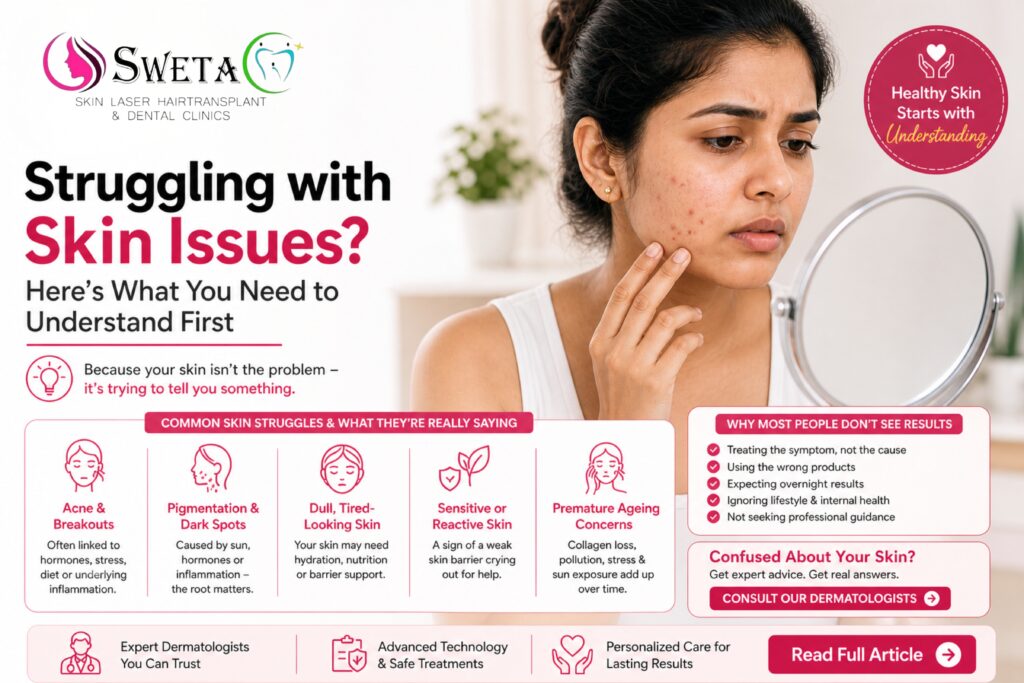
Because your skin isn’t the problem — it’s trying to tell you something.
There’s a particular kind of frustration that comes with skin problems.
It’s not just physical. It’s the kind that creeps in when you’re standing in front of a mirror at 7 AM, already tired before your day has started, staring at a breakout that wasn’t there yesterday. Or the quiet embarrassment of cancelling plans because your skin is flaring up again. Or the slow, draining feeling of spending money on product after product — each one promising to be the answer — and still not seeing any real change.
If you’ve ever felt that way, this article is for you.
Not to sell you something. Not to overwhelm you with a 12-step routine you’ll abandon in a week. But to help you genuinely understand what’s happening with your skin — and why that understanding matters more than any single product ever could.
Let’s start from the beginning.
You’re Not Failing Your Skin. You Just Haven’t Had the Right Information.
This is the first thing worth saying out loud, because a lot of people carry unnecessary guilt about their skin.
They think: “If I just washed my face more. If I drank more water. If I had more discipline with my routine.”
But skin issues — real ones, persistent ones — are rarely about discipline or cleanliness. They are biological. They are hormonal. They are environmental. They are sometimes genetic. And they are almost always more complex than any face wash or home remedy can fully address.
According to the American Academy of Dermatology (AAD), even dermatologists emphasise that acne and many other skin conditions are driven by internal biological factors — not poor hygiene or a lack of effort. The reason so many people don’t see results despite genuinely trying is not because they aren’t trying hard enough. It’s because they’re working with incomplete information — about their own skin, about what’s actually causing the problem, and about what their skin actually needs.
That’s what we’re going to fix today.
First, Understand This: Your Skin Is Not the Enemy
Your skin is your body’s largest organ. Every single day, it does an extraordinary amount of work — regulating temperature, protecting you from bacteria and environmental damage, and constantly renewing itself.
When something goes wrong on the surface — a breakout, a dark patch, redness, dryness — it’s almost never random. It’s your skin responding to something. A shift in hormones. An accumulation of stress. A product that doesn’t agree with it. A nutrient it’s missing. Or simply genetics playing their role.
The problem is that most of us were never taught to read these signals. We were taught to cover them up, dry them out, scrub them off, or bleach them away — and when that doesn’t work, we feel like we’ve failed.
But your skin isn’t broken. It’s communicating. And the moment you start listening to it instead of fighting it, everything begins to make more sense.
The Most Common Skin Struggles — and What They’re Really Saying
Acne and Breakouts
Acne is one of the most emotionally charged skin concerns there is — partly because it’s so visible, and partly because it’s so persistent.
What most people don’t realise is that acne is not one single condition. It’s an umbrella term for several different things happening in your skin — excess oil production, bacterial activity, clogged pores, hormonal influence, inflammation — and each person’s acne has a different combination of these factors driving it. The Indian Journal of Dermatology has documented extensively how acne presentations vary significantly across individuals — which is precisely why a treatment that works for one person may do nothing for another.
This is why a product that cleared your friend’s skin completely does absolutely nothing for yours. Because your acne may be primarily hormonal while hers was primarily bacterial. You need different things.
When acne keeps coming back despite everything you try, your skin is telling you: “This is deeper than what a cleanser can fix.”
Pigmentation and Dark Spots
Dark spots, uneven skin tone, patchy darkening — pigmentation issues are among the most common complaints, especially in India where sun exposure is intense and hormonal fluctuations are frequent.
But here’s what people often miss: pigmentation is a symptom, not the root problem. The dark spots themselves are just melanin deposits left behind after inflammation, sun damage, or hormonal triggers. The AAD explains that treating only the surface without addressing the underlying cause — whether that’s ongoing sun exposure or hormonal activity — means the pigmentation will keep returning regardless of which brightening product you use.
Treating only the surface is like painting over a damp wall. It looks better temporarily, but the problem keeps coming back.
When your pigmentation keeps returning after fading, your skin is saying: “The cause hasn’t been addressed yet.”
Dull, Tired-Looking Skin
This one is often dismissed as “just stress” or “just age” — but dull skin is actually your skin’s way of waving a flag.
Dullness usually means one or more of the following: your skin’s cell turnover has slowed down, there’s a buildup of dead skin cells on the surface, your skin barrier is compromised, or your skin is simply dehydrated and undernourished. Healthline’s dermatology resources outline several evidence-backed reasons behind persistent dullness — many of which have nothing to do with your skincare products at all.
When your skin looks tired even when you’re not, it’s saying: “I need more support than I’m getting.”
Sensitive or Reactive Skin
If your skin turns red easily, burns when you apply products, breaks out in rashes without obvious cause, or feels perpetually irritated — you likely have a compromised skin barrier.
The skin barrier is a thin, protective layer that keeps moisture in and irritants out. When it’s damaged — from over-exfoliation, harsh products, weather, or stress — your skin becomes reactive to almost everything. The National Eczema Association notes that a disrupted skin barrier is at the root of most reactive skin conditions, and that adding more products is often counterproductive. The frustrating cycle begins: you try products to help the redness, the products irritate it more, the redness worsens, and you try more products.
When your skin reacts to everything, it’s saying: “Stop adding things. Help me repair first.”
Why Most People Don’t See Results — The Real Reasons
1. Treating the Symptom, Not the Cause
This is the most common and most costly mistake. Most skincare products — even good ones — are designed to manage symptoms. A salicylic acid cleanser manages oily, congested skin. A vitamin C serum helps fade dark spots. A hydrating moisturiser relieves dryness.
But if the underlying cause isn’t addressed — hormonal imbalance driving your acne, sun exposure continuously creating new pigmentation, a damaged barrier causing your dryness — the symptoms will keep returning no matter what you put on your face.
Real, lasting skin improvement starts with identifying and addressing root causes. Not just managing what you see in the mirror.
2. Not Knowing Your Skin Type — or Misidentifying It
This matters more than most people realise. Using products designed for oily skin on combination skin, or treating dehydrated skin as if it were dry skin, leads to routines that actively work against you.
Many people with oily skin skip moisturiser because they think their skin doesn’t need it. But according to research published by the AAD, skipping moisturiser triggers the skin to produce more oil to compensate — worsening the exact problem they’re trying to fix.
Many people with sensitive skin also use “natural” or “herbal” products assuming they’re gentler — not realising that some natural ingredients (like essential oils, lemon, or certain plant extracts) are among the most common skin irritants.
Know your skin before you shop for your skin.
3. Switching Products Too Quickly
We live in an age of instant results. Two weeks into a new serum with no visible change and most people have already moved on to the next thing.
But skin works on a cell turnover cycle of approximately 28 days — the time it takes for new skin cells to form and reach the surface. Dermatologists widely recommend waiting at least 6–8 weeks of consistent use before judging whether a product is genuinely effective for your skin.
Constantly switching products means you’re never giving anything enough time to actually work. And you’re also never allowing your skin to stabilise — which is why many people feel like their skin is always “adjusting” to something new.
4. Overcomplicating the Routine
More is not more in skincare. Using 8 different products twice a day — many of which contain active ingredients that interact with each other — is one of the fastest ways to irritate your skin and make problems worse.
Vitamin C and retinol used together without proper spacing can cause irritation. Niacinamide in high concentrations combined with strong acids can cause flushing. Multiple exfoliating products used simultaneously damage the skin barrier. Paula’s Choice skincare research and similar evidence-based resources explain these interactions in detail — and consistently point to simplicity as the smarter approach.
Simple, well-chosen, consistently applied — that’s the approach that works. Not impressive-looking shelves full of products.
5. Ignoring What’s Happening Inside
Your skin is a reflection of your internal health. And this isn’t a wellness cliché — it’s physiology.
Your gut, your hormones, your stress levels, your sleep quality, your nutrition — all of it shows up on your skin. A growing body of research published on PubMed explores the gut-skin axis — the direct biological relationship between gut health and skin conditions — and consistently finds that external skincare cannot override what’s happening internally.
This is why people who go through high-stress periods break out even if they’ve been doing everything right with their skincare. Why people with hormonal conditions like PCOS struggle with persistent acne that topical products simply cannot resolve. Why someone who’s chronically sleep-deprived looks dull and tired regardless of how many serums they use.
External skincare can support your skin. But it cannot override what’s happening internally. Both need attention.
The Lifestyle Factors Nobody Talks About Enough
Stress and Cortisol
When you’re stressed, your body produces cortisol — a hormone that directly increases oil production in the skin and triggers inflammation. Healthline’s overview of stress and skin explains clearly how elevated cortisol breaks down collagen, increases sebum production, and delays skin healing. This is why stress and breakouts are so tightly linked, and why managing stress isn’t just good for your mental health — it’s genuinely good for your skin.
Chronic stress also impairs sleep, disrupts hormones, and weakens your immune system — all of which show up on your face.
Sleep and Skin Repair
Between 10 PM and 2 AM, your body is in peak repair mode. Skin cell turnover accelerates. Collagen is produced. Inflammation is managed. Research published by the National Institutes of Health (NIH) confirms that sleep deprivation significantly impairs skin barrier function and increases signs of ageing, dullness, and inflammation.
When you consistently cut short this repair window — late nights, irregular schedules, poor sleep quality — your skin literally has less time to heal and renew itself.
The concept of “beauty sleep” is not a myth. It’s biology.
Diet and Skin Health
The connection between diet and skin is real and well-documented. High-sugar, high-processed-food diets trigger insulin spikes that stimulate oil production and inflammation. A study published in the Journal of the Academy of Nutrition and Dietetics found meaningful correlations between high-glycaemic diets and acne severity. Dairy has also been linked to acne flare-ups in a significant proportion of patients studied.
On the other side, antioxidant-rich foods, omega-3 fatty acids, zinc, and probiotics actively support skin health from the inside.
You don’t need to overhaul your entire diet. But being aware of patterns — noticing that breakouts worsen after certain foods, for example — is genuinely valuable information.
Environment and Pollution
If you live in a city, your skin is dealing with pollution, dust, and particulate matter every day. The World Health Organization (WHO) consistently flags urban air pollution as a significant environmental health concern — and dermatologists increasingly recognise its direct impact on skin ageing, pigmentation, and inflammation. These particles settle into your pores, trigger oxidative damage, and accelerate skin ageing.
Your environment is a constant factor in your skin’s health. Accounting for it — rather than ignoring it — makes a real difference.
A Simpler, More Realistic Approach to Skincare
Here’s the honest truth: most people’s skin would dramatically improve with three things done consistently.
1. A gentle, appropriate cleanser used twice a day. Not harsh. Not stripping. Something that removes dirt, oil, and pollution without disrupting your skin barrier.
2. A moisturiser suited to your skin type, used every day. Even oily skin. Even in summer. Your skin needs moisture to function properly.
3. Sunscreen, every single morning, without exception. SPF 30 minimum. Broad spectrum. Reapplied if you’re spending time outdoors. The Skin Cancer Foundation consistently identifies daily sunscreen use as the single most impactful thing you can do for long-term skin health.
That’s the non-negotiable foundation. Everything else — serums, exfoliants, treatments — is additional and only beneficial if the foundation is solid.
Beyond the routine, the lifestyle piece genuinely matters. Prioritise sleep when you can. Manage stress however works for you — movement, time outdoors, creativity, rest. Eat in a way that makes you feel good. Drink water consistently.
None of this is revolutionary. But the gap between knowing these things and actually doing them consistently — that’s where most skin journeys stall.
When Should You Consider Seeing a Skin Specialist?
Home care and lifestyle changes can do a lot. But there are situations where they genuinely aren’t enough — and continuing to manage on your own means continuing to be frustrated.
Consider seeing a dermatologist if:
- You’ve been dealing with acne, pigmentation, or any persistent skin concern for more than 3 months without improvement
- Your breakouts are painful, deep, or leaving scars — this level of acne almost always needs prescription treatment
- You suspect a hormonal imbalance (irregular periods, excess hair growth alongside acne) — this needs medical evaluation, not more skincare
- Your skin is highly reactive to almost everything — your barrier may need professional support to repair
- You’ve spent significant money on products with no meaningful results — a proper diagnosis would likely save you more money in the long run
- Any skin concern is affecting your confidence or daily life — that alone is reason enough to seek help
A dermatologist doesn’t just prescribe a cream and send you off. A good consultation involves understanding your skin’s history, identifying root causes, and building a targeted plan — one that’s specific to your skin, not a generic routine copied from the internet.
There’s no threshold of severity you need to meet before you’re “allowed” to seek professional help. If your skin is bothering you, that’s enough.
One Last Thing — Be Kind to Yourself Through This
Skin struggles are exhausting in a way that’s hard to explain to someone who hasn’t experienced them. The constant self-monitoring. The hyperawareness in social situations. The hope every time you try something new, and the quiet disappointment when it doesn’t work.
You deserve to feel comfortable in your skin. Not perfectly flawless skin — that doesn’t exist outside of filtered photographs — but skin that feels healthy, cared for, and yours.
The path there isn’t a 10-step routine or a viral ingredient. It’s understanding your skin, addressing what’s actually causing the problem, being consistent with the basics, and knowing when to ask for help.
That’s it. That’s the whole answer.
Start there.
If you’re based in Hyderabad and looking for professional guidance on any skin concern — whether it’s persistent acne, pigmentation, sensitivity, or something you haven’t been able to figure out on your own — Sweta Clinics in Kukatpally offers expert dermatological consultations tailored to your skin’s specific needs. Sometimes, one honest conversation with the right specialist changes everything.