By the Skin Care Team at Sweta Clinics, Kukatpally, Hyderabad
The moment April arrives in Hyderabad, you already know what’s coming.
The fan goes from slow to full speed overnight. The water you splash on your face dries before you even reach for the towel. And somewhere around 11 AM, just stepping outside feels like standing next to a tandoor.
But while most of us are busy complaining about the heat, our skin is silently dealing with a lot more than we realise.
Summer in Hyderabad isn’t just uncomfortable — it’s genuinely hard on your skin. The combination of intense UV radiation, crushing humidity, sweat, dust, and pollution creates a perfect storm for breakouts, pigmentation, rashes, and a whole list of other skin issues that people tend to either ignore or mismanage.
This article is for anyone who’s noticed their skin acting up lately and wondered, “Is this normal? What’s going on?”
Let’s talk about it honestly.
Why Summer Is So Tough on Hyderabad Skin
Before jumping to problems and solutions, it helps to understand why summer specifically is such a difficult season for the skin.
Here’s what’s happening at a biological level:
1. UV radiation peaks. From March to June, the sun’s ultraviolet rays hit their highest intensity across South India. According to the World Health Organization (WHO), UV-A rays penetrate deep into the skin and cause long-term structural damage, while UV-B rays cause immediate surface burns. Both are working overtime during summer afternoons.
2. Heat increases oil production. Your sebaceous glands — the ones that produce oil — respond to heat by going into overdrive. More oil means more clogged pores, and that means more breakouts.
3. Sweat creates a breeding ground for bacteria. Sweat by itself isn’t the villain. But when it sits on your skin and mixes with dead cells, dirt, and oil, it creates the perfect environment for bacterial and fungal infections.
4. Air conditioning dries your skin out. Yes, this seems contradictory — but moving between hot, humid outdoor air and cold, dry air-conditioned rooms all day long repeatedly disrupts your skin’s moisture barrier. It leaves your skin confused, irritated, and dehydrated.
5. Pollution is worse in dry heat. Dust and particulate matter are significantly higher during dry summer months. The Central Pollution Control Board (CPCB) regularly records elevated particulate levels during peak summer. These particles settle into your pores, trigger inflammation, and accelerate skin ageing.
With all of this happening simultaneously, it’s no wonder that skin clinics across Hyderabad see a significant surge in patients during summer months.
The Most Common Skin Problems in Summer — Explained Simply
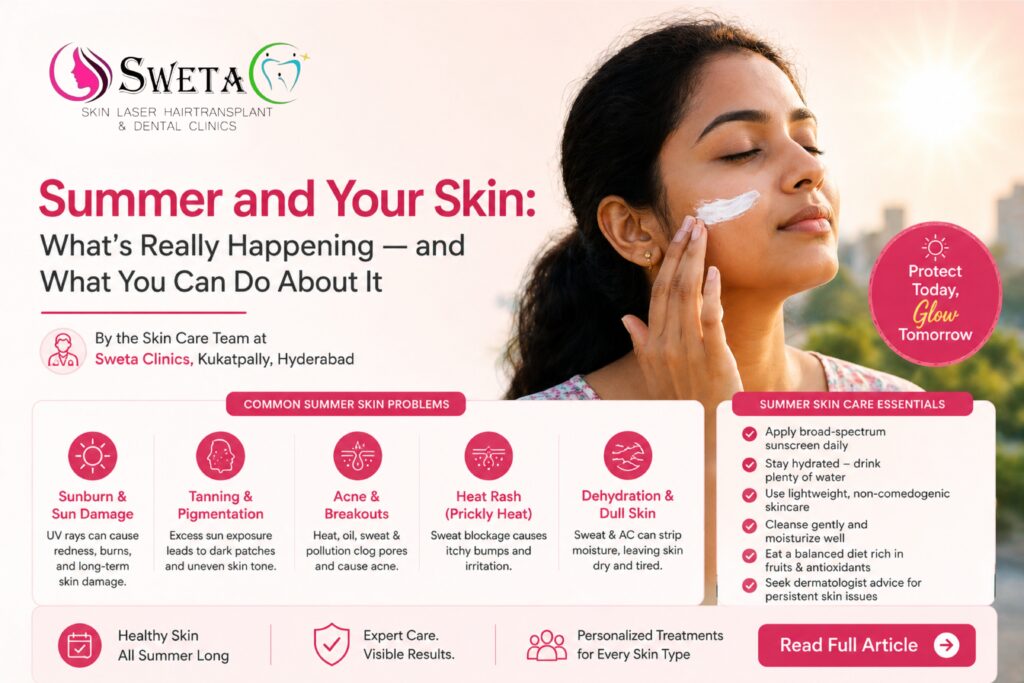
1. Sunburn and Sun Damage
This one seems obvious, but it’s deeply underestimated.
A lot of people think sunburn is just some temporary redness that goes away in a day or two. And sometimes, it does. But the Skin Cancer Foundation points out that repeated sun exposure without protection — even without visible burns — quietly damages your skin’s DNA, breaks down collagen, and lays the groundwork for premature ageing and, in some cases, more serious skin conditions.
Signs to watch for:
- Redness or warmth on the skin
- Peeling, especially on the nose, cheeks, and shoulders
- Skin that feels tight or sore to touch
- In severe cases, blisters
What helps: Apply a broad-spectrum sunscreen (SPF 30 or higher) at least 20 minutes before stepping out. Reapply every 2–3 hours if you’re outdoors. Wear protective clothing, sunglasses, and use an umbrella when possible.
2. Tanning and Hyperpigmentation
Tanning is your skin’s defence mechanism — it produces more melanin (pigment) to absorb UV radiation and protect deeper layers. But that tan doesn’t always fade evenly, and over time, it can turn into patchy, persistent darkening called hyperpigmentation.
In Hyderabad’s summer, hyperpigmentation is one of the most common concerns patients come in with — especially women who commute regularly or spend extended time outdoors. The American Academy of Dermatology (AAD) explains that without consistent sun protection, dark spots can take months or even years to fade.
What it looks like:
- Uneven dark patches on the face, neck, arms, or hands
- Darkening around the mouth, cheeks, or forehead
- Skin that looks “dull” or “dirty” even after washing
What helps: Sun protection is always step one. Beyond that, ingredients like Vitamin C, Niacinamide, and Alpha Arbutin can help brighten and even out the skin. Medical treatments like chemical peels, laser toning, and prescription depigmenting creams (under a dermatologist’s guidance) can make a significant difference for stubborn pigmentation.
3. Acne and Breakouts
Summer and acne go hand in hand — literally.
The heat stimulates excess oil production. Sweat carries bacteria across your skin. Humidity prevents proper evaporation. The result? Clogged pores, inflamed skin, and a breakout that seems to appear out of nowhere.
Many people also make a common mistake during summer: they switch to heavy, rich moisturisers or apply coconut oil thinking it’ll help, when it actually worsens the congestion. The Indian Journal of Dermatology has published multiple studies linking high-humidity environments to increased acne severity — particularly in tropical climates like ours.
Types of summer acne:
- Closed comedones (whiteheads) from clogged pores
- Open comedones (blackheads) from oxidised sebum
- Inflammatory acne (red, painful pimples) from bacterial infection
- Cystic acne (deep, painful lumps under the skin) — this needs medical attention
What helps: Keep it simple. Use a gentle, non-comedogenic (non-pore-blocking) face wash twice a day. Switch to a light, water-based moisturiser. Avoid touching your face frequently. Don’t pop pimples — this spreads bacteria and causes scarring.
If breakouts are frequent, persistent, or painful, a dermatologist can help with targeted treatments.
4. Heat Rash (Prickly Heat / Ghamoriyan)
Almost everyone in Hyderabad has experienced this at some point — those tiny, itchy red bumps that appear when your sweat ducts get blocked.
Heat rash is extremely common in children but very much affects adults too, especially in areas where skin folds or clothing traps sweat: the neck, underarms, back, inner thighs, and under the breasts. The Mayo Clinic notes that it’s one of the most frequently occurring skin conditions during hot, humid weather worldwide.
What it looks like:
- Small red or pink bumps
- Intense itching or a “prickling” sensation
- Sometimes tiny blisters or pustules
What helps: Stay cool. Wear loose, breathable cotton clothing. Keep skin dry — especially in the folds. Calamine lotion can soothe mild heat rash. If the rash becomes widespread, spreads across large areas, or is accompanied by fever, consult a doctor promptly.
5. Fungal Infections
Summer humidity is a paradise for fungi.
Tinea infections — commonly known as ringworm, jock itch, or athlete’s foot — multiply rapidly in warm, moist conditions. They’re incredibly common during summer and far more contagious than people realise. According to the Centers for Disease Control and Prevention (CDC), fungal skin infections affect millions globally each year, with cases peaking in hot, humid seasons.
Warning signs:
- Circular, scaly patches with clear centres
- Intense itching, especially after sweating
- Redness between the toes, on the inner thighs, or under the arms
- Skin that looks flaky or cracked
What helps: Keep affected areas clean and dry. Antifungal powders can help in persistently sweaty areas. Avoid sharing towels, clothing, or footwear. Fungal infections often need antifungal medication — creams, powders, or oral tablets depending on severity. Importantly, do not use steroid creams without a prescription; they can actually suppress the visible symptoms while allowing the infection to spread deeper.
6. Dry and Dehydrated Skin (Yes, Even in Summer)
This surprises a lot of people. They assume summer means oily skin — but dehydrated skin is extremely common in summer, and it’s a different problem entirely.
Dry skin lacks oil. Dehydrated skin lacks water. Spending hours in air-conditioned environments, not drinking enough water, and using harsh face washes strips your skin of moisture, leaving it tight, dull, and prone to fine lines. Healthline’s dermatology resources explain this distinction well — and why treating them requires different approaches.
Signs your skin is dehydrated:
- Skin that feels tight, especially after washing
- Dull, tired-looking complexion
- Fine lines appearing more prominent
- Skin that’s oily on the surface but feels uncomfortable underneath
What helps: Hydration starts from the inside — drink water consistently throughout the day. Use a lightweight, hydrating moisturiser with hyaluronic acid or glycerin. Avoid hot showers, which strip natural oils. Use a gentle, sulphate-free cleanser.
7. Milia
These are tiny, white cysts that form just under the skin’s surface when dead skin cells become trapped. They’re not acne, but they look similar and often appear on the nose, cheeks, and around the eyes.
Summer worsens milia because heavy sunscreens or rich creams can trap dead skin if you’re not exfoliating regularly. The Cleveland Clinic notes that milia are particularly common when the skin’s normal shedding process is disrupted — something that heavy summer products can trigger.
What helps: Gentle exfoliation once or twice a week helps prevent milia from forming. Don’t try to squeeze or extract them yourself — unlike pimples, they have no opening, and squeezing risks scarring. A dermatologist can remove them safely through extraction or minor treatment.
A Word About “Home Remedies” — Be Careful
The internet is full of summer skin hacks, and while some are harmless, others cause real, lasting damage.
The National Institutes of Health (NIH) has documented cases of phytophotodermatitis — severe skin reactions triggered by applying citrus juices (like lemon) on skin before sun exposure. This is far more common than people realise.
Some things to be cautious about:
- Lemon juice on skin — highly acidic, can cause chemical burns and severe darkening in sunlight
- Toothpaste on pimples — dries and irritates, doesn’t treat the root cause
- Ice directly on skin — can cause frostbite-like damage on sensitive skin
- Baking soda face masks — disrupts your skin’s natural pH balance
- Random “brightening” creams from local shops — many contain undisclosed steroids or mercury compounds that cause serious long-term harm
When in doubt, consult a qualified dermatologist rather than experimenting on your skin.
Building a Simple Summer Skincare Routine
You don’t need an elaborate 10-step routine. Here’s a simple, practical approach — backed by what dermatologists actually recommend:
Morning:
- Gentle cleanser (wash off sweat and overnight oil)
- Lightweight moisturiser (hyaluronic acid or gel-based)
- Sunscreen — broad spectrum, SPF 30 or above (this is non-negotiable)
Evening:
- Double cleanse if you’ve worn sunscreen (micellar water or cleansing oil, followed by a face wash)
- Toner (optional — only if your skin is congested or oily)
- Targeted serum if needed (Vitamin C for pigmentation, Niacinamide for oil control)
- Night moisturiser
Weekly:
- Exfoliate once or twice with a gentle chemical exfoliant (like lactic acid or glycolic acid)
- Sheet mask or hydrating mask if your skin feels dehydrated
That’s honestly enough for most people. The AAD’s skincare guidelines consistently emphasise that consistency with a simple routine outperforms an inconsistent elaborate one.
When Should You See a Dermatologist?
Home care can go a long way, but some things genuinely need professional attention. Consider seeing a skin specialist if:
- Your acne is painful, frequent, or leaving scars
- You have dark patches that aren’t fading despite regular sunscreen use
- A rash or infection is spreading or not clearing up
- Your skin is consistently irritated, red, or burning without an obvious cause
- You notice any new mole or growth that is changing in shape, size, or colour
- You’ve tried over-the-counter products for several weeks with no improvement
A dermatologist can accurately diagnose what’s happening, prescribe targeted treatments, and help you avoid making things worse with the wrong products or approaches.
Final Thoughts
Summer is the season that tests your skin the most — and it does it quietly, day by day, with every sun-soaked commute, every sweaty afternoon, every cold blast of AC.
The good news is that most summer skin problems are preventable and treatable. You don’t need expensive products or complicated routines. You need consistent basics: sunscreen, hydration, gentle care, and knowing when to ask for help.
Your skin works hard for you all year. This summer, return the favour.
If you’re dealing with a persistent skin concern and are based in Hyderabad, Sweta Clinics in Kukatpally offers consultations across skin, laser, and hair treatments. Their team of dermatologists can help you understand what your skin actually needs — no guesswork, no one-size-fits-all solutions.